
At 5:35 a.m. on Jan. 25, 1949, Rabbi Moshe Yekutiel Alpert got up, drank coffee and put on his finest Shabbat clothes.
Together with his wife, brother and brother-in-law, he walked to the polling station on Habashim Street in Jerusalem, his Israeli identity document in his hand. In his diary, he compared the walk to a Simchat Torah procession, when worshippers carry Torah scrolls.
“There were no limits to the happiness and joy I felt,” he wrote.
They arrived at 5:50 a.m., even before the polling officials. When the chairman appeared at 6:02, Alpert chastised him. Voting was supposed to begin at six.
The chairman apologized.
As the oldest person present, Alpert was given the honor of voting first. With a trembling hand, he selected his ballot, recited the Shehecheyanu blessing and deposited the envelope. By 6:28, the family was home. Alpert went to pray.
As Israelis go to the polls on Tuesday, Oct. 27, Alpert’s diary recalls the excitement and reverence surrounding the country’s first national vote, held just over eight months after independence.
The War of Independence had not yet ended. Elections originally envisaged for October 1948 had been postponed because of the fighting. Voters were choosing a Constituent Assembly, charged with preparing a constitution. It would soon become the first Knesset.
A country prepares for its first elections
Before anyone could vote, the state needed to establish who its voters were.
On Nov. 8, 1948, residents were placed under a seven-hour curfew while census takers went from house to house. The count provided the basis for the electoral register.
Missing registration could have consequences, even for a cabinet minister. Foreign Minister Moshe Shertok, later known as Sharett, was abroad at the United Nations during the census and therefore could not vote in the first election.
Officials also had to prevent people from voting twice. Identity documents were stamped to show their holders had voted and punctured with a nail. According to a retrospective published by Ynet with the National Library of Israel, there were not enough hole punches to equip all the polling stations.
Some of those following the campaign were still too young to vote.
Shevach Weiss, a teenage Holocaust survivor newly arrived from Poland, waited outside election meetings in Tel Aviv collecting leaders’ autographs. Ben-Gurion did not stop to sign. Sharett and Rachel Cohen-Kagan, who headed the WIZO list, did.
In a 2015 interview with Israel Hayom, Weiss recalled feeling part of the political life of his new country, even though he could not yet cast a ballot. He would eventually become speaker of the Knesset.
An unexpected invitation
In Jerusalem, sixth-grader Uzi Baram, a young supporter of Ben-Gurion’s Mapai party, and his friend Uri Haklai attended political speeches in the city’s cinemas. They chose whom to hear according to how good a speaker he was, even if he sometimes belonged to a rival party.
They also volunteered to distribute campaign literature.
One Friday, the boys were delivering pamphlets attacking the Irgun, the underground organization formerly led by Menachem Begin, to mailboxes in Rehavia when a man asked whether they were thirsty and invited them into his home.
He introduced himself as Eliyahu Meridor, a lawyer and former Irgun fighter.
Writing in Israel Hayom in 2023, Baram recalled exchanging astonished looks with his friend. Their host belonged to the movement their leaflets condemned. His hospitality was difficult to reconcile with what they had been told about their opponents.
Meridor later became a Knesset member, as did Baram.
Taking turns to campaign
The streets grew noisier as Election Day approached. A Jewish Telegraphic Agency dispatch described parties taking their campaigns outside, where loudspeakers and sound trucks competed for attention. Speakers took turns at microphones in town centers according to an agreed schedule.
Twenty-one lists were competing.
The government declared Election Day a national holiday. Factories and businesses were ordered closed from 8 a.m. until midnight. Rallies and electioneering were prohibited that day.
First at the ballot box
Alpert was not the only voter eager to reach the ballot box first.
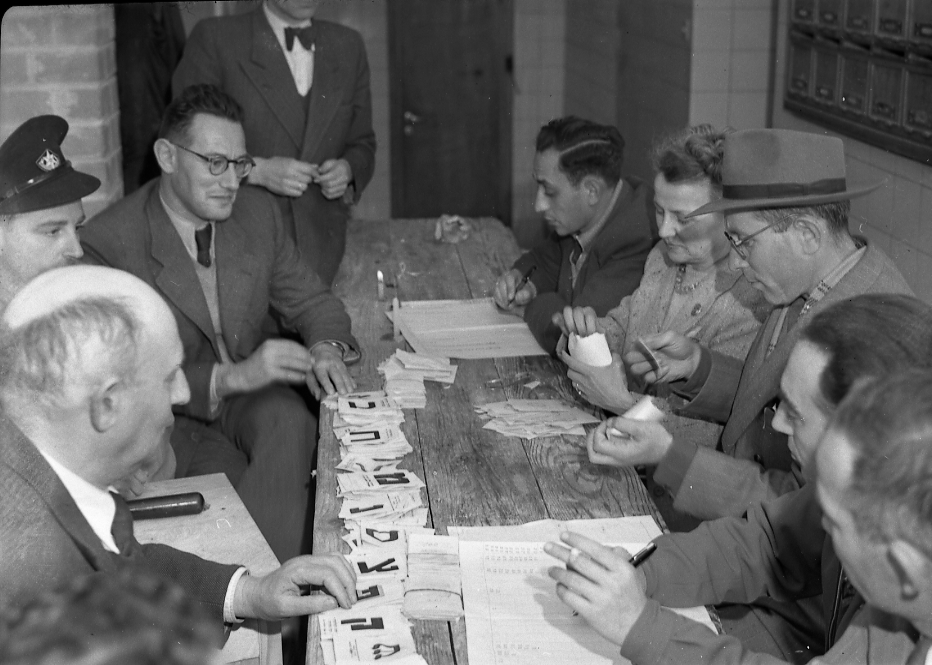
A JTA report published the following morning described a Sephardi Jewish man asking for that privilege at a Jerusalem polling station as voting began at six. The committee agreed. With businesses and offices closed, the correspondent described a Shabbat-like atmosphere in the city.
Some soldiers voted under much simpler conditions.
Zir Luz was serving in Golani’s 13th Battalion when the ballot box reached him in the field.
“They brought a cardboard box and called it a ballot box,” he recalled in an interview with Ynet published this month.
Near Jerusalem, the polling station in Abu Ghosh was decorated with flags. Residents gathered outside while a five-member committee, including two Arab teachers, checked their credentials.
JTA reported that the villagers were voting for the first time in their lives. Many appeared to support an Arab electoral list backed by Ben-Gurion’s Mapai party, although the village chief himself was running on the Fighters’ List, formed by former members of the Lehi underground.
Waiting their turn
In Tel Aviv, Ben-Gurion and his wife, Paula, arrived at a polling station on Lassalle Street with their identity documents.
A Ynet retrospective described the officials standing, sitting and standing again in confusion at the prime minister’s arrival. Ben-Gurion told them to sit down and continue working.
The couple were invited forward to vote, and the waiting crowd applauded.
Elsewhere in the city, Herut leader Menachem Begin arrived with his wife and two children at a polling station at 10 Dizengoff Street. They joined the back of a long, slow-moving queue.
Photographers discovered him, delaying proceedings further. When he was offered the chance to bypass the line, Begin refused. The people ahead of him applauded that, too.
Ben-Gurion’s outing had interrupted medical instructions. In his diary the following morning, he recorded that he had been ordered to stay in bed and had gone out only to vote.
By 9 a.m. on Jan. 26, Ze’ev Sherf had brought him partial results. Another update followed at 9:30. Ben-Gurion began calculating seats and possible coalitions while still waiting for returns from important parts of the electorate.
The final tally recorded 440,095 voters, a turnout of 86.8%. Ben-Gurion’s Mapai won 46 seats, followed by the rival socialist party Mapam with 19; the United Religious Front, an alliance of four religious parties, with 16; and Begin’s Herut with 14.
On Feb. 14, the representatives gathered at the Jewish Agency building in Jerusalem. It was Tu Bishvat, and many traveling from the coastal plain stopped at Sha’ar Hagai to plant trees. Two days later, the Constituent Assembly adopted the name Knesset.
For some citizens of the fledgling Jewish state, the opportunity to vote was something almost sacred. They dressed for it, recited blessings and gave thanks for having lived to see it.
As Alpert wrote about placing his ballot in the box: “And then came the holiest moment of my life, a moment neither my father nor my grandfather had been privileged to experience.”