
After the piece below had been drafted, news came in of a third development that was perhaps even more consequential than the two described, the victory of Luiz Inácio Lula da Silva, or Lula, in the second round of the Brazilian presidential election. His defeat of the right-wing populist Flávio Bolsonaro, son of former President Jair Bolsonaro, was unexpected after a first round in which the latter ended up with the largest plurality of votes. Lula’s victory broke a string of seven consecutive right-wing victories in Latin American presidential elections. Flávio Bolsonaro has called for the election to be annulled, and it is at this point uncertain what his followers will do in reaction to Lula’s victory. Nonetheless, given Brazil’s size and importance on the world stage, this is a stunning and hopeful development that may signal, together with the developments in Venezuela and Serbia and the upcoming U.S. midterm elections, a major reversal of the wave of authoritarian-populist victories around the world.
—Frank
Sunday October 25 saw two very hopeful events from different parts of the world. They give us some optimism that democratic backsliding is not inevitable, and that it is possible to fight back against the rising tide of authoritarianism.
The first was the return of María Corina Machado to Venezuela. Machado should rightfully be president of Venezuela today. She sought to run against Nicolás Maduro during the July 2024 presidential election, and attracted huge enthusiastic crowds all over Venezuela during her primary campaign. Because of the threat she posed, she was disqualified by the regime; her stand-in, Edmundo Gonzalez, went on to win the election by a huge margin.
We know this because the democratic opposition kept voter records from each polling place in the country, and published them before the regime could declare its own falsified results naming Maduro the winner. Machado had to then go into exile to accept her Nobel Peace Prize, and has been living out of the country until this past weekend. Her return was marked by the same rapturous crowds cheering her that had come out during her election campaign two and a half years earlier.
The current situation in Venezuela following the Trump administration’s arrest of Maduro in early January is completely unsustainable and unjust. Trump made a deal with Delcy Rodríguez Maduro’s, vice president and member of his inner circle, to stabilize the country as the United States sought to take control of the country’s oil assets. Venezuela since then has been run by the same authoritarian clique that existed previously, with a pliable Rodríguez substituting for a resistant Maduro. Trump made no pretense that any of this was being done for the benefit of the Venezuelan people, bragging instead that he had put the United States in control of the country’s oil. As he told the UN General Assembly in September, “to the victors go the spoils.” Worse than that, there has been no transparency regarding where any of the oil revenues were going, or even how large they were. The administration revealed that it was working with Alejandro Betancourt, a businessman notorious all over Venezuela for his corruption.
In the meantime, Trump sidelined Machado, claiming that “she doesn’t have respect within the country.” To the contrary, she was by far Venezuela’s most popular politician. The State Department claimed that there would eventually be democratic elections, but without specifying a timetable, and held talks with various opposition groups that excluded Machado. Neither the regime nor the United States permitted her to go back to her country, and at the present moment we don’t know how she managed to return.
Her return puts both the Rodríguez regime and the Trump administration in a difficult position. Much as they might like to, neither can afford to arrest or otherwise silence the most popular politician in the country, certainly not in the face of the rapturous crowds greeting her. Machado has spent the time since January trying to placate Trump, giving him her Nobel Prize and refraining from public criticism of the United States.
But this kind of appeasement has never worked with this president, who has no interest in Venezuelan democracy. There is growing anger at the United States among ordinary Venezuelans, who naturally would like to know where money from their oil patrimony is going. Delcy could buy temporary peace, but as time goes on, the corrupt deal she struck with Trump is going to be a huge liability. Machado needs to get behind what would amount to an anti-corruption protest. It is likely that anti-American (and anti-Delcy) protests will gain momentum, and it is only at that moment that people in Washington may realize that a legitimate election is the only route to long-term stability.
Trump thinks that he is in control of the situation, but he is not; only the Venezuelan people have the right and ultimately the power to create a legitimate government.
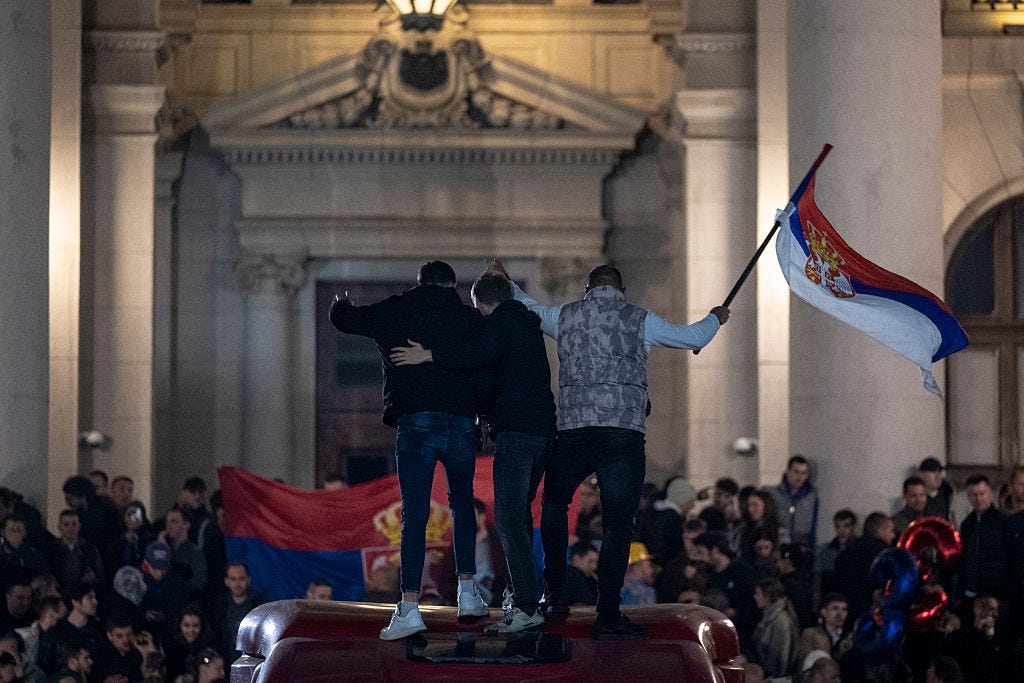
The second rather miraculous event occurring Sunday was the victory of the Student List over the ruling Serbian Progressive Party (SNS) in Serbia’s parliamentary election, and strongman Alexander Vučić’s concession. Most informed observers fervently wished for Vučić’s defeat, but believed that in the end he and his party had enough levers to intimidate voters and manipulate the process. Vučić had been in power in one capacity or another—he recently resigned as president so he could become prime minister under an SNS-led government—such that many young Serbs had known no other leader than him.
The roots of the Student List victory lay in the student movement that emerged following the lethal collapse of the roof of a train station in the city of Novi Sad in November 2024. The station, a Chinese project, was riddled with corruption linked to the regime, and students across the country started mobilizing in protest.
There had been many protest movements previously in Serbia, including the one that brought down Slobodan Milošević back in October 2000. This movement, however, was deliberately organized in a way that minimized the measures that the regime could take against it. It had no leaders and no evident hierarchy. There were no immediate political demands except for an end to corruption; the movement was able to organize gigantic protests in Belgrade and other Serbian cities on this basis. In 2025, the students began marching across the country, stopping in villages and towns where they were frequently greeted by rural sympathizers. In organizing ahead of Sunday’s election, they deliberately did not include prominent politicians or existing opposition parties in the Student List. A large number of the Student List’s members are in fact academics. The movement did not put forward any detailed accounts of the programs it would pursue were it to win the election, or even who would be likely to emerge as the prime minister under those circumstances.
Persuasion is a registered nonprofit that relies on reader support to pay our staff and keep our content free for everyone. If you value our work and want to fight for liberal values wherever they are threatened, please become a paying subscriber today!
In response to this broad mobilization, the Vučić regime employed all of the tools that have by now become commonplace among rising authoritarians. There was massive manipulation of the electoral process itself, and the disqualification of many popular personalities. A huge number of Serbs, many of whom were sympathetic to the Student List, live outside the country; the government made it very difficult for them to vote. The state controlled most of the legacy media in Serbia, putting newspapers and TV channels in the hands of friendly oligarchs and making it hard for the opposition to get its message out.
Nonetheless, the students evidently benefited from the generational shift that was taking place in media consumption all over the world. Young people got most of their information online from sources beyond the regime’s control, and made an art of leaderless mobilization in the two years of protesting.
Now that the Student List has won the parliamentary election, however, the very tactics that allowed them to achieve this victory will become a major liability. The new parliamentary majority will now actually be responsible for governing the country. This cannot be done without a leadership hierarchy or a concrete policy program.
We’re expanding our events offerings! Please check out our events page to join Book Club, Ask the Author, and Intellectual Bootcamp—and to watch recordings of recent events.
The Student List was able to attract a broad coalition of followers by not being specific about its intentions, but there will clearly be tensions among the groups supporting it. The electoral practice of avoiding existing politicians and members of other parties means that no one on the list has actual experience running a government. Other movements built around civil society organizations, like those in Ukraine in 2004 or Egypt in 2011, ultimately failed because of their inability to make the transition to the responsibilities of governance.
These obvious challenges make me wonder whether Vučić was being clever in conceding defeat so quickly. Had he tried to hang on through the usual tactics of intimidation and fraud, he would have faced continuing protests. He may have calculated that the Student List was like the proverbial dog finally catching the car it was chasing and not knowing what to do with it. A failed transition might then create the conditions for him and the SNS to return to power.
Let’s hope that this is not the case. At this point, Serbia’s outside friends need to give it every possible form of support, and focus especially on building the Student List’s ability to govern. While its victory and Machado’s return to Venezuela are hopeful developments, there are a huge number of things that need to happen in both countries in the coming weeks and months to turn either of them into a sustainable victory for democracy.
In the meantime, however, we can enjoy the fact that the spirit of democracy is still alive in different parts of the world. The most important election of all will occur in the United States, where American voters will have the opportunity of rejecting a Republican Party that has been dominated by a right-wing authoritarian, Donald Trump. If this happens we will have clear evidence that democracy, far from being a dying doctrine, has strength and vitality in many different parts of the world.
Francis Fukuyama is the Olivier Nomellini Senior Fellow at Stanford University. His latest book is In The Realm of the Last Man. He is also the author of the “Frankly Fukuyama” column, carried forward from American Purpose, at Persuasion.
Follow Persuasion on X, Instagram, LinkedIn, and YouTube to keep up with our latest articles, podcasts, and events, as well as updates from excellent writers across our network.
And, to receive pieces like this in your inbox and support our work, subscribe below: