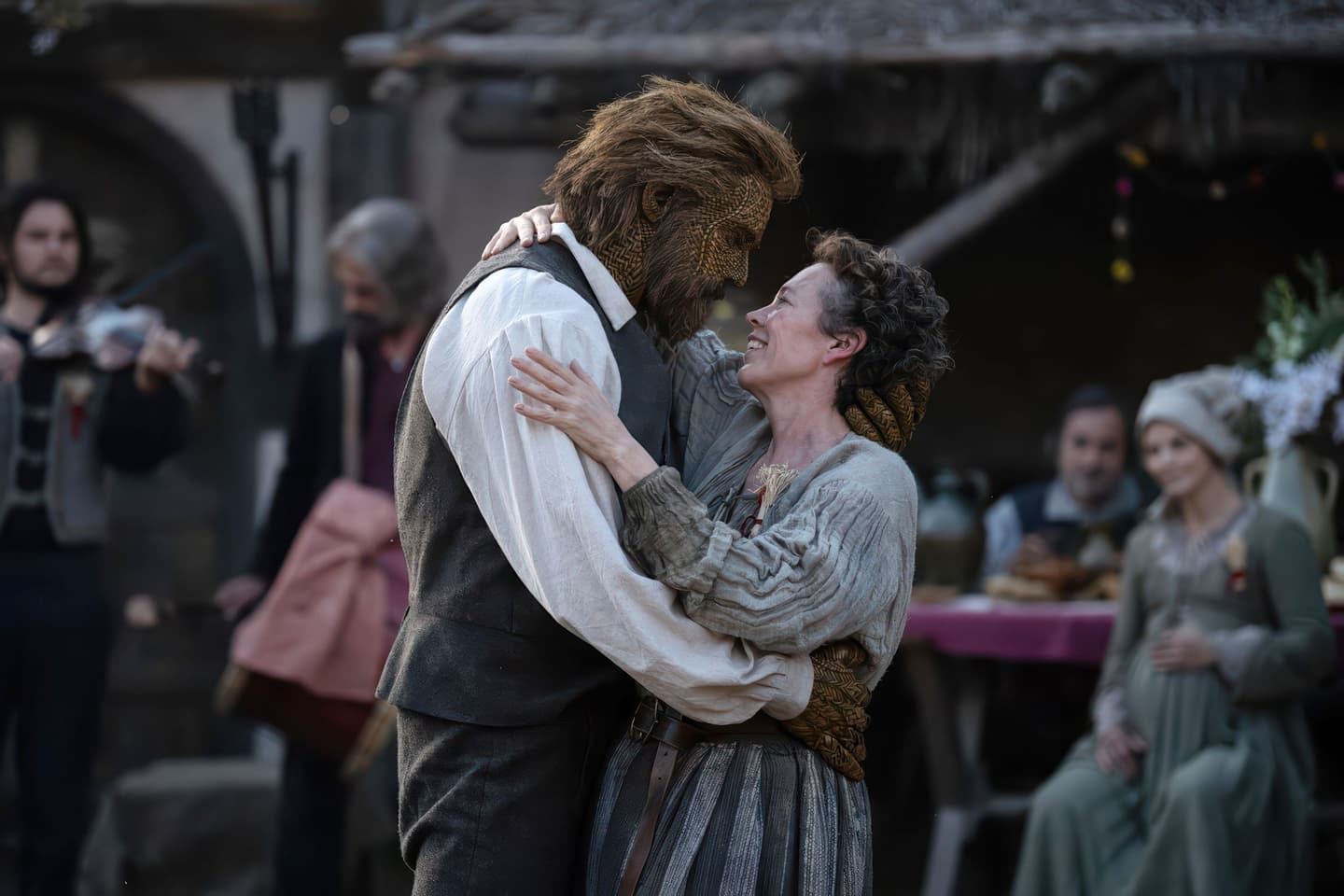
There’s a moment early in Wicker where Olivia Colman’s Fisherwoman is presented with her romantic options. As she sells her wares in the town square, a slovenly villager gets down on one knee to “propose.” The gesture immediately sends the crowd into fits of laughter, the idea that anyone could want a woman they mock for being smelly and undesirable the punchline to an oft-repeated joke. As a spinster with an unglamorous job and lowly status, the Fisherwoman exists outside the rigid structure of their society—one where women are wed and bred young, their survival dependent on the match they make. The Tailor’s Wife (Elizabeth Debicki), the resident mean girl, delivers her own verdict, giving the Fisherwoman a smug look that says, well, it’s the best you can do.
Naturally, when Colman shows up later with a tall, tan, and intricately woven husband (Alexander Skarsgård, under layers of practical effects), chaos ensues.

Wicker, a bawdy fairytale from husband-and-wife team Alex Huston Fischer and Eleanor Wilson, is Hollywood’s latest foray into monster romance. The genre, which has seen women fall for gilled aquatic creatures (The Shape of Water), long-haired wolf men (Your Monster), and reanimated corpses (Lisa Frankenstein), now tackles a well-endowed cornucopia. Adapted from Ursula Wills-Jones’s short story “The Wicker Husband,” the film is a deliberately provocative commentary on gender expectations, social caste, and sexual pleasure. It arrives at a time when the idea of commissioning a local artisan to solve your relationship woes through handcraft, instead of swiping through Tinder, doesn’t seem like such a bad idea.
Monsters filling in for men isn’t a new conceit. The idea shows up in mythology—from Zeus transforming into every kind of animal to commit adultery to Psyche being warned that her new husband, Eros, would be grotesque—as well as in folklore and countless retellings of Beauty and the Beast. But those earlier tales often used monstrousness as an allegory for male violence. The gods enact their whims indiscriminately, presenting themselves as beautiful or hideous to those they desire, who must either accept their form or face their wrath. A creature can kidnap a maiden and hold her hostage, so long as the story ends with marriage.

More recent monster romances center female desire—erotic and emotional. In Your Monster, Melissa Barrera’s Laura manifests a towering beast to work through the pain of a traumatic breakup and cancer diagnosis. Lisa Frankenstein’s teenaged hero doesn’t resurrect a Modern Prometheus to abandon; she happens upon a deceased boyfriend who helps her unpack the pain of her mother’s death. Guillermo del Toro grounds The Shape of Water in Elisa’s quest to be understood by those around her. Her amphibian love affair is the result of finally connecting with another being who sees her in totality. In each story, the monsters provide the characters with something the human world failed to grant them.

Hollywood’s monsters are tame compared to those in modern fiction. In a freakier offshoot of the romantasy that has overtaken bestseller lists in recent years, these monster tales have sensational titles and even wilder plots. Take Ice Planet Barbarians, where human women are stranded in space with blue-tinted humanoids called the Sakh, all of whom are very interested in mating. Morning Glory Milking Farm is the tale of a broke postgraduate who takes a job collecting minotaur semen for a pharmaceutical company. (Yes, you read that correctly.) In Tusk Love, orcs engage in behaviors J.R.R. Tolkien never could have imagined.
It would be easy to make a mockery of the passionate communities online that enjoy such stories, but that misses the point. The objects of female desire—boy bands, teen idols, soap opera characters, suspiciously close hockey players—have always been subject to ridicule. Monster romances embrace the transgression by offering up the most extreme scenarios possible to titillate and (on occasion) challenge prevailing mores.
It is inherently ridiculous for a woman to marry a sentient basket, but when he’s more capable and considerate than the men around her, he becomes the sane option. Whether they are werewolves, goblins, or men woven out of wicker, it’s their representation of masculinity that matters most. Outsiders, persecuted for features they have no control over, these fictional men are also privy to the lookism that women face daily. It’s not uncommon for them to express their insecurities around how others perceive them or commiserate with their partner about what it’s like to be misunderstood, judged solely based on their appearance.
In fact, many monsters display a whole range of emotions conventional heroes lack. Romance authors have written self-actualized and emotionally aware men for hundreds of years, but the further those ideals stray from our cultural reality, the less absurd the monsters seem. In a world where red-pill podcasts and self-proclaimed “life coaches” are telling men that compassion is weakness and only “simps” show affection, basic virtues like kindness can feel like fantasies. When the men become monstrous, the appetite for an alternative grows, even one that is stripped of all human identifiers.
I am not immune. Spicy BookTok reads are not my thing (sorry), but if I had to cite a fictional example of the ideal man, it would be X-Men’s Kurt Wagner, Nightcrawler. He’s a bookish, blue-skinned mutant with a love of swashbuckling stories and a boundless capacity for kindness. He’s pious but not preachy, gentle above all else; despite having three fingers on each hand and a prehensile tail, he’s the comic’s embodiment of human goodness—something he’s punished for repeatedly. X-Men ’97 ends its second season with him dying for everyone’s sins in an unsubtle religious allusion.
Goodness being punished is also a recurring theme in monster romance, including Wicker. The Wicker Husband is kind and attentive; he views his wife as the center of his universe and treats her with a care and dignity that draws the ire of the human men. He does his share of the domestic labor without complaint, and his ability to fix the bed they repeatedly break puts the village’s husbands to shame; their inadequacies both in carpentry and sex soon become glaringly obvious. The monster is a change agent; his existence offers an alternate view of what marriage, intimacy, and life can be—all of which makes him dangerous.

Photo: Courtesy Everett Collection
As the women of the village take note of the Wicker Husband’s presence, the men gripe at his open displays of affection, and the Tailor’s Wife balks. To detail the form their jealousy ultimately takes would be a spoiler; suffice it to say that it’s the actions of “normal” people that cause the greatest harm.
When the trailer for Wicker dropped, the internet immediately turned Skarsgård’s character into a meme. The actor, who gravitates toward outré romantic roles—see last year’s BDSM romcom Pillion or his tenure as a Nordic vampire on HBO’s True Blood—is beloved online, so a big reaction was to be expected. TikTok videos dubbed the Wicker Husband a “hear me out”; many “wick” jokes were made; Ikea’s official Instagram account shared pictures of baskets and rattan furniture with the caption “husband material.” Alongside the wit and anticipation, largely from women, another stream of commentary also arose: men confused by the film’s basic premise.
In a moment of meta-kismet, the exact men Wicker satirizes were oblivious to its appeal. Just as the village’s men griped amongst themselves about the husband’s chivalry and sexual prowess, men in the comment sections of TikTok and Reddit chalked interest in the film up to Skarsgård’s good looks or the general horniness of an audience starved for romantic movies. The idea that beauty comes from within never entered the discussion. Perhaps the joke’s on them.