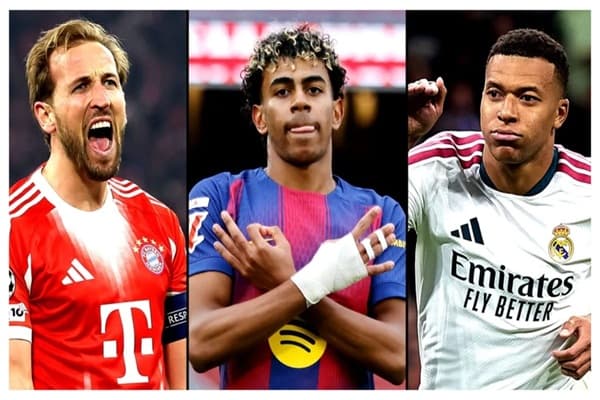
As football’s finest gather at the London Palladium on Monday, October 26, the race for the 2026 Ballon d’Or presents three compelling but distinctly different arguments. Harry Kane has delivered extraordinary goalscoring numbers while finally collecting major domestic honours with Bayern Munich. Kylian Mbappé has continued to demonstrate his capacity…...
As football’s finest gather at the London Palladium on Monday, October 26, the race for the 2026 Ballon d’Or presents three compelling but distinctly different arguments. Harry Kane has delivered extraordinary goalscoring numbers while finally collecting major domestic honours with Bayern Munich. Kylian Mbappé has continued to demonstrate his capacity to dominate individual scoring charts, including at the World Cup. Lamine Yamal, meanwhile, has combined domestic success with Spain’s triumph on the global stage, strengthening the argument that his influence extends beyond goals.
The question is not simply who scored the most, won the most trophies or produced the most memorable moments. It is which player best satisfies the criteria established by France Football, the award’s organiser, and how voters will weigh individual excellence against collective achievement.
The 2026 edition, which marks the 70th anniversary of the award first presented in 1956, will be decided by an international jury of specialist journalists. With no universally convincing candidate across every category, the contest is a genuine examination of what football’s most prestigious individual award is supposed to recognise.
Understanding the Ballon d’Or criteria
France Football’s regulations identify three criteria, ranked in order of importance.
The first is individual performance, including the decisive and impressive character of a player’s displays. The second is collective performance and the trophies won. The third is class and fair play.
The distinction matters because the award is not formally a prize for the player with the most goals or the greatest collection of medals. Goalscoring is an important measure of individual performance, but influence, consistency, creativity and the ability to change significant matches also matter. Trophies strengthen a candidate’s case, but the regulations place individual performance above collective honours.
The assessment period for the 2026 award runs from August 3, 2025, to July 19, 2026, incorporating the 2025/26 club season and international competitions, including the 2026 FIFA World Cup.
Each member of the men’s jury selects 10 players from a 30-man shortlist. The selections earn points in descending order: 15, 12, 10, 8, 7, 5, 4, 3, 2 and 1. The player with the highest total wins.
This structure leaves room for different interpretations of the same season. One journalist might prioritise Kane’s extraordinary scoring and Bayern’s domestic success, while another could consider Yamal’s influence on Barcelona and Spain’s World Cup triumph more persuasive. Mbappé’s individual scoring achievements also give voters a substantial reason to place him high on their ballots.
Harry Kane: Goals, trophies and a long-awaited breakthrough
For Kane, the 2026 Ballon d’Or represents an opportunity to turn years of elite goalscoring into individual recognition at the highest level.
The Bayern Munich striker has recorded 73 goals across the 2025/26 season, according to figures reported by Sky Sports and GOAL. His campaign included 36 goals in 31 Bundesliga appearances, 14 in 13 Champions League matches and 12 goals for England, six of them at the World Cup.
Those numbers provide the foundation of his candidacy. Across club and international football, Kane has been the most prolific scorer among the leading contenders, demonstrating a level of consistency that is difficult to dismiss.
His Bundesliga performances were particularly significant. Kane scored 36 league goals as Bayern secured the German championship, while also helping the club complete a domestic treble. For a player whose career had long been accompanied by questions about his lack of major team honours, the trophies gave his outstanding individual production a stronger collective context.
Read Also: Thierry Henry, Kate Scott To Host 2026 Ballon d’Or Ceremony
Kane also became the fastest player to reach 100 Bundesliga goals, achieving the milestone in 98 appearances. It was another indication of how quickly he had adapted to German football and how consistently he had delivered for Bayern.
The significance of Kane’s season, however, extends beyond the raw total. He has shown that his game remains effective at the highest level, combining finishing, intelligent movement and the ability to lead an attack. His value is not confined to a single competition, and his performances for club and country give voters a broad body of evidence to consider.
Yet the limitations of his candidacy are equally important.
Bayern’s domestic treble did not include the Champions League, with the German club falling short in the European competition. For a Ballon d’Or contender, that absence matters because success in Europe’s most prestigious club tournament can elevate an otherwise exceptional season.
England’s World Cup campaign also offered Kane an opportunity to strengthen his case further. He scored six times as England finished third, but he did not score after the round of 16. That leaves a question about his decisive influence in the closing stages of the tournament, particularly when compared with players whose contributions helped their countries reach the final or win the title.
Kane’s argument is therefore straightforward: no other leading candidate matched his overall goalscoring output, and he combined it with major domestic silverware. The counterargument is that his season lacked the two most influential trophies in the race — the Champions League and the World Cup.
If voters treat the Ballon d’Or primarily as recognition of the best individual campaign, Kane has a formidable case. If they place greater emphasis on decisive contributions to the biggest international and European prizes, his position becomes less secure.
Kylian Mbappé: A scoring phenomenon without the major trophies
Mbappé’s candidacy is built around a familiar quality: his extraordinary ability to score goals, particularly when the pressure is highest.
The Real Madrid forward topped the scoring charts in La Liga, the Champions League and the 2026 World Cup, according to GOAL’s assessment of the race. At the World Cup, he won the Golden Boot with 10 goals and became the tournament’s all-time leading scorer.
Those achievements strengthen his individual case substantially. Mbappé has demonstrated that he can produce at the highest level across different competitions, and his World Cup performances ensured that his campaign would be judged against the most prominent stage in international football.
The World Cup is especially relevant because it can reshape the Ballon d’Or conversation. A player who dominates the tournament gains a level of global visibility and competitive credibility that is difficult to reproduce during an ordinary club season. Mbappé’s scoring record gives voters a compelling reason to regard him as one of the campaign’s most influential attacking players.
There is also a broader argument in his favour. The Frenchman has remained among the most dangerous forwards in world football, capable of creating chances through pace, movement and individual skill. His scoring achievements are not simply the product of a strong league campaign; they extend to the Champions League and international football.
But the central weakness in Mbappé’s bid is the gap between individual production and team success.
Real Madrid exited the Champions League in the quarter-finals, while France finished fourth at the World Cup after losing in the semi-finals and the third-place play-off. Neither campaign delivered the major trophy that could have transformed his statistical dominance into an overwhelming Ballon d’Or argument.
Read Also
This does not mean that Mbappé should be penalised simply because football is a team sport. A forward cannot single-handedly guarantee a Champions League or World Cup victory. Nevertheless, the award’s second criterion explicitly considers collective performance and honours won, making the absence of major silverware a legitimate consideration.
His candidacy also faces a question of how voters interpret individual influence. Scoring heavily is an essential part of a forward’s role, but the Ballon d’Or considers the overall quality and decisiveness of performances. Mbappé’s supporters can point to his remarkable output; his critics can ask whether those goals translated into sufficient team success.
Among the three leading contenders, Mbappé may have the strongest case built around individual scoring across multiple competitions. His challenge is to convince voters that this production should outweigh the trophy advantage enjoyed by Kane and Yamal.
Lamine Yamal: The impact of individual brilliance and collective success
Yamal’s candidacy presents a different argument. Rather than relying primarily on goalscoring totals, the Barcelona winger’s case rests on his ability to influence matches through creativity, dribbling, chance creation and attacking unpredictability — while also collecting major honours.
Yamal finished second in the 2025 Ballon d’Or voting, establishing himself as a serious contender before the current campaign. At Barcelona, he helped the club secure a second consecutive La Liga title and a domestic double, adding further evidence that his individual development is translating into collective success.
He scored 25 goals for club and country during the 2025/26 campaign, according to Sky Sports, a career-best return at that point. His output included three goals in the Champions League knockout stages, underlining his capacity to contribute when the competition becomes more demanding.
Yet goals alone do not fully explain his appeal. Yamal’s ability to beat defenders, draw multiple opponents and create space for teammates makes him a difficult player to contain. His influence can be visible even when he does not score or provide the final pass. He can alter the shape of an opposition defence and create opportunities for others simply by carrying the ball into dangerous areas.
That distinction matters under the first Ballon d’Or criterion, which refers to the decisive and impressive nature of individual performances. A player’s contribution cannot always be reduced to goals and assists. Creativity, control of attacking situations and the ability to make a difference against elite opponents also form part of the assessment.
Spain’s World Cup triumph provides Yamal’s case with an additional advantage. He became part of a team that won the tournament, adding the sport’s biggest international title to his domestic achievements. The success gives his season a compelling collective dimension and places him alongside players whose performances were tied to major trophies.
There are, however, important reservations.
Yamal was not at his best throughout the World Cup. GOAL reported that he scored once at the tournament and registered no assists, despite completing more dribbles than any other player in the competition. An injury also affected his campaign and curtailed his club season.
That creates a tension in his candidacy. Spain’s victory strengthens his collective record, but voters must distinguish between being part of a successful national team and being the player who most decisively drove that success. Yamal’s individual tournament statistics do not, on their own, establish him as Spain’s most influential performer.
Barcelona’s failure to win the Champions League is another limitation. While domestic success and a World Cup medal make a powerful combination, the absence of European club glory leaves room for competing arguments.
Even so, Yamal has an advantage that neither Kane nor Mbappé can reproduce in precisely the same way: a season that combines domestic silverware, a World Cup title and an attacking style that captures the imagination. His case is not based on trophies alone, but on the belief that his influence and technical quality make him one of the defining players of his generation.
Winning the Ballon d’Or would also make him the youngest recipient in the award’s history. That milestone would be historic, although age itself is not one of the official voting criteria and should not substitute for an assessment of performance.
The decisive comparison: Goals against influence, trophies against statistics
Comparing the three contenders through the official criteria reveals why the race is so difficult to settle.
On individual goalscoring, Kane has the strongest overall numbers, with 73 goals across the season. Mbappé can counter with his scoring leadership in three major competitions and his World Cup Golden Boot. Yamal’s goal total is lower, but his creative influence and ability to destabilise defences provide a broader measure of contribution.
On collective achievements, Yamal has the World Cup and Barcelona’s domestic double. Kane has Bayern’s domestic treble. Mbappé has no major team trophy from the season, leaving him at a disadvantage under the second criterion.
On decisive performances, the debate is more subjective. Kane’s consistency and scoring volume are compelling, but his late-tournament output for England leaves questions. Mbappé’s World Cup goals are extraordinary, though France did not reach the final. Yamal’s team won the World Cup, but his own individual production during the tournament was more modest than that of his principal rivals.
Fair play and conduct complete the official criteria, but there is no basis to declare a clear winner on that measure without comparable, substantiated evidence. It should be considered, not used as an assumption to strengthen any candidate’s case.
The voting system also means that the result may depend on how journalists rank the entire shortlist, not simply on a direct choice between these three. A candidate can benefit if voters consistently place him first or second, while another may lose ground if support is divided among several players.
Verdict: Who deserves to win the 2026 Ballon d’Or?
Kane has the strongest statistical case. His 73 goals and Bayern’s domestic treble represent a remarkable season, and his candidacy challenges the tendency to place international and Champions League success above sustained individual excellence.
Mbappé has the most explosive scoring argument. Leading La Liga, Champions League and World Cup scoring charts is an extraordinary achievement, but the absence of major team honours weakens his position when the official criteria are applied in full.
Yamal has perhaps the most balanced trophy case. Barcelona’s domestic double and Spain’s World Cup triumph give him the strongest combination of collective success among these three, while his creativity and technical influence support an argument beyond goals alone. His quieter World Cup statistics, however, mean that his individual contribution must be weighed carefully against his team’s success.
On balance, Yamal has a compelling route to the award because his campaign combines elite individual quality with the two forms of collective success that carry enormous weight in football: domestic titles and a World Cup victory. Kane remains his most formidable challenger, particularly if voters place individual production first, as the official criteria instruct them to do. Mbappé cannot be dismissed, but he faces the clearest obstacle in the absence of major trophies.
Ultimately, the Ballon d’Or should not be decided by one headline statistic, one tournament or the appeal of a player’s reputation. The question is who delivered the most impressive individual season, made the greatest difference in decisive moments and backed that performance with meaningful team success.
Kane has the goals. Mbappé has the scoring records on the biggest stages. Yamal has the combination of creative influence and major trophies. The final decision will reveal which of those arguments the international jury considers the most persuasive.