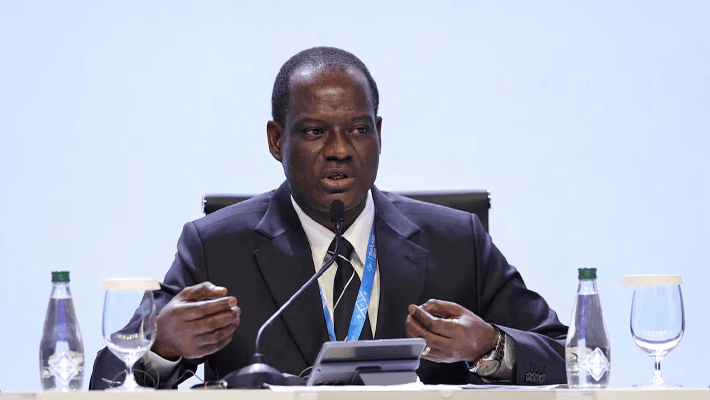
The federal government has proposed mandatory impact assessments before major changes to taxes, tariffs and economic regulations to curb abrupt decisions that raise business costs and discourage investment.
The Minister of Finance and Coordinating Minister of the Economy, Taiwo Oyedele, announced the proposal on Monday at the ongoing Nigerian Economic Summit in Abuja while presenting the draft Nigeria Economic Policy Framework for public consultation.
Mr Oyedele said the framework would require policymakers to explain the problem an intervention seeks to address, the evidence supporting it, who would benefit, who would bear the costs and the conditions under which it would end.
“Ad hoc rulemaking must give way to transparent, predictable governance,” he said.
The framework, which is still a consultation draft, seeks to establish consistent rules for economic decisions across successive administrations.
Mr Oyedele said Nigeria’s development had been undermined by inconsistent policies and weak implementation rather than a shortage of plans.
“Too often, the progress achieved through one reform is undermined by another policy, while our economic direction is reinvented with changing administrations,” he said.
He criticised the announcement of major regulations without sufficient evidence, consultation or time for businesses to adjust, saying such practices made planning difficult, increased financing costs and prevented job creation.
“Policy uncertainty is an invisible tax on enterprise, and unlike most taxes, it generates no revenue for government. It only destroys value and discourages investment,” he said.
The proposal comes as the summit examines how economic reforms can translate into jobs, higher productivity and improved living standards. The event runs from October 26 to 27.
Under the proposed framework, impact assessments would cover interventions including tax adjustments, tariff changes, regulatory restrictions and incentives.
The ministry’s consultation document also lists fiscal and business effects, implementation capacity, risks, performance indicators and review dates among the matters a policy impact statement would address.
Mr Oyedele said better coordination was also necessary because businesses bear the combined costs of decisions taken by different government institutions.
“Businesses do not interact with isolated ministries, departments, or agencies. They experience the cumulative cost of government,” he said.
He argued that support for local industries should help them become competitive, not protect inefficient businesses indefinitely.
“A tariff must serve as a runway for local industry to take off, never a permanent shelter from competition,” he said.
The framework also proposes an annual National Economic Scorecard, to be published on or before October 1, tracking whether real wages are rising, productive jobs are increasing, and poverty is declining.
Mr Oyedele said economic success should be reflected in household incomes, employment and the ability of small businesses to expand, rather than aggregate growth figures alone.
“GDP growth matters, but per capita income matters even more,” he said.
Public consultation on the framework opened on October 26 and will close on November 27, 2026. Nigerians are invited to respond to 17 consultation questions through the finance ministry’s website.
Mr Oyedele said the draft would proceed to the Federal Executive Council for approval and the National Economic Council for endorsement after consultation and validation.
He urged the Nigerian Economic Summit Group, businesses, and other stakeholders to scrutinise the proposals and submit recommendations supported by evidence.
We have recently deactivated our website's comment provider in favour of other channels of distribution and commentary. We encourage you to join the conversation on our stories via our Facebook, Twitter and other social media pages.