
In 2026, Americans will stake more than $1.4 billion on prediction markets tied to the outcome of U.S. midterm elections. Millions of voters, alongside major trading firms and private companies, will partake in the speculative frenzy. And election markets will permeate—not to mention price—the zeitgeist, as millions more monitor the odds on exchanges, television networks, and social media.
This trading boom has provoked vociferous opposition from Democratic Party leaders, state governments, and much of the electorate. At issue are two questions: one of legality and one of prudence. The first is whether election markets are legal to begin with—specifically, if they qualify as “swaps” under federal commodities law and can therefore be offered nationwide. The second is whether the utility of election markets outweighs the risks they pose to the United States’ moral fabric, democratic process, and financial markets.
The swaps question is being litigated fiercely, and may eventually be decided by the Supreme Court, while the question of prudence has sparked an equally intense debate. But until the judiciary renders a final verdict, election markets will operate at scale with the Trump administration’s support. In the interim, policymakers must develop a first-principles understanding of election markets, and, drawing on this assessment, update an outdated regulatory regime.
Election markets have the potential to serve the public interest as tools for political forecasting and hedging political risk, but existing regulations invite fraud and insider trading. Left unchecked, such abuse will harm market participants and, more important, undermine public confidence in the democratic process. To mitigate those risks, Congress and the Commodity Futures Trading Commission (CFTC), the independent agency charged with regulating these markets, must work together to define and enforce new legal standards for insider trading in election markets; require public disclosure of large positions to deter manipulation and expose conflicts of interest; pressure offshore exchanges to adopt U.S. standards; and study the financial impact of election markets on retail traders. Congress must also adequately fund the CFTC.
Introduction
Long prohibited by law and CFTC rules, election markets now enjoy the robust backing of the Trump administration. In May, President Donald Trump declared that prediction markets—a new breed of derivatives exchanges which allow users to trade on elections, sports, and a wide array of real-world events—“will thrive” during his presidency. (His son Donald Trump Jr. is a major investor in one exchange, Polymarket, through 1789 Capital, and a paid advisor to another major exchange, Kalshi.) Trump’s handpicked CFTC Chairman, Michael Selig, is similarly supportive and has loosened the rules governing prediction markets to enable the listing of contracts tied to sporting events and elections. Under Selig’s leadership, the CFTC withdrew a proposed Biden-era ban on election markets, drafted rules to help election markets become a permanent fixture of U.S. derivatives trading, and joined the Department of Justice to sue nine states to stop them from enforcing their gambling laws against prediction markets, including vis-à-vis elections.
The Trump administration’s support is now the subject of a sprawling legal battle—comprising some 120 lawsuits across 28 states—among leading prediction markets, the states, and the CFTC. This litigation centers on whether the Commodity Exchange Act permits federally regulated exchanges to list event contracts on sports and elections, and, if so, whether it preempts state gaming laws. Federal courts are divided on this question, particularly regarding sports, and legal experts expect that ongoing litigation will take years to resolve.
All the while, election markets have become one of the fastest-growing segments in the U.S. derivatives industry. This year, U.S. trading volume on markets tied to the 2026 midterms has eclipsed $1.4 billion, and markets tied to the 2028 general election are forecast to surpass $10 billion. The mainstream adoption of election markets has likewise surged: a recent Paradigm/Echelon Insights poll found that more than a third of likely voters have used prediction markets in some form, whether to trade or simply check prices. Meanwhile, CBS, CNN, Fox News, the Wall Street Journal, and the social network X, among others, have struck agreements with the two leading prediction markets, Kalshi and Polymarket, to integrate election market odds directly into their 2026 midterm coverage.
Policymakers and voters, however, are still assessing the core costs, benefits, and mechanics of election markets. Are they accurate? Are they vulnerable to manipulation and insider trading? Are they of tangible economic benefit? Are they a risk to election security? And are they immoral?
A growing body of literature answers a number of these questions. Recent analysis has found that election markets are a uniquely accurate mechanism for forecasting political results and public opinion. Those markets have also proven generally resilient to partisan bias and attempts at manipulation in recent years. And businesses are already using election markets to hedge against regulatory change.
Election markets, however, are particularly vulnerable to insider trading, and many traders engage with them as a form of gambling, putting them at great risk of financial harm. The case for greater regulation is strong on both counts. For election markets to meet their economic and democratic potential, Congress should take steps to control for insider trading, such as implementing a blanket prohibition on election-market trading by members of Congress, the executive branch, and campaign staff, among other insiders and conflicted parties. Legislators should also work with the CFTC to improve oversight of designated contract markets (such as Kalshi and Polymarket) and offshore trading venues, and take action to protect retail traders.
Betting on elections in the United States is as old as the republic itself.
Everything Old Is NEw Again
Betting on elections in the United States is as old as the republic itself. In upstate New York’s earliest congressional contests, candidates and their allies wagered frequently on the outcome of races. Local newspaper offices often facilitated those bets and published new wagers in weekly broadsheets. In one 1796 gamble, the New York politico Joab Griswold staked “more pounds than I am worth pence” that his patron, William Cooper, would win reelection to Congress by one thousand votes. Cooper lost by eighteen ballots, and Griswold, presumably, lost his capital.
In the 1880s, a clique of brokers in New York’s Financial District institutionalized electoral wagering, and betting volumes soared. According to Paul Rhode and Koleman Strumpf’s research, the equivalent of about $6 in today’s money was bet for every vote cast in the general election of 1888. And during some years, election trading even “dominated transactions in the stock exchanges on Wall Street.”
Throughout the Progressive Era, betting also doubled as electioneering. New York’s Tammany Hall machine maintained a war chest for electoral wagers, and its well-publicized bets served as “indirect propaganda” meant to manufacture political momentum. Republican Party bosses may have done just the same. In 1904, the New York Times accused the Republican Party of manipulating the betting odds in the presidential election to favor Teddy Roosevelt.
Such ploys may have altered prices, but only briefly. In 1924, the New York Times reported that the “old axiom in the financial district [is] that Wall Street betting odds are ‘never wrong.’” And they rarely were. In the fifteen presidential elections held from 1884 to 1940, the mid-October favorite lost just once.
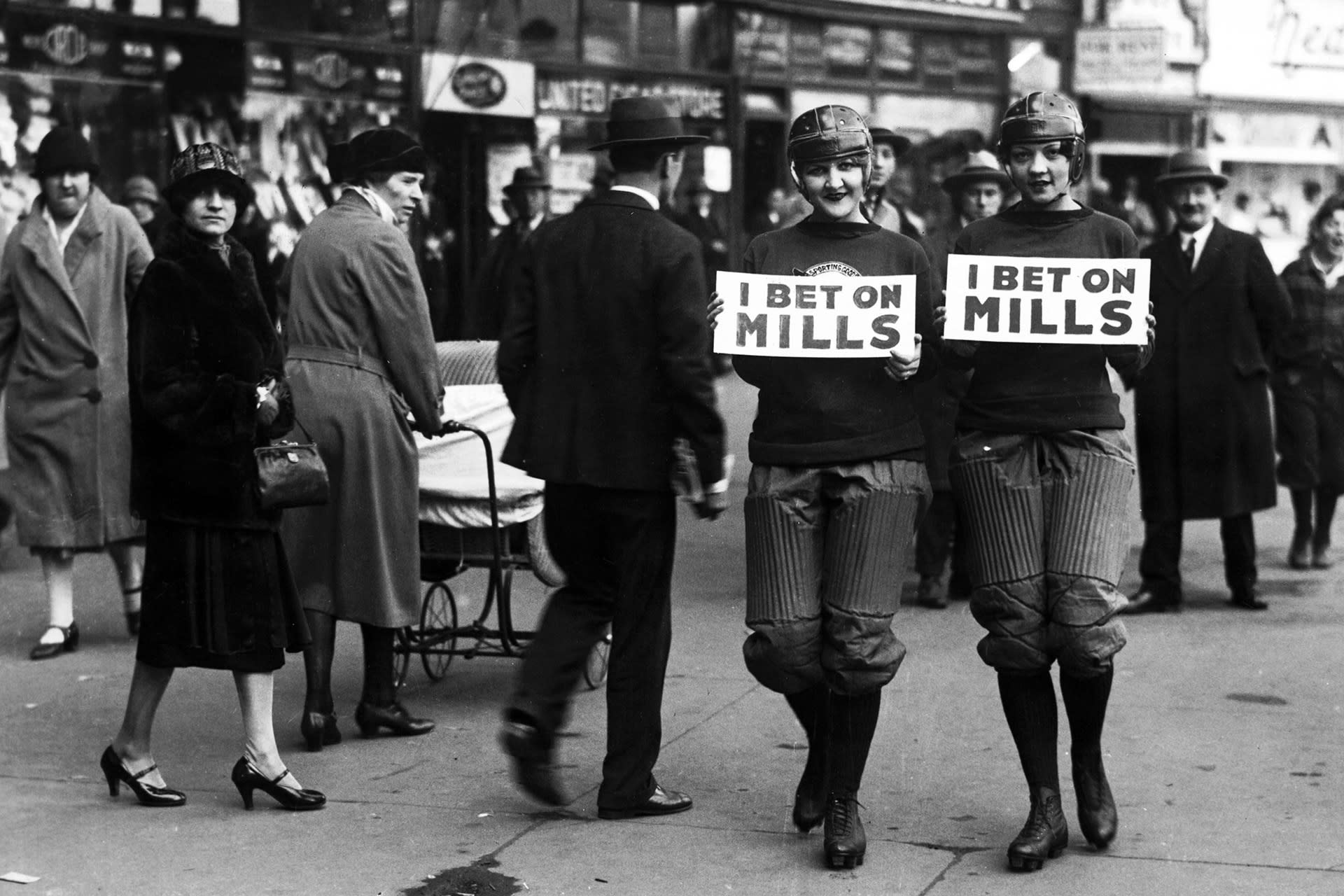
Although many states had banned election betting by 1850, the practice still flourished. At the markets’ 1916 peak, bettors in New York wagered $10 million ($300 million in 2026 dollars), more than double campaign spending that year. Major newspapers printed the odds almost daily as Election Day neared.
Yet the markets could not outcompete scientific polling or the changing politics of gambling. In the 1920s, Literary Digest’s straw poll began crowding out betting odds in major newspapers, and when George Gallup correctly called Franklin D. Roosevelt’s 1936 landslide, newspapers embraced his weekly numbers in lieu of betting markets. Three years later, New York legalized betting on horse races, which proved more enticing to election bettors, and Mayor Fiorello La Guardia cracked down on election brokers. By the 1944 presidential election, betting commissioners were hard to find on Wall Street.
Organized election betting did not return in earnest to the United States until 1988, when economists at the University of Iowa launched Iowa Electronic Markets (IEM). IEM was a small-stakes marketplace that the CFTC permitted in 1992, by special exception, under the auspices of academic research. Its founders described it as a “political stock market” and spoke of traders and contracts rather than bettors and wagers. Modern prediction markets function similarly and have adopted the same vernacular.
IEM traders could risk up to $500 on contracts that paid $1 if a candidate won and $0 if they lost. A contract priced at 60 cents thus implied a 60 percent chance of victory. IEM attracted about a thousand traders by 2000. Studies revealed that IEM prices were more accurate, on average, than leading political polls. But even at its peak, election trading on IEM drew less than 0.5 percent of the trading volume that presidential races enjoyed on Wall Street in the early 1900s.
In the 2000s, commercial election markets emerged offshore beyond the reach of U.S. regulators. Foremost among them was Intrade, a for-profit Irish exchange launched in 2002. The firm’s contract on President George W. Bush’s 2004 reelection drew more than $15 million in volume. Though Intrade was barred by U.S. law from serving Americans, up to 40 percent of its market participants were U.S. persons. In 2012, the CFTC sued Intrade’s parent company for failing to keep Americans off the exchange, and the firm halted trading less than a year later amid regulatory and financial troubles.
Betfair, a London-based betting exchange started in 2000, launched a parallel offshore market. Over $50 million traded on its 2012 U.S. presidential market; but unlike Intrade, it effectively blocked American users and avoided regulatory reprisal.
Then, in 2014, came PredictIt. Much like IEM, it was a small-stakes exchange focused on U.S. politics. When it launched, in 2014, PredictIt secured a CFTC “no-action letter,” in which agency staff pledged not to recommend enforcement in exchange for certain restrictions. These included an $850 cap per trader per market and a limit of 5,000 traders per market.
Despite those limitations, PredictIt had about 110,000 users by Election Day 2020 and facilitated millions of dollars in trading. In 2022, amid public scrutiny, the CFTC ordered the market to close. But after a legal battle and corporate restructuring, PredictIt remains operational.
Modern Election Markets
Today, U.S. election markets are far larger, more sophisticated, and, increasingly, legal than their predecessors. Trading takes place on platforms known as prediction markets, an emerging type of derivatives exchange that the CFTC classifies as a designated contract market (DCM). Similarly designated exchanges facilitate the trading of grain futures as well as derivatives on everything from crude oil and Treasury bonds to stock indexes.
Traders on these exchanges speculate on elections by using derivatives known as “event contracts,” which resolve on outcomes such as which party controls the House or Senate, who wins a race, and by what margin. Exchanges settle these contracts against set criteria, such as election certifications or race calls by major news organizations. As on stock exchanges, or on IEM and PredictIt before them, traders post bids and offers between $0 and $1 per contract. Trades occur continuously as bids are matched with offers. Any American eighteen or older can open an account on a licensed prediction market, and tens of millions have done so.
The CFTC regulates election event contracts as swaps. Exchanges need not seek approval before listing event contracts, including those on elections. Instead, they may “self-certify” that contracts comply with federal law and begin trading as soon as the next business day. If the Commission suspects a contract is unlawful, it can ask the exchange to suspend trading during a review of up to ninety days, then approve or prohibit the contract.
Most election trading in the United States now takes place on two large DCMs, Kalshi and Polymarket, which account for about 95 percent of industry volume. Kalshi became a DCM in 2020, and Polymarket launched one for American customers in December 2025, alongside its large cryptocurrency-based offshore exchange. Both platforms rely on sports contracts for the lion’s share of volume and revenue, though election trading is a meaningful side business.
As of this writing, Kalshi and Polymarket offer more than one thousand markets on the 2026 midterm elections, and volume is growing rapidly. In 2024, Polymarket’s offshore presidential markets drew about $3.6 billion and Kalshi’s onshore markets more than $500 million. In 2025, the two exchanges handled roughly $550 million on New York City’s mayoral race alone. And by early October 2026, they had facilitated $1.4 billion in trading volume on 2026 election markets.
How Is This Legal?
The meteoric rise of election trading is the fruit of a years-long campaign of regulatory arbitrage, lobbying, and litigation waged by industry leaders.
The meteoric rise of election trading is the fruit of a years-long campaign of regulatory arbitrage, lobbying, and litigation waged by industry leaders. Until 2024, election markets were effectively prohibited on federally regulated exchanges. Under a 2010 provision of the statute, known as the special rule, the CFTC may prohibit event contracts involving terrorism, assassination, war, gaming, or activity unlawful under federal or state law if it finds them contrary to the public interest. In 2012, the Commission used that power to block election contracts proposed by the exchange Nadex, finding that they involved gaming and were contrary to the public interest.
But in 2020, Polymarket sidestepped this ruling, and CFTC jurisdiction altogether, by launching an offshore cryptocurrency-based exchange that attracted millions of users. Many users never needed to verify their identity or country of residence, and Americans traded heavily on election markets—resulting in a $1.4 million CFTC fine in 2022 and a criminal investigation by the FBI in 2024.
Kalshi, founded in 2018, chose to seek regulatory approval for election contracts from the outset. It became an authorized DCM two years later and has never operated offshore. In June 2023, the company began a drive to resurrect legal trading on elections, but by September the CFTC had invoked the special rule to prohibit the contracts.
In response, Kalshi sued the CFTC, arguing that elections were neither games nor unlawful, and in September 2024, a federal judge agreed and vacated the agency’s order. When the D.C. Circuit denied the CFTC’s motion to halt trading pending appeal that October, Kalshi rolled out contracts on the presidential race and other contests, and they have traded on CFTC-regulated exchanges ever since. In May 2025, after Trump replaced the CFTC’s leadership, the Commission dropped its appeal against Kalshi, opening the field for new onshore entrants. The next month, the investigation into Polymarket and its CEO Shayne Coplan was also dropped.
Since then, the CFTC has crafted an accommodating regulatory regime. In February 2026, Selig, its chairman, withdrew a 2024 proposal that would have banned election contracts outright. In June, the agency proposed rules stating that elections were contests, not games, placing election contracts outside the special rule. And to prevent states from blocking election markets under state gaming laws, the agency now asserts exclusive jurisdiction over event contracts listed on DCMs and has sued nine states, joined by the Justice Department in most cases, to block enforcement.
At the heart of this legal battle is whether sports and election contracts are illegal wagers under state law or swaps under exclusive federal jurisdiction. On the sports question, the federal circuits have split: the Third Circuit sided with Kalshi, while the Ninth Circuit and the Sixth Circuit sided with the states, finding that games likely lack the economic consequence that defines a swap. New Jersey—backed by thirty-nine states and the District of Columbia, the National Football League, and former CFTC Chairman Gary Gensler—has petitioned the Supreme Court to resolve the circuit split.
On the election question, federal courts have yet to rule, and they appear poised to separate the matter from sports. The Ninth Circuit sided with Nevada on sports but sent the state’s challenge to Kalshi’s election contracts back to a lower court. In March, Arizona brought criminal charges against the company for wagering on Arizona elections, but a federal judge has since blocked the prosecution. And in October, Utah sued Kalshi in state court to halt its contracts on elections and other events.
The Promise of Election Markets
Before proposing sensible rules of the road while the courts deliberate, policymakers must first understand the utility of election markets and the unique risks they pose.
The Wisdom of Crowds
The broadest public benefit of election markets is as a free and reliable source of information on the democratic process. More than a century of data, encompassing thousands of election markets, shows that these markets forecast elections accurately.
On balance, the forecasts that election markets generate can serve the public interest by improving our collective understanding of the democratic process.
In 2026, Kalshi released a study covering all 2.2 million markets resolved on the exchange since trading began on its platform in 2021, including some 6,000 election markets. The study found that prices behave like genuine probabilities: when Kalshi markets assign a candidate a 60 percent chance of winning, such candidates win almost exactly 60 percent of the time. The results of Kalshi’s study have been independently verified, track closely with trading data from Polymarket’s offshore exchange, and mirror the accuracy of IEM and PredictIt markets.
Individual election outcomes remain difficult to predict with great certainty, however, even for traders. Look no further than Brazil’s presidential runoff on October 25, 2026, in which President Luiz Inácio Lula da Silva (commonly known as Lula) won in an upset over Flávio Bolsonaro. Markets gave Lula a mere 20 percent chance of reelection, but he won by more than 4.4 million votes. Four-to-one underdogs still win one out of every five times, and setting those odds accurately, over long periods of time and many different elections, is where election markets excel.
To the extent election markets err, their imprecision is unbiased. The economist Eric Zitzewitz examined election markets from 1880 to 2025 and found no systematic overpricing of candidates on either the left or the right. Zitzewitz’s estimates rule out partisan mispricing of roughly 5 percentage points or more.
Some claim that modern polling can afford equally accurate and unbiased forecasts, making election markets redundant. But this argument is misleading: polls are lagging indicators that measure public sentiment at a given point in time; modern election markets, by contrast, trade continuously and can price breaking developments that polls cannot capture, such as “October surprise” scandals, sudden economic or geopolitical shocks, and live ballot counts on Election Day.
Election markets also provide real-time feedback for candidates and policymakers, revealing how policy choices and exogenous shocks impact their electoral prospects. Leaders whose odds fall after announcing a policy learn quickly that voters are likely to punish them, and may change course accordingly.
On balance, the forecasts that election markets generate can serve the public interest by improving our collective understanding of the democratic process. As a nonpartisan mechanism of electoral forecasting, election markets can cut through misinformation, spurious or premature declarations of victory, and unproven claims about the popularity of specific policy choices.
Hedging Political Risk
Bona fide hedging on election markets—and political event contracts more broadly—is a nascent but rapidly growing practice.
The second use case for election markets is as a hedging tool for individuals and businesses. Federal, state, and local elections, as well as ballot measures, can have significant economic consequences, including changes to tax and immigration policy, as well as government spending and industry-specific regulation. Without election markets, hedging those policy risks is laborious and legally complex. Insurance products for election risk are opaque, costly, and often available only to the largest businesses. Unhedged firms operate less efficiently, and some suffer heavy losses or go bankrupt, which over time reduces output and competitiveness. Election markets can ease this drag.
Bona fide hedging on election markets—and political event contracts more broadly—is a nascent but rapidly growing practice. This summer, an expired wage exemption threatened to push a California goat-herding company’s labor costs from about $60,000 to as much as $240,000 per herder a year. To hedge against this risk, the firm’s owner purchased $50,000 in Kalshi contracts, which would have paid out $500,000 had the state failed to restore the exemption by the end of September. Susquehanna International Group, one of the world’s largest proprietary traders and market makers, priced the contract and took the other side.
In the institutional realm, large U.S. firms with outsize exposure to financial and cryptocurrency regulation have hedged on the outcome of 2026 Senate races and the 2028 presidential race using Kalshi contracts. Susquehanna now has an eighty-person prediction markets team that prices such hedges and trades for institutions, including on election markets. Investment bank Cantor Fitzgerald brokers large, privately negotiated block trades on Kalshi for hedge funds and other institutional clients seeking to reduce policy risk or speculate on election outcomes. Polymarket, for its part, recently hired former Goldman Sachs partner Lisa Mantil to lead its institutional business and will soon offer block trades on its U.S. exchange.
The Perils of Election Markets
Despite those benefits, under the current regulatory regime, election markets may undermine financial market integrity and public trust in the electoral process.
Election Security and Manipulation
Election security experts worry that malign actors could manipulate prices to alter or suppress turnout. The concern is not illusory: in the final two weeks of the 2012 presidential race, a single Intrade trader accounted for a third of all money staked on Mitt Romney. And on May 20, 2026, a trader poured $1.25 million into Kalshi contracts on Spencer Pratt in the Los Angeles mayoral race.
One speculator’s attempt at market manipulation is another’s arbitrage opportunity.
Yet those episodes actually reveal the resilience of election markets. On Election Day in 2012, the “Romney whale” placed massive orders to buy Romney contracts on Intrade, holding the candidate’s odds steady for hours even as prices on rival exchanges moved sharply toward Barack Obama. The distortion lasted only because Intrade required traders to post cash covering their worst-case losses up front, and few could wire in funds on election night to trade against him. Once the whale pulled his orders as exit polls were released, Intrade’s price converged immediately with other markets, and the manipulative trader lost close to $7 million. Today’s more liquid exchanges are far less fragile. For example, when the 2026 Pratt trader began buying contracts en masse, Pratt’s price jumped 16 cents. But within nine seconds, other traders sold into the spike and returned the price to its prior level. (The “Pratt whale” lost $1.25 million.) One speculator’s attempt at market manipulation is another’s arbitrage opportunity.
Nor does the case for market resilience rest on those two anecdotes. In a field experiment, the economists Paul Rhode and Koleman Strumpf placed random trades in IEM’s 2000 presidential contracts, and prices drifted back toward their prior levels within a day. Zitzewitz’s research likewise found no partisan tilt in prices three weeks before elections. His study included the periods in which trades were placed by the 2012 Intrade “Romney whale” and the 2024 Polymarket “Trump whale”—a French speculator who walked away with over $85 million in profit after predicting Trump’s victory. Even prices on the Progressive Era exchanges were well calibrated, in spite of alleged partisan trickery and a total lack of regulatory enforcement.
Nonetheless, a coordinated attempt to manipulate prices—including by foreign, state-backed actors seeking to sway public sentiment—remains a concern. In the long run, market integrity will depend on stricter regulations and ample liquidity provided by institutional “market makers,” firms with enough capital to bid against manipulative traders.
Financial Market Integrity and Fraud
Experts in financial regulation and fraud rightly worry about insider trading on election markets. These markets present two core insider trading problems. The first is the number and novelty of the insiders. A plethora of inside information about electoral contests—such as unreleased polling, a candidate’s plan to withdraw from a race, opposition research, vetting files, unreleased exit polls, and vote tallies—is held by candidates, campaign staff, pollsters, consultants, election administrators, and various government officials. These insiders number in the thousands, if not more, and few are subject to the trading blackouts and preclearance rules that public companies impose on employees. Several candidates have been caught betting on their own races, and in April 2026, Kalshi fined and suspended three congressional candidates for doing so. In October 2026, an analysis by Betting Intelligence also found that a Kalshi account linked to a pollster traded on three races hours before his former firm released suspicious opinion polls on those very contests.
Applied to election markets, this legal regime is flawed. A campaign aide who trades on internal polling likely breaks the law, but a candidate who does the same may not. The polling data is the candidate’s property, so he has misappropriated nothing. And the evidentiary burden to prove manipulation or a breach of trust is exceedingly high. Most insider trading cases are typically brought under the CFTC’s antifraud rule, which requires proof that a trader acted deceptively and with scienter (i.e., an intent to deceive).
Both problems are manageable. Election market insiders may be particularly numerous, but CFTC-regulated exchanges are singularly bad places to engage in insider trading. By law, they must verify the identity of every trader, keep a time-stamped record of every order and trade, watch for suspicious trading, and enforce exchange rules. The CFTC can examine those records whenever suspicion arises.
Licensed exchanges are now adapting those tools to secure election markets. Kalshi screens customers against Federal Election Commission records of paid campaign staff, bars candidates from trading on their own races, and requires users in some high-risk markets to name their employers. It opened more than two hundred investigations in the first half of 2026. Its screening tools also blocked more than one hundred potential insider trades in the first quarter. And it has referred more than fifty suspected insider traders to the CFTC in 2026, prompting at least twenty investigations.
But exchanges cannot wield the threat of federal penalties. The gravity of the electoral process demands that Congress close gaps in insider trading law as well as give the CFTC ample resources to investigate a growing volume of referrals.
Offshore markets pose the thorniest challenge. Platforms such as Polymarket’s international exchange, which is separate from its U.S. platform, are not registered with the CFTC or subject to a DCM’s surveillance regime. Many let traders remain anonymous, and Americans barred from these platforms can still trade via virtual private networks and proxies. Insider trading on these platforms is difficult to interdict, but it can be mitigated.
In crafting new regulations, policymakers must recognize that no regime can fully prevent insider trading. It occurs in every U.S. financial market, and regulators police it rather than shut those markets down. Traders and regulators tolerate this equilibrium because the losses attributable to insider trading are bounded and often smaller than a market’s underlying utility. In election markets, the principal harm is financial loss for traders without inside information, who can be compensated through restitution. Insider trading can also erode public trust in these markets and, by association, elections. But insider trading does not distort the forecasts these markets produce, nor does it pose any direct risk to election security.
Morality and Social Welfare
Finally, there is the question of whether mass speculation taints the electoral process. This depends on one’s ethical view of gambling, and whether its moral and material harms are offset by the benefits of election markets, as well as one’s view of the proper relationship between capital and the democratic process. These are subjective waters, yet a few things are obvious.
For one, despite the assertions of prediction market firms, most people who trade on election markets do so as a form of gambling and lose money over time. The same is true for retail investors who speculate on short-dated options, day-trade stocks, or sports. Millions of U.S. citizens, including a disproportionate share of young men, now engage in such speculation and suffer serious financial consequences.
The costs are not borne solely by traders. Recent studies of sports-betting legalization find that wagering displaces household saving, with each dollar wagered reducing net investment by a dollar or more. And betting is also tied to increased rates of personal bankruptcy. On both counts, these negative fiscal externalities are absorbed by lenders and public assistance programs, to the detriment of shareholders and taxpayers.
Although election markets are not a core driver of the United States’ resurgent gambling addiction—which the country has fought with varying degrees of success since Puritan times—they ought to be part of a broader, data-driven conversation about healthy risk-taking. To this end, exchanges should proactively steer clear of listing frivolous election trading products, such as parlays that bundle several event outcomes, including elections and sports games, into a single contract. Those products serve little to no bona fide hedging or forecasting purpose; their sole function is to entice gamblers.
Yet an uncomfortable truth of election markets, and all derivatives markets, is that speculation is part and parcel of trading.
Yet an uncomfortable truth of election markets, and all derivatives markets, is that speculation is part and parcel of trading. This premise was once hotly contested. In the late nineteenth century, professional speculators crowded into Chicago’s grain futures markets alongside the farmers, merchants, and millers who used them to hedge. A populist backlash followed.
In 1892, thousands of petitions urged lawmakers to ban “speculative gambling in grain,” and an anti-option bill that would have crippled futures trading with a prohibitive tax passed both houses of Congress before it was stymied by a procedural vote.
But futures markets survived, and in 1905, Justice Oliver Wendell Holmes explained why. Speculation on financial markets, he conceded, leads “incompetent persons” to “bring themselves to ruin.” But legislatures and courts had recognized that “the natural evolutions of a complex society are to be touched only with a very cautious hand,” and that a “simple prohibition” of speculation is “harmful and vain.” The same logic may apply to election markets: they should be policed for fraud and manipulation, not banned outright. This is the basic argument at hand in Kalshi’s battle with the state of Nevada over election contracts. Yet it is an entirely subjective question whether the economic and informational benefits of election markets outweigh the costs of the speculation they enable.
Money is already the lifeblood of American elections.
As for the charge that election markets financialize democracy, they do, but incrementally so. Money is already the lifeblood of American elections. The Supreme Court has treated campaign spending as protected speech since Buckley v. Valeo (1976), and in the wake of Citizens United v. FEC (2010), corporations may spend unlimited sums to influence elections through super PACs. Some legal scholars argue that trading election contracts may itself be a form of protected political speech.
Campaign spending figures and financial markets tell a similar story. The analytics company AdImpact projects a record $11.6 billion in political advertising this cycle, and by mid-2026, congressional candidates had already raised $2.8 billion. Stocks swing on electoral outcomes too: the day after the 2024 election, private-prison operators GEO Group and CoreCivic jumped 42 and 29 percent, respectively. In campaign season, these and similar securities function as de facto election markets and are marketed by major institutional brokerages as such. And in September 2026, Trump went so far as to promise every adult citizen a $5,000 “dividend” if Republicans held both chambers in November.
Many Americans of both parties decry this state of affairs, but there is no denying it. It is therefore difficult to argue that regulated election markets take the electorate into uncharted waters. They may even incentivize more Americans to vote by providing them a tangible and immediate stake in electoral outcomes—perverse as some may find this phenomenon.
Policy Recommendations
So long as election markets operate, policymakers have a duty to ensure market integrity and deter malign actors. To advance this aim, they should adopt a combination of the following measures:
Strengthen and pass the Prediction Market Act of 2026. Of the more than a dozen measures on prediction markets pending in Congress, this bipartisan Senate bill (S. 4469) comes closest to meeting the moment. The bill would enhance case-by-case public-interest review of contracts, apply Bank Secrecy Act know-your-customer and anti-money-laundering requirements to clearinghouses that offer event contracts to retail traders, direct the CFTC to decide whether exchanges and brokers need stronger insider-trading safeguards and to require them if so, and create an Office of the Retail Advocate. It would also bar the president, the vice president, members of Congress, and senior executive branch officials from trading event contracts on CFTC-regulated exchanges.
The bill takes no position on the questions that have rendered the courts “hopelessly confused.” It leaves aside the scope of the CFTC’s exclusive jurisdiction, whether sports contracts are swaps, and whether federal law preempts state gambling statutes. It has stalled in the Senate Agriculture Committee since its introduction in April. In advancing (or reintroducing) the bill, Congress should broaden its public-interest test, which centers on violence and unlawful activity, to weigh manipulation and insider-trading risk, as the CFTC’s June 2026 proposal does, and ensure the new test does not constrain the CFTC’s ability to tighten contract requirements.
Extend the Senate’s trading ban to the House. On April 30, 2026, the Senate unanimously amended its standing rules (S. Res. 708) to bar senators, Senate officers, and Senate staff from trading on prediction markets. The House has no equivalent rule, although two resolutions to create one are pending. It should adopt a parallel rule, which could be implemented much faster than S. 4469.
Prohibit and prevent insider trading in election markets. Commodities law has no general prohibition on insider trading. The CFTC’s antifraud rule applies only when “confidential information” is misappropriated in breach of a duty or obtained by fraud or deception. Provisions added by the Dodd-Frank Act also prohibit derivatives traders from using nonpublic federal government information, but that prohibition does not extend to nonpublic state or local information. In April, the CFTC brought its first case under the latter rule against a soldier accused of trading on classified details of the operation to capture Venezuelan President Nicolás Maduro. But neither rule sufficiently covers election insiders. And even where these laws apply, it is difficult to prove what information a trader held and when it was obtained. Congress should therefore amend the CEA to categorically bar the following people from trading any election-related event contract, regardless of what information they hold:
- candidates, campaign staff, and any person employed by an active campaign contractor or consultant;
- party committee staff, PAC staff, and staff of other entities actively involved in allocating political donations and funds;
- pollsters, survey firms, and data vendors;
- news media decision desks, exit-poll teams, and vote-tabulation services that report results;
- journalists and members of the media actively covering elections;
- election officials, poll workers, and canvassing boards;
- vendors of voting machines, tabulation software, and electronic poll books;
- judges, court staff, and lawyers in election litigation; and
- the immediate families and household members of anyone above.
To prevent “tipping” and trading by proxy, Congress should also bar those persons from providing information they hold to help others trade on it, and bar anyone who receives such information, directly or indirectly, from knowingly trading on it. Drawing on the CEA’s ban on insider trading by government officials, Congress should treat information as covered if it “may affect or tend to affect the price” of an election-related event contract and has not been made “generally available to the trading public.”
Violations should invite the full weight of the Commodity Exchange Act’s existing civil and criminal penalties. And until Congress acts, the CFTC should require any exchange that lists election contracts to adopt these trading prohibitions by screening new and existing account holders.
Require disclosure of large positions. Congress should work with the CFTC to explore legislating a new public disclosure regime for election markets, modeled on the Securities and Exchange Commission’s Schedule 13D. Such requirements are atypical in swaps markets but may be advisable here, given malign actors’ incentive to manipulate election markets and the importance of market transparency as a matter of public trust. A sensible disclosure provision might require any person or entity whose exposure to a given election market exceeds a set threshold—with positions aggregated across affiliates, parties acting in concert, and all CFTC-regulated exchanges—to disclose their identity, market position, and source of funds. Congress should direct the CFTC, by statute, to conduct a study of the legal and technical requirements for such a regime and report its findings within 180 days.
Hold offshore exchanges to U.S. standards. The executive branch should pressure foreign governments and regulators in countries that host offshore exchanges to adopt U.S. standards for election markets. Policymakers should treat regulatory harmonization, and the co-option of foreign regulators into U.S. enforcement efforts, as a standing priority in broader diplomatic negotiations. To the extent possible, U.S. policymakers should demand that offshore exchanges that list contracts on U.S. elections meet U.S. requirements for know-your-customer protocols, insider-trading prohibitions, surveillance, and recordkeeping. When suspicious trading occurs, foreign regulators should provide the CFTC and Justice Department with exchange data through formal information-sharing agreements. Finally, an act of Congress or a new CFTC rule should condition the designation of any DCM whose affiliate runs an offshore exchange on that affiliate’s compliance with U.S. know-your-customer, surveillance, and recordkeeping requirements, as well as the contract-listing standards that apply to DCMs.
Prevent the disenfranchisement of voters who trade on elections. At least two states bar any citizen who “bets” on an election, including by way of election markets, from voting in it. Wisconsin does so under a law dating to 1849, and New York does so under its constitution. In July 2026, Wisconsin’s Elections Commission warned that trading on a race and then voting in it could be a felony. These laws are antiquated and invite abuse. In 1864, agents employed by President Abraham Lincoln’s campaign reportedly lured swing-state Democrats into wagers to disqualify their votes. Such laws are seldom enforced and would be contested in court by the CFTC and other parties—but the right to vote should not depend on prosecutorial restraint or the outcome of litigation, and states should repeal or amend them.
Protect retail traders. The majority of speculators on election markets are retail traders who often participate for the purpose of entertainment and lack experience in derivatives or political forecasting. Some of those retail traders are problem gamblers, or simply fail to manage their trading risk, and fall into financial ruin. The CFTC should study election market trading data to grasp the scope of irresponsible retail trading, and consider mandating safeguards for retail speculators, such as cumulative loss thresholds that trigger suitability reviews, self-exclusion tools, and the banning of election parlays or similar products that appeal to problem gamblers.
Give the CFTC the capacity to do the job. Congress designed the CFTC as a bipartisan, five-member commission. Yet it has had only a single commissioner since December 2025. It has also lost a fifth of its staff, largely to the administration’s buyouts and layoffs, just before monthly trading on Kalshi and Polymarket soared fivefold. The president should nominate four new commissioners, two from each party, as the Republican chair and Democratic ranking member of the House Agriculture Committee have urged. The CFTC should also reconstitute its enforcement staff, and Congress should fund the administration’s $410 million budget request for fiscal year 2027.
Conclusion
Election markets can serve the public interest over the coming years, but not if they are poorly regulated. Their current legal purgatory presents a unique opportunity to implement technical reforms while continuing important moral and legal debates. Voters demand no less. A recent Reuters/Ipsos poll found that 69 percent of Democrats and 61 percent of Republicans opposed using prediction markets to “bet” on election results. This bipartisan concern ought to align incentives, both across the political spectrum and between the CFTC and Congress, to pursue a program of reform.
For opponents of election markets, reform would protect what they hold dear: consumer protection and financial market integrity, election security, and public trust in the democratic process. For their advocates, reform would prevent political backlash, allow election markets to fulfill their potential should the courts uphold their legality, and keep the United States at the forefront of financial innovation. Inaction will serve neither camp: scandals will abound, trust in the democratic process will erode, and traders will be defrauded.