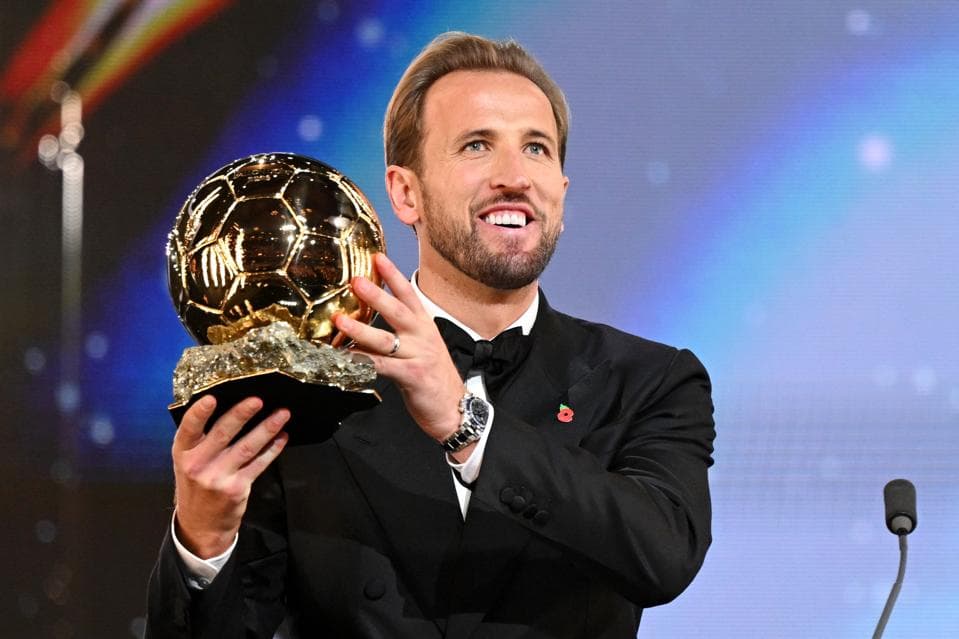
For nearly two decades, the Ballon d’Or was defined by a rivalry that transcended soccer. Lionel Messi and Cristiano Ronaldo did not simply dominate the bane’s most prestigious individual award; they reshaped expectations of greatness, turning extraordinary seasons into the standard against which every other player was measured.
Messi and Ronaldo top the all-time rankings with eight and five Ballons d’Or, respectively.
Now, with the 33-year-old Harry Kane claiming the prize on Monday night (ahead of Kylian Mbappe and Lamine Yamal) after a remarkable campaign for Bayern Munich and England, the game has another chance to ask a question that has been waiting in the background for years: What comes after Messi and Ronaldo?
Kane’s triumph at the London ceremony represents more than a personal milestone or the end of a 25-year wait for an English Ballon d’Or winner. It signals a changing soccer landscape, one in which the sport’s biggest individual prize can once again become a contest between different generations, playing styles and definitions of excellence.
“Being in London, it is extra special, it felt like a good omen,” Kane said during his speech. “Thank you to everyone who voted for me, I can imagine it was tough, so thank you.”
Kane’s achievement carries a particular significance for English soccer. The last Englishman to win the Ballon d’Or was Michael Owen in 2001, when his pace and goalscoring exploits made him one of the most exciting young strikers in the world at the time. A quarter of a century later, Kane has restored England’s presence at the summit of individual recognition.
“It’s just the journey," Kane said. “For any young boy or girl who wants to achieve their dream, anything is possible.”
But the significance of this victory extends beyond nationality. Kane’s journey has never followed the conventional path of a superstar. He was not universally regarded as a generational talent in his teen years, nor did he arrive at the top of the game with the mythology that surrounded Messi and Ronaldo. Instead, he built his reputation through persistence, consistency and an almost relentless commitment to improving his skills.
Kane’s 73 goals for club and country last season, combined with domestic silverware with Bayern and a prolific World Cup campaign, provide the statistical foundation for his recognition. But the story behind those numbers is equally important: Kane has reached the highest level through evolution rather than instant superstardom.
The Messi-Ronaldo era was not merely about individual brilliance. It was about longevity at a level rarely seen in sports. They turned excellence into an annual expectation and transformed individual awards into chapters in a much larger historical argument.
Kane led Bayern to the Bundesliga and German Cup double last season, scoring a hat trick against Stuttgart in the cup final. At the World Cup this past summer, he scored six goals to pass Gary Lineker as England’s all-time leading tournament scorer. England lost to Argentina in the semifinals, but beat France for third place.
Kane’s Ballon d’Or victory, however, suggests that the award can move beyond the gravitational pull of two extraordinary careers. The award can again become a genuine reflection of contemporary game rather than another referendum on the achievements of its two defining figures.
That does not mean the new era will be less competitive. If anything, it could become more unpredictable. Without two established superstars dominating the game, players from different leagues and soccer cultures have a greater opportunity to make their case.
Kane is both scorer and creator. He can take on defenders in the penalty box, drop into midfield to link play, deliver incisive passes and dictate attacking movements. His game combines the traditional instincts of a winger with the technical awareness of a playmaker.
This versatility has helped make him one of the most productive forwards of his generation. His move to Bayern Munich also placed him in a different environment, challenging him to demonstrate that his influence could translate beyond the Premier League.
Winning major domestic honors while continuing to produce extraordinary scoring numbers strengthens the argument that Kane’s career should be judged not simply by the goals he scores, but by the range of responsibilities he can fulfill.
This latest triumph may also encourage a broader reassessment of how the sport currently evaluates individual excellence. Kane’s achievement offers a compelling case for that broader understanding of greatness.
This article was originally published on Forbes.com