
A marvel happened this past week: everyone can suddenly hear the voices of women politicians speaking out about the escalating violent threats from the right-wing manosphere.
The alleged attack on independent MP Helen Haines, followed by alleged threats at the office of WA Minister Hannah Beazley on Wednesday, has contributed to these politicians finally being listened to. The motives are yet unknown, but as Sean Kelly wrote in the morning’s Nine mastheads, the incidents have nonetheless resonated with a deeper problem. These febrile threats against politically active women aren’t new. It’s just that it’s rarely been capital-N News before last Monday.
Related Article Block Placeholder Article ID: 1270080
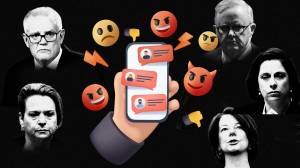
Driven by misogyny, male entitlement and anger at an increasingly feminist society, the manosphere ecosystem of influencers, thinkers and con-men — rendered suddenly everywhere by digital networks and social media — is the dark matter of democratic politics. It’s a central driver of the politics of the radical right parties, such as in One Nation’s long-standing embrace of the manosphere’s men’s rights movement, where “domestic violence is a two-way street”.
The manosphere lies at the core of that outrage factory, and too often turns outrage into violence, as Australia’s eSafety Commissioner warned in an online safety advisory last March: “Some parts of the manosphere promote ideas that can feed into gender-based violence, especially when they are repeated, normalised and reinforced in online groups.”
Trouble is: which parts? With its Digital Duty of Care legislation currently moving through parliament, the Albanese government plans to make that question the platforms’ problem to sort out. The conservative parties plan to, well, not.
Independent. Irreverent. In your inbox
Get the headlines they don’t want you to read. Sign up to Crikey’s free newsletters for fearless reporting, sharp analysis, and a touch of chaos.
By continuing, you agree to our Terms & Conditions and Privacy Policy.
This past week, the women’s angle on threats against politicians has been a largely ABC-led story, pushed along by Sarah Ferguson on 7.30, and then Insiders, which managed to pull together three blokes to chew it over with Nikki Savva on the weekend.
As far back as 2016, Julia Gillard was talking about the monotonous regularity of rape threats against women in parliament, off the back of the murder of British Labour MP Jo Cox in the lead-up to the 2016 Brexit referendum. Just this past August, the not-for-profit Women for Election surveyed women involved in politics and found that nearly 90% reported tech-facilitated gender-based violence. Treat that as code for: the manosphere.
It’s no surprise that women journalists — particularly high-profile on-air presenters or reporters in the field — get it. They’re too often targets. As a recent UNESCO report led by Australia’s Julie Posetti said: “Networked misogyny and gaslighting intersect with racism, religious bigotry, homophobia and other forms of discrimination to threaten women journalists — severely and disproportionately.”
There is a risk of this debate turning into more generalised hand-waving about social media. But that would be to misunderstand manosphere content, which comes freshly made out of the right-wing outrage factories, with social media algorithms and everyday news judgements across right-wing media then driving that content across our feeds.
The right-wing direction of Silicon Valley platforms has become a point of contention this past week, with Meta accused of a Bolsonaro bias amid Brazil’s presidential runoff and of suspending the anti-Trump “No Kings” Instagram page during nationwide protests. These platforms have their own self-defence mechanisms too: TikTok, YouTube and Meta all imposed restrictions on advertising a documentary about Elon Musk, only lifting them later and calling it an error.
If this week has been spent grappling with the effect of the manosphere in the real world, we saw, too, how the outrage factories make the content. On the right’s more public-facing media platforms like News24 and 2GB, they’ve been busy amplifying the rehabilitation tour of Ben Roberts-Smith, currently facing five charges of the war crime of murder.
Roberts-Smith was arrested in April. The Sydney Morning Herald and The Age (whose journalists broke the war crimes stories in the first place) cautiously backgrounded his charges this weekend: “A judge in a long-running defamation case that involved multiple SAS witnesses found to the civil standard in 2023 that Roberts-Smith had committed four murders — of one civilian and three combatants who were ‘under control’ and posing no threat.” They also added: “Bullying complaints were also found proved against him.”
Suddenly, this month Roberts-Smith has been everywhere, providing fodder for the manosphere along the way. He turned up on October 11 with his service medals at the Australian War Memorial commemoration of the 25th anniversary of Australia’s intervention in Afghanistan. Nine News puffed it as an “Act of Defiance” in a Facebook push that earned more than 3,000 “likes” and “loves”.
On October 16 he launched a blokey clothing brand of hoodies, t-shirts and trucker caps. And last week he conducted lengthy sit-down “exclusives” with the Murdochs’ News24 and with Ben Fordham on 2GB (now owned by Tapt Media, which is owned in turn by the Laundy pub-and-pokie-owning billionaire family). For a straight breakdown of his 2GB interview, go to the fact-check from investigative reporter Michael Bachelard.
As a defence strategy for Roberts-Smith, it seems unusual. As a networking ploy, it’s been useful, tying himself to two more billionaires to add to the support he’s been getting from Gina Rinehart and Kerry Stokes. In the manosphere, it’s a play for what Australian feminist philosopher Kate Manne has termed “himpathy” — the outsized sympathy that male perpetrators of violence get over their victims, usually women, who are treated as less deserving.
And in conservative media and the manosphere alike, himpathy content will always have an audience.