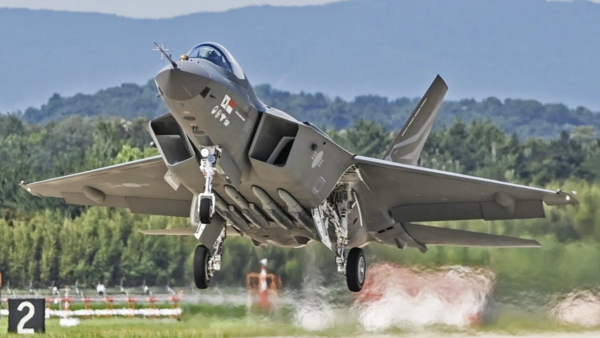
 KF-21 Boramae, the domestically developed fighter jet led by KAI. (Photo courtesy of KAI)
The privatization rumors surrounding Korea Aerospace Industries (KAI), the only complete aircraft manufacturer in the country, are showing little sign of subsiding. This comes as the Export-Import Bank of Korea (26.41%), the largest shareholder of KAI, commissioned a consulting service to strengthen the competitiveness of the aerospace industry, and Hanwha Group subsequently secured an over 15% stake in KAI. The relatively slow external growth compared to major defense companies and the increasing financial burden are also cited as factors raising voices about the possibility of KAI’s governance restructuring.
According to the office of People Power Party Representative Ahn Sang-hoon of the National Assembly Strategy and Finance Committee and the defense industry on Oct. 27, the Export-Import Bank of Korea selected the consulting firm AT Kearney as the preferred bidder in connection with the recently commissioned consulting service for strengthening the competitiveness of the aerospace industry and is proceeding with follow-up procedures. A project budget of 1.8 billion won (about $1.36 million) was allocated for this service, which was commissioned in August.
Suspicions were raised that the service might have KAI’s stake sale or governance restructuring in mind, as it includes an individual analysis of major domestic aerospace companies and the preparation of measures to foster global anchor companies. In particular, a controversy arose as it was reported that the government had requested the promotion of the service.
Hwang Ki-yeon, President of the Export-Import Bank of Korea, recently stated during the National Assembly Strategy and Finance Committee audit, “The service was not conducted on the premise of privatization or a sale, and there is currently no plan to sell KAI.” However, he left the possibility of privatization open by adding, “It is difficult to speak conclusively about future plans.”
Hanwha Group’s expansion of its KAI stake has also fueled the privatization rumors. Hanwha Group first disclosed that it held a 5.09% stake in KAI in May, but subsequently increased its stake rapidly, raising its stake ratio to 15.89% in August, just three months later, to become the second-largest shareholder following the largest shareholder, Eximbank. The KAI labor union is expressing concerns that Eximbank could hand over its KAI stake to Hanwha in the future.
The fact that KAI’s growth trend is relatively slow compared to major defense companies is also cited as a background for the privatization discussion. According to the corporate analysis research institute Leaders Index, KAI’s sales growth rate from 2020 to 2025 was 30.8%, the lowest among the five major defense companies. During the same period, the average sales growth rate of the remaining four companies, including Hanwha Aerospace, LIG Defense and Aerospace (LIG D&A), Hanwha Systems, and Hyundai Rotem, reached 200.9%. The assessment is that while major competitors were expanding their external size based on the expansion of global defense demand, KAI’s growth speed was relatively slow.
The burden regarding financial soundness also appears to be growing. KAI’s total borrowings increased from 608.2 billion won in 2023 to 2.9801 trillion won at the end of June. During the same period, the debt ratio also rose from 340.7% to 484.2%.
A business circle official said, “If Hanwha embraces KAI, it will possess an integrated defense system that encompasses land, sea, air, and even space,” adding, “If the private sector’s unique bold research and development (R&D) investments and rapid decision-making are added, the development of next-generation weapon systems and the strengthening of global competitiveness will gain momentum.”
However, as KAI is a core defense company directly linked to national security, it is pointed out that not only could public interest be compromised, but the concentration of dominance toward Hanwha could also heighten concerns about a monopoly and oligopoly in the defense industry.
Business Korea · সাধারণ
KAI Privatization Rumors Grow Amid Governance Review
২৭/১০/২০২৬
 KF-21 Boramae, the domestically developed fighter jet led by KAI. (Photo courtesy of KAI)
The privatization rumors surrounding Korea Aerospace Industries (KAI), the only complete aircraft manufacturer in the country, are showing little sign of subsiding. This comes as the Export-Import Bank of Korea (26.41%), the largest shareholder of KAI, commissioned a consulting service to strengthen the competitiveness of the aerospace industry, and Hanwha Group subsequently secured an over 15% stake in KAI. The relatively slow external growth compared to major defense companies and the increasing financial burden are also cited as factors raising voices about the possibility of KAI’s governance restructuring.
According to the office of People Power Party Representative Ahn Sang-hoon of the National Assembly Strategy and Finance Committee and the defense industry on Oct. 27, the Export-Import Bank of Korea selected the consulting firm AT Kearney as the preferred bidder in connection with the recently commissioned consulting service for strengthening the competitiveness of the aerospace industry and is proceeding with follow-up procedures. A project budget of 1.8 billion won (about $1.36 million) was allocated for this service, which was commissioned in August.
Suspicions were raised that the service might have KAI’s stake sale or governance restructuring in mind, as it includes an individual analysis of major domestic aerospace companies and the preparation of measures to foster global anchor companies. In particular, a controversy arose as it was reported that the government had requested the promotion of the service.
Hwang Ki-yeon, President of the Export-Import Bank of Korea, recently stated during the National Assembly Strategy and Finance Committee audit, “The service was not conducted on the premise of privatization or a sale, and there is currently no plan to sell KAI.” However, he left the possibility of privatization open by adding, “It is difficult to speak conclusively about future plans.”
Hanwha Group’s expansion of its KAI stake has also fueled the privatization rumors. Hanwha Group first disclosed that it held a 5.09% stake in KAI in May, but subsequently increased its stake rapidly, raising its stake ratio to 15.89% in August, just three months later, to become the second-largest shareholder following the largest shareholder, Eximbank. The KAI labor union is expressing concerns that Eximbank could hand over its KAI stake to Hanwha in the future.
The fact that KAI’s growth trend is relatively slow compared to major defense companies is also cited as a background for the privatization discussion. According to the corporate analysis research institute Leaders Index, KAI’s sales growth rate from 2020 to 2025 was 30.8%, the lowest among the five major defense companies. During the same period, the average sales growth rate of the remaining four companies, including Hanwha Aerospace, LIG Defense and Aerospace (LIG D&A), Hanwha Systems, and Hyundai Rotem, reached 200.9%. The assessment is that while major competitors were expanding their external size based on the expansion of global defense demand, KAI’s growth speed was relatively slow.
The burden regarding financial soundness also appears to be growing. KAI’s total borrowings increased from 608.2 billion won in 2023 to 2.9801 trillion won at the end of June. During the same period, the debt ratio also rose from 340.7% to 484.2%.
A business circle official said, “If Hanwha embraces KAI, it will possess an integrated defense system that encompasses land, sea, air, and even space,” adding, “If the private sector’s unique bold research and development (R&D) investments and rapid decision-making are added, the development of next-generation weapon systems and the strengthening of global competitiveness will gain momentum.”
However, as KAI is a core defense company directly linked to national security, it is pointed out that not only could public interest be compromised, but the concentration of dominance toward Hanwha could also heighten concerns about a monopoly and oligopoly in the defense industry.