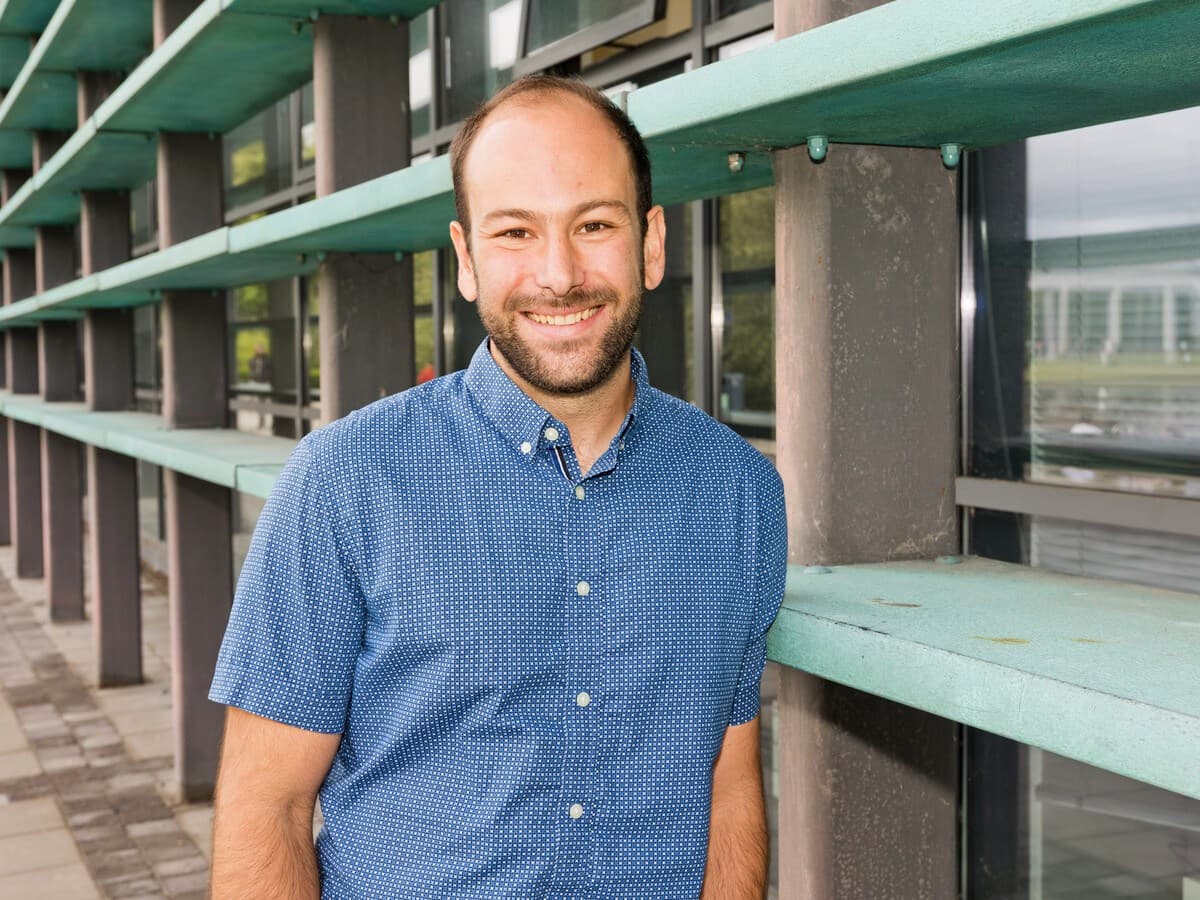
Dr Alan Seltzer. Image: Angela Halpin/ University College Dublin
‘There are remarkable ways in which nature spontaneously records information about itself over time.’
Earlier this month, a paper co-authored by University College Dublin (UCD) hydrogeology expert Dr Alan Seltzer said it found a new way to test for water quality using a rare form of nitrogen gas.
The quantity of nitrogen in water is a telling source of its quality. Extremely high concentrations, for example, can lead to algal blooms, which can cause aquatic death.
Microbes in water can remove nitrogen by converting it into gas – but the amount of nitrogen this process removes is something researchers have often struggled to determine.
Seltzer’s study, published in the journal Science, found that the rare, but naturally occurring 15N15N isotopologue acts like a natural fingerprint for microbial nitrogen conversion.
The UCD assistant professor has specialised in water geochemistry for more than a decade. “In particular, much of my career has revolved around dissolved noble gases – the far-right column of the periodic table – and their isotopes,” Seltzer says.
“Noble gases are remarkable natural tracers because they are chemically unreactive, allowing them to preserve physical signals that can help us reconstruct the history of groundwater and the oceans.”
Seltzer has been working in the UCD School of Earth Sciences since 2025. He completed his PhD in Earth science from the University of California San Diego and served on the research faculty at Woods Hole Oceanographic Institution, where he was also a postdoctoral researcher.
“My goal is to build upon the techniques I’ve developed throughout my career, applying them in new ways to advance our understanding of the sources and fate of nitrogen contamination in groundwater.”
Seltzer is also building a new research programme that combines geochemical tools to better understand how human activities have altered groundwater systems and to develop new methods for tracing groundwater contamination and the natural processes that can help remove it.
What inspired you to become a hydrogeochemist?
As strange as it might sound, my interest in hydrogeochemistry grew out of a realisation I had after an undergraduate lecture about inert gases and past climate.
Although the second law of thermodynamics tells us that entropy tends to increase in the universe, there are remarkable ways in which nature spontaneously records information about itself over time. Through geochemical measurements, we can recover that information to reconstruct the history of natural systems.
When I first learned about this as an undergraduate, I was immediately motivated to dig deeper and start working with these geochemical tracers.
I was captivated by the idea that we could extract precise, quantitative information about processes we could never directly observe, whether because they occurred thousands of years ago, deep underground, or both, simply by measuring the gases dissolved in water. That fascination has stayed with me throughout my career.
Can you tell us about the research you’re currently working on?
At the moment, much of my focus is on establishing a new laboratory at UCD capable of developing and implementing new techniques to trace the physical and biogeochemical properties of groundwater systems.
In particular, I’m interested in understanding how human activities have altered the nitrogen cycle in groundwater: how much nitrogen gas is produced through the microbial consumption of nitrate, where that nitrogen comes from, how quickly the process occurs, and how groundwater levels have changed over recent decades to centuries.
My recently awarded European Research Council (ERC) Starting Grant, Tracing Anthropogenic Biogeochemical and Physical Influences on Subsurface Hydrogeology (TABPHISH), brings together laboratory-based geochemical tracer development and field-based research across six study areas around the world, including southeastern Ireland.
One of the main goals of this project is to tackle a longstanding challenge in groundwater science: how can we determine how much nitrate originally entered a groundwater system, and where it came from, when some or even all of that nitrate may have subsequently been consumed by microbes and converted into nitrogen gas.
In your opinion, why is your research important?
Groundwater is a primary source of drinking water for billions of people around the world, as well as a major source of water for agriculture and industry. Here in Ireland, nitrogen pollution is a particularly relevant environmental challenge, with important implications for water quality and ecosystem health.
Much of my research focuses on developing geochemical techniques that allow us to measure aspects of groundwater systems that would otherwise be difficult or impossible to observe.
Although we develop and test these techniques in particular study areas, they have the potential to be applied to groundwater systems around the world, helping us better understand and manage these critical water resources. It’s this possibility of making an impact that extends far beyond any single study that I find most exciting about my research.
How do you feel about your work as a researcher in today’s geopolitical scenario?
I don’t think recent geopolitical events have fundamentally changed my perspective on the importance of my research.
I got into this profession because I love science and thoroughly enjoy the research process. One of the things I value most about science is its underlying objectivity: through careful experimentation, analysis, and statistical treatment, we can often arrive at answers that stand on their own scientific merit, independently of political considerations.
Of course, science doesn’t operate entirely independently of politics. Research funding, international collaborations, and the ways in which scientific findings are used can all be influenced by political developments. And I certainly believe that rigorous scientific research is essential to informing how we interact responsibly with the natural world.
What are some of the biggest challenges you face as a researcher in your field?
It’s often the seemingly minor things that collectively pose the greatest challenges to making progress: paperwork, logistics, purchasing procedures, and financial administration.
It’s continuously surprising to me how much time scientists can spend doing things other than science, simply to keep their research moving forward. Of course, there’s a need for accountability and good administration, particularly when working with public funding, but I do think there’s enormous value in finding ways to make these processes more efficient.
Funding, of course, is another perpetual challenge. I’ve been fortunate to receive substantial support for my research, and I’m particularly encouraged by Ireland’s recent investments in new research funding streams and scientific infrastructure.
What are some of the areas of research you’d like to see tackled in the years ahead?
There’s been a growing push to develop portable, field-deployable mass spectrometry systems. As these instruments become more widely available, user-friendly, and affordable, I think there’s enormous potential to expand access to sophisticated geochemical measurements.
Imagine water agencies around the world, particularly in regions that have historically lacked routine access to analytical laboratories, being able to make high-quality dissolved gas measurements directly in the field. That could be a game-changer for our understanding of groundwater resources globally.
Second, there have been remarkable advances in both high-precision and high-resolution mass spectrometry in recent years. High-resolution techniques allow us to distinguish between molecules that have almost identical masses, including the exceptionally rare nitrogen molecules containing two nitrogen-15 atoms that I mentioned earlier.
As these measurements become more routine, I think we’re going to see a substantial expansion in the kinds of questions we can quantitatively address in hydrogeochemistry.
Don’t miss out on the knowledge you need to succeed. Sign up for the Daily Brief, Silicon Republic’s digest of need-to-know sci-tech news.