In September 2025, Nepal’s Gen Z uprising brought down a government and exposed a generation’s deep frustration with the state. Within days, youth-led protests reshaped the country’s political landscape. One of the shortest yet most consequential protest movements in Nepal’s recent democratic history, as it forced the resignation of the then prime minister. In its aftermath, Gen Z representatives recommended a former chief justice to lead an interim government tasked with holding elections within six months. The uprising revealed how quickly accumulated public anger can become a direct challenge to political power.
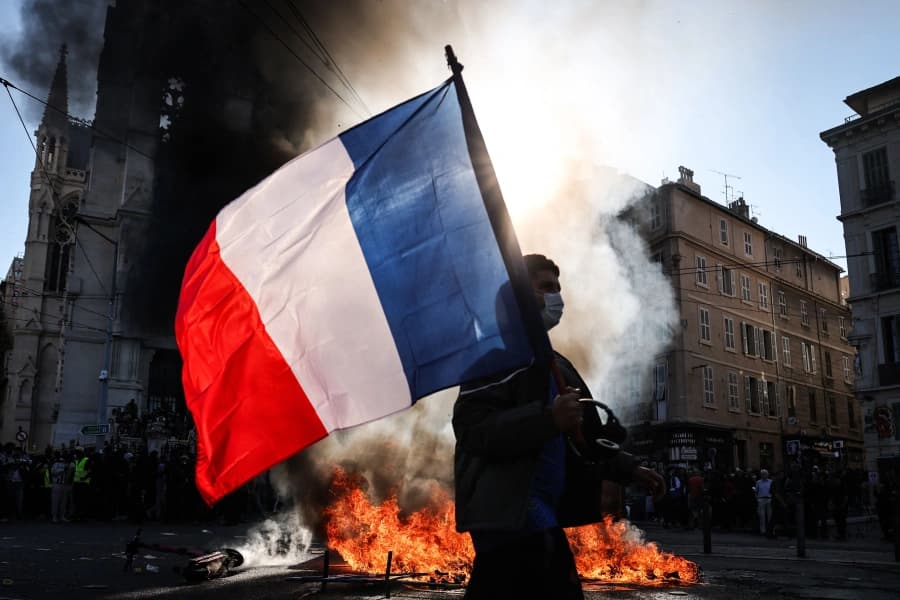
A year later, in France, I find myself watching unsettlingly familiar scenes unfold. Some public buildings burned, historic landmarks were damaged, and businesses were looted. It is painful to watch a movement born out of anger and demands for change descend into destruction.
Different grievances, a common unease
The countries are different, their grievances distinct and their political circumstances far from identical. Yet, as I witness these events here in France, I cannot escape a troubling sense of déjà vu. These images raised a question Nepal had already forced us to confront: what happens when a generation loses faith in the state?
In both countries, young people appear increasingly disillusioned with the institutions meant to represent them, protect their interests, and secure their future.
What drives a generation to turn its anger against the state? How does legitimate frustration spill over into the burning of town halls, the destruction of public property, and the looting of private businesses? And what does this tell us about the widening distance between governments and the young people they are supposed to serve?
Related story
Chairman of Club Déjà Vu Manoj Shrestha arrested

On October 17, France witnessed what was supposed to be a day of legitimate protest against the rising cost of living, the lack of resources in schools, and the deterioration of public services. According to the Interior Ministry, the demonstrations brought together 550,000 people. The violence spread across major cities of France, with town halls targeted and shop fronts smashed in cities including Marseille, Paris, Lyon, Lille, Bordeaux, and Nice. Authorities reported more than 1,800 arrests nationwide and over 500 police officers, gendarmes, and firefighters injured.
On Monday morning, Prime Minister Sébastien Lecornu said that no protesters had been killed. This contrasts sharply with Nepal, where several dozen people were killed by security forces during the uprising. Perhaps this difference highlights one of the fundamental distinctions between the two countries’ experiences of protest and state power. The French president reiterated that “Peaceful demonstrations have every place in our Republic. Fires, looting and attacks have no place in it whatsoever.” He also promised that “those who smashed things, attacked businesses, and looted even our town halls will be prosecuted and punished.”
Yet this day was not the begging of France’s unrest. It was the culmination of tension that had been building for weeks. High-school student mobilizations and protests had been gathering momentum since mid-September, with several schools and universities blocked by protesters. High-school students were demanding more teachers, better resources, improved infrastructure, and better learning conditions. The other groups joined the demonstrations, bringing together people protesting against the rising cost of living, supporters of the Yellow Vest movement, workers from various sectors, left-wing political leaders, and trade unions. The aim was to create a “convergence of struggles” among different groups. This was not simply a youth uprising, but a broader coalition of people frustrated with the direction of the country.
Despite their differences, the two uprisings share important parallels. Economic insecurity, the cost of living, inadequate public services, and better access to education can all deepen the sense that political institutions are failing to deliver. These pressures do not automatically produce unrest, nor do they justify violence. But when grievances persist and avenues for meaningful change appear inadequate, frustration can become harder to contain.
Yet the Nepali and French uprisings are not isolated events. Similar youth-led movements have emerged in many parts of the world, evoking comparisons with the Arab Spring, when widespread public frustration fuelled demands for political change.
Across Asia and beyond, Generation Z has emerged as an increasingly influential political force. A new generation is reshaping political participation across the region. From Bangladesh’s student-led movement and Sri Lanka’s ‘Aragalaya’ protests to youth mobilizations in Indonesia and the Philippines, young people are using digital platforms to organize, mobilize, and challenge established institutions. Similar mobilization has also emerged far beyond Asia, from Morocco and Madagascar to Peru and Bulgaria.
While each movement arose from its own national context, they shared a common thread. A Bloomberg Economics report, which used a machine-learning model to analyze 22 million data points on youth-led global protests, concluded that unemployment, corruption, and rising inequality are strong predictors of youth-led unrest.
In Nepal, the uprising was followed by the formation of an interim government tasked with holding elections within six months. The country subsequently held elections peacefully and is now grappling with the challenge of implementing reforms. France, meanwhile, has its presidential election approaching in six months. The ballot box offers an opportunity for voters to demand change, but elections alone cannot restore trust. Political leaders must demonstrate that they understand people’s grievances and can offer credible responses.
What’s Next?
France faces these political tensions amid mounting economic pressures. The country’s growing public debt and rising borrowing costs could further constrain the resources available for public services. According to Le Figaro, the yield on France’s ten-year government bonds reached 4.989%in October, its highest level since 2002. Public debt stood at €3,595.5 billion at the end of the second quarter, equivalent to 119% of gross domestic product, according to France’s national statistics institute, INSEE data.
This creates a difficult dilemma. Students are demanding greater investment in education and social protection just as debt and borrowing costs threaten to narrow the government’s room for manoeuvre. Bringing public finances under control and making difficult fiscal choices may be necessary. But if fiscal restraint comes at the expense of essential public services, it risks deepening the very frustration that political leaders need to address. The challenge is not simply to balance the books, but to do so without widening the distance between the state and the people it serves.
Despite these challenges, I retain faith in both countries’ ability to find a way forward. I hope Nepal will accelerate its journey towards development and improve the welfare of its people. France’s Fifth Republic has weathered serious upheavals before, and its institutions have shown resilience. The coming presidential election will offer French voters an opportunity to choose a path forward and demand that their concerns be taken seriously.
Ultimately, the question facing both countries is whether their institutions can regain young people’s trust before another crisis erupts.
On Monday morning, I was walking through the city center of Clermont-Ferrand, where I live, when I felt a small but meaningful sense of hope. Shopkeepers were reopening their businesses, and one had already cleared the debris from outside the shop. It was a reminder that recovery starts with small acts of renewal. But rebuilding trust between a generation and the state will require far more than clearing the streets.
Thapa is currently pursuing a PhD in Economics in France and is also a Research Fellow at the Nepal Policy Institute (NPI).