
Canva bets on Craft, its cheaper home-grown AI image model, to defend 250M users from chatbot design creep.
Canva has launched Craft, its first image generation model built from scratch, as it faces a battle to keep customers who can now create marketing material without the Australian design platform.
Canva says it plans composition, layout and text before generating an image, aiming to produce legible lettering and designs that need fewer corrections. The company said that through advanced model distillation, it reduced the number of inference steps required by Craft to a fraction of the original model.
The launch comes 10 weeks after Canva CEO and cofounder Mel Perkins flagged a cut in Canva’s forecast revenue growth by a third, from 30% to 20%, as the business tackled escalating AI costs. Perkins said in early August that the “average cost of serving an AI task was too high” and the design platform was “relying too heavily on frontier models”.
Two weeks later, Canva’s valuation was cut by $11 billion, a drop of 20%, to US$31bn (A$43.5bn), down from US$38.9bn a year ago. The company was also dealing with
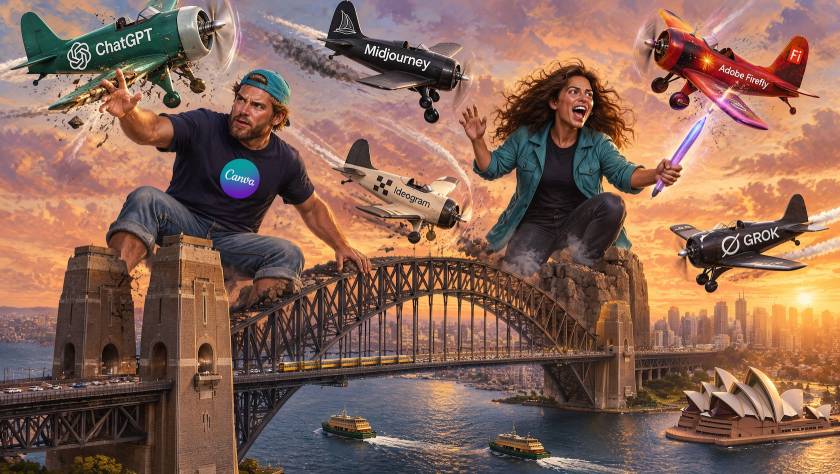
Now the company’s entering a crowded battlefield hoping that its home-grown AI is a better, cheaper alternative to the frontier models by tech giants such as OpenAI’s ChatGPT, Google’s Nano Banana and Adobe Firefly.
Building its own model gives the business greater control over costs, although development and computing remain serious expenses. Canva is also developing faster, cheaper Craft variants and plans connections that let AI assistants use the model.
Get the best of Startup Daily straight to your inbox
Want to know the latest in startup news? Subscribe to our daily news and analysis coverage on what’s happening to ANZ startups, investors and the broader ecosystem. And best of all, it’s FREE!
By continuing, you agree to our Terms & Conditions and Privacy Policy.
Two upcoming variants, Craft-fast and Craft-ultrafast, are designed to deliver high-quality image generation at a fraction of the cost of leading frontier models.
The company said “Craft produces photorealistic images that bring together the fine detail, depth, and soft transitions of real-world imagery”.
And of course it also has pioneering local image generator Leonardo.ai which it acquired in 2024. But that became something of an albatross this year due to a ‘seat cycling’ scam stealing AI tokens from free accounts. Fraudsters exploited linkages between Canva and Leonardo.ai to acquire free tokens and resell them.
Meanwhile, Canva’s original advantage, making design accessible to non-designers, is increasingly a standard AI capability, and the competitive risk is straightforward: if someone can produce an ad or social post via chatbots they already use, who needs another design subscription?
And having around 250 million monthly users means Canva has a substantial customer base to defend, making Craft a defensive move as much as a product launch. The test now is whether that AI usage translates into retained subscriptions and profitable growth.