
Former Tamil Nadu BJP chief K Annamalai has warned the Centre on MDR charges on UPI and has urged that small retailers be shielded from the proposed levy. Annamalai made the appeal in Udupi, a BJP stronghold in Karnataka where he once served as an IPS officer.
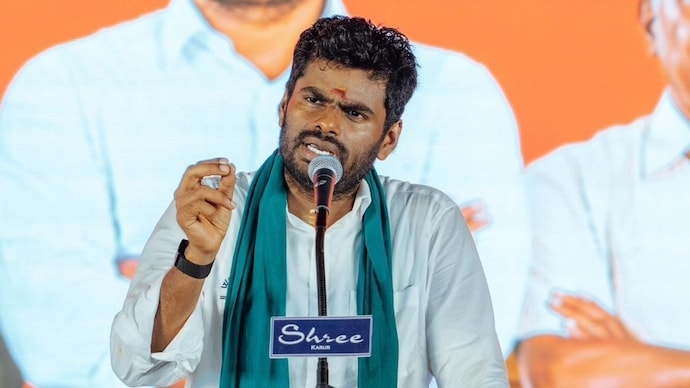
K Annamalai, former Tamil Nadu BJP President, began his career as Assistant Superintendent of Police in Udupi's Karkala in 2013. (Image: X/@annamalai_k)
Karnataka's Udupi district once knew K Annamalai as its own "Singham" police officer for his tough approach to crime. More than a decade later, the former IPS officer has returned to the coastal Karnataka town not with an answer to crime but questioning a policy of the BJP-led Union government. Annamalai, who once led the BJP in Tamil Nadu, has started a "political movement" and named it We The Leaders.
At a convention of retailers in Udupi on Saturday (October 24), Annamalai urged the Centre to exempt small and retail traders from Merchant Discount Rate (MDR) charges on Unified Payments Interface (UPI) transactions. He argued that protecting the livelihoods of local businesses was more important than collecting revenue from a digital payment system that has grown on the promise of free transactions.
"UPI is like a hen that lays a golden egg every day. If you kill it expecting to get a hundred eggs at once, you will end up with nothing," Annamalai said, warning that introducing charges could undermine the very ecosystem that has made digital payments a part of everyday life in India.
The government has maintained that customers will not be impacted and that around 96% of merchant transactions will remain unaffected. Small merchants covered by the zero-MDR provisions will continue to be exempt.
The former Tamil Nadu BJP chief's remarks, delivered at the State-level retailers' convention of the All India Mobile Retailers Association (AIMRA) at Town Hall in Udupi's Ajjarkad, carry significance beyond the debate over digital payments.
Udupi is part of coastal Karnataka, a region where the BJP has maintained a strong electoral presence for years. Annamalai's intervention here places his criticism of the Centre in a politically sensitive setting, where he is a familiar figure with a legacy from his police service and the days with the saffron camp.
The UPI MDR attack is the latest in the series of criticisms by Annamalai against the BJP-led Centre.
ANNAMALAI: THE UDUPI 'SINGHAM', NOW A BJP CRITIC
Annamalai's connection with Udupi dates back to September 2013, when he began his police career as Assistant Superintendent of Police in Karkala. He took charge as Superintendent of Police of Udupi district on January 1, 2015, and served until his transfer to Chikkamagaluru in July 2016. His tenure in the district, spanning nearly three years across the two postings, earned him a reputation for firm policing and public engagement.
The former officer later served as SP of Chikkamagaluru and Deputy Commissioner of Police in Bengaluru South before resigning from the IPS in 2019. He joined the BJP on August 25, 2020, and became the party's Tamil Nadu president in July 2021. He remained at the helm until April 2025, when Nainar Nagenthran succeeded him.
During his political stint, Annamalai sought to expand the BJP's footprint in Tamil Nadu, a state where the party has struggled to challenge the dominance of the Dravidian parties. Since stepping away from the BJP leadership, he has increasingly questioned decisions and positions associated with the party and the Union government.
The series of events makes Annamalai's intervention in Udupi notable. The BJP has long enjoyed a strong presence in the coastal belt of Karnataka, with party candidates repeatedly winning Assembly and parliamentary elections in Udupi and neighbouring Dakshina Kannada districts. Annamalai, meanwhile, remains associated with his earlier police career in the region, giving his remarks a local resonance that goes beyond his current political position.
WHY ANNAMALAI IS OPPOSING THE CENTRE'S UPI CHARGES
At the heart of Annamalai's argument is the question of whether the government should prioritise the financial sustainability of the digital payment ecosystem or protect small traders from additional costs.
The Centre introduced a revised MDR framework in September 2026, ending the blanket zero-MDR regime for specified merchant transactions. Under the framework, a 0.4% MDR applies to eligible merchant payments above Rs 2,000, subject to prescribed caps and exemptions. The government has insisted that neither customers nor small merchants will be impacted due to the MDR.
The National Payments Corporation of India (NPCI) had on October 13 deferred the introduction of the MDR until after Diwali this year.
Annamalai wants the government to reconsider the policy, particularly its implications for small retailers. Speaking at the Udupi interaction, he said the estimated Rs 15,000 crore associated with the charges was relatively insignificant compared with the Centre's annual budget of around Rs 50 lakh crore.
"The government says that money is spent from the public exchequer to facilitate UPI transactions. But why can't the government consider this an investment in improving the country's economy?" he asked.
He argued that UPI's growth had been driven substantially by the decision to make transactions free in 2020. Its widespread acceptance, including among rural users and people unfamiliar with English, demonstrated how accessible digital payments could transform everyday commerce.
Annamalai also pointed to the concentration of transaction value among a relatively small proportion of merchants. "Even if a limited number of transactions attracted charges the sums involved could be substantial for businesses operating on narrow margins," he said.
The founder and chief of We The Leaders, urged the Union Finance and Commerce ministries to work together to provide relief to small traders, arguing that the government should consider subsidising the payment infrastructure rather than placing additional costs on merchants.
ANNAMALAI'S LIVELIHOODS, LOCAL BUSINESSES AND 'MAKE FOR INDIA' ARGUMENTS
Annamalai's criticism extended beyond UPI charges to the larger question of how government policies affect India's domestic retail economy.
He said local retailers generated employment, kept money circulating within their communities and contributed to regional economic growth. According to Annamalai, the contrast in profits earned by large corporations could flow abroad, limiting the benefits for local economies.
Warning against excessive dependence on foreign companies, the former Tamil Nadu BJP chief called for a stronger domestic manufacturing ecosystem. Referring to the Centre's Make in India initiative, Annamalai said the country should now focus on 'Make for India', with greater emphasis on domestic production and meeting the needs of Indian consumers.
He urged local MPs to take up the concerns of retailers in Parliament and press the Finance Ministry to ensure that multinational companies operated within a framework that did not disadvantage smaller domestic businesses.
ANNAMALAI HAD A MESSAGE ABOUT KARNATAKA'S POLITICS TOO
Annamalai also used the Udupi platform to make a broader political point about governance in Karnataka, arguing that electoral competition should be driven by development rather than promises of freebies or political publicity.
"Karnataka should not remain a state dependent solely on Bengaluru, but rather achieve development across all its regions," he said, calling for more balanced growth across the state.
The former IPS officer argued that political parties should compete on the basis of their governments' achievements, with development projects and improvements in public services becoming the benchmarks for political rivalry. He also criticised the "poster culture", saying political publicity should focus on communicating a government's contributions rather than merely announcing the visits of chief ministers and other leaders.
For Annamalai, the concerns of Udupi's retailers therefore form part of a wider argument about governance, economic priorities and the role of local businesses. His return to a region where he once served as a police officer has provided a platform to raise those questions directly.
- Ends