


Craig is a reporter for Pocket-lint based in Toronto. He earned a diploma in journalism from Seneca Polytechnic and holds a Media Foundations certificate from Humber College. Craig previously interned and wrote for MobileSyrup, a Canadian tech publication. He enjoys reading and writing about consumer technology, especially phones, tablets, and PCs.
Sign in to your Pocket-lint account
Apple has been on a roll with new product announcements lately, unveiling its new HomeView smart home hub, HomePod mini 2, and Apple TV 4K earlier this month. Back in September, the company also announced the iPhone 18 Pro and its first foldable iPhone, the iPhone Duo, which launched last week.
Now, it's finally the iPad's turn in the spotlight. Ahead of its big "Pro and tell" event on October 28, Apple has unveiled its new iPad mini, calling it the device's "biggest update ever." It features a larger OLED display, a faster A20 Pro chip, and a thinner, lighter design.
But all those upgrades come at a cost. The new iPad mini starts at $700, a $100 increase over the previous model. That puts it just $50 below the iPad Air (M4), which starts at $750.
With just $50 separating the two, which one is worth buying? The iPad mini or the iPad Air? Let's take a closer look at the key differences between Apple's two tablets, including their specs, pricing, availability, design, and more.
Price, specs, and availability
-
Apple iPad mini (A20 Pro) Apple iPad Air (M4) Brand Apple Apple Storage 128GB, 256GB, 512GB 128GB, 256GB, 512GB, 1TB CPU A20 Pro M4 Operating System iPadOS 27 iPadOS 26 Ports USB-C USB-C Display type 8.5-inch Super Retina XDR display (OLED) 11-inch Liquid Retina display, 13-inch 11-inch Liquid Retina display Price $700 $750 Colors Midnight, Starlight Blue, Purple, Starlight, Space Grey Front Camera Landscape 12-megapixel Center Stage camera, ƒ/2.0 aperture Landscape 12-megapixel Center Stage camera, ƒ/2.0 aperture Rear Camera 12-megapixel Wide camera, ƒ/1.8 aperture 12-megapixel Wide camera, ƒ/1.8 aperture
The iPad Air (M4) is available now, having launched earlier this year in March. It originally started at $600 for the 11-inch, 128GB model, but a $150 price hike in June, due to the ongoing global memory shortage, raised the starting price to $750. It's available in three additional storage options: 256GB, 512GB, and 1TB. You can choose from four colors, Purple, Blue, Starlight, and Space Gray, and two screen sizes: 11-inch and 13-inch.
Apple's new iPad mini will be available for pre-order on October 28, ahead of its official launch on November 6. Powered by the A20 Pro chip, it starts at $700 for the 128GB Wi-Fi model, with two additional storage options: 256GB and 512GB. Both variants also offer nano-texture glass for the 8.5-inch OLED display, which helps reduce glare. As for colors, the iPad mini comes in two options: Midnight and Starlight.
The last-gen iPad mini (A17 Pro), released in 2024, originally started at $500 but also received a price hike earlier this year, jumping $100 to $600. That means the new iPad mini's $700 starting price is $100 more than its predecessor's current price and $200 more than the last-gen model's launch price from two years ago.
Display
The iPad mini has the OLED advantage

The biggest difference between the new iPad mini and the iPad Air (M4) is their displays. The iPad mini has a much smaller 8.5-inch screen, while the iPad Air comes with an 11-inch display, with the option to go even bigger with the 13-inch model.
However, despite its smaller size, the iPad mini has one major advantage: its Super Retina XDR display, which uses an OLED panel for the first time on an iPad mini. The iPad Air, by contrast, uses a Liquid Retina LCD display. This gives the iPad mini the edge in picture quality, with more vivid colors, deeper blacks, richer contrast, and better overall color accuracy, thanks to OLED's advantages over LCD.
So, if you don't mind a smaller screen, the iPad mini's OLED display is a major benefit. But if you'd rather have a larger canvas, the iPad Air's display still looks good; it just doesn't offer the same benefits as OLED.
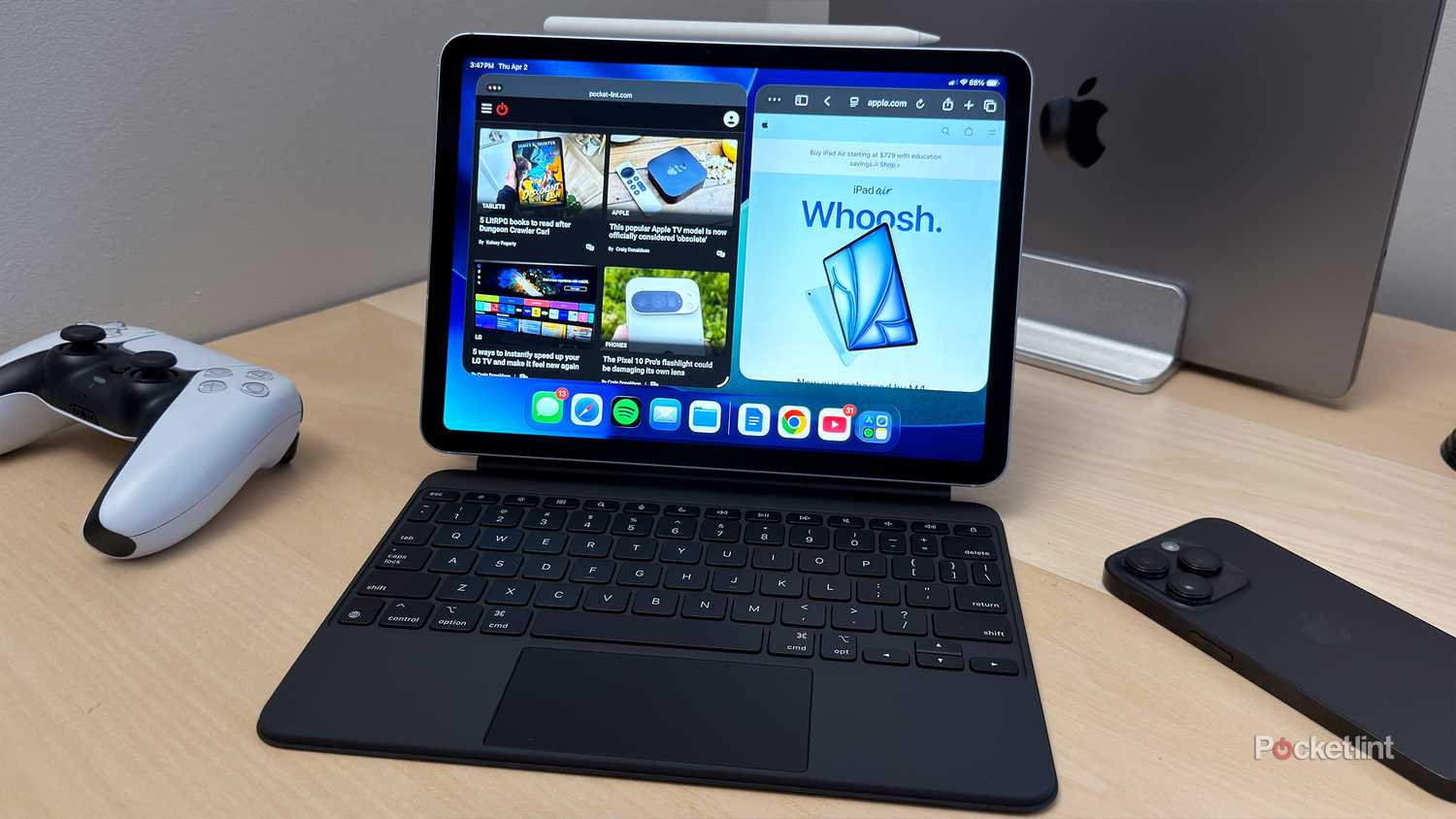
As for the specs, the iPad mini's 8.5-inch OLED display has a resolution of 2316 x 1512 pixels at 326 ppi (pixels per inch). The 11-inch iPad Air, meanwhile, has a resolution of 2360 x 1640 pixels at 264 ppi, while the 13-inch model bumps that up to 2732 x 2048 pixels.
The iPad mini also has the edge in brightness, reaching up to 600 nits for SDR content and 1,200 nits for HDR. By comparison, the 11-inch iPad Air tops out at 500 nits, while the 13-inch model reaches 600 nits.
Unfortunately, neither the iPad mini nor the iPad Air supports 120Hz ProMotion, so both are limited to 60Hz.
Design and cameras
The new iPad mini is more portable than ever

The new iPad mini and iPad Air (M4) share a similar overall design philosophy. Both have thin, lightweight aluminum bodies with flat edges and rounded corners. When it comes to cameras, they also share the same setup: a 12-megapixel landscape-oriented Center Stage front camera that supports 1080p video, along with a 12-megapixel rear camera capable of recording 4K video.
The new iPad mini, however, does have a couple of design improvements over its predecessor. Most notably, it's the thinnest and lightest iPad mini yet, measuring just 5.4 mm thick and weighing 0.56 pounds (255 grams). For comparison, the previous-gen iPad mini measured 6.3 mm thick and weighed 0.65 pounds (293 grams). In other words, Apple has shaved almost a full millimeter off its thickness while trimming some weight, too. Together, these changes make the iPad mini even more portable than before.

Compared to the 11-inch iPad Air (M4), the difference is even more noticeable. The iPad Air measures 6.1 mm thick, making it about 0.7 mm thicker than the new iPad mini. It also weighs 1.02 pounds (464 grams), nearly twice as much as the iPad mini. So, if portability is your priority, the iPad mini has the clear advantage.
Looking at some of the smaller details, both the iPad mini and iPad Air have a USB-C port and support the Apple Pencil and Apple Pencil Pro. The iPad Air also supports Apple's Magic Keyboard, but given the iPad mini's size, it doesn't have a Magic Keyboard of its own and only supports Bluetooth keyboards.
Hardware
Both are powerful tablets

Under the hood, the new iPad mini and iPad Air have some pretty substantial differences, particularly when it comes to their chipsets.
The new iPad mini runs on Apple's A20 Pro chip, the same processor used in the iPhone 18 Pro. The base model features a five-core CPU with two super cores and three efficiency cores, along with a 16-core Neural Engine. Interestingly, the 512GB model comes with a slightly more powerful version of the A20 Pro, featuring a six-core CPU with two super cores and four efficiency cores, as well as a dual 16-core Neural Engine.
The iPad Air, on the other hand, is equipped with Apple's M4 chip, which features an eight-core CPU with three performance cores and five efficiency cores, alongside a 16-core Neural Engine.
Both chipsets pack plenty of power, but benchmarks give the A20 Pro an edge in single-core performance, while the iPad Air's M4 chip comes out only slightly ahead in multi-core performance. So, while the iPad mini has the more powerful chip overall, the M4 in the iPad Air is no slouch.
As for battery life, there's little to separate the two. Apple claims both tablets can last up to 10 hours when watching videos or surfing the web. However, the iPad mini has one advantage: fast charging. With a 35W charger or higher, Apple says it can reach a 50 percent charge in just 30 minutes.
Verdict: Is the new iPad mini worth it over the iPad Air?
Both have clear advantages

With only a $50 gap between the new iPad mini and iPad Air, there's a lot to consider if you're looking to pick up a new iPad in this price range. Ultimately, though, the decision boils down to how you plan to use it. If you're constantly on the go and want a powerful tablet that's light and easy to throw into your backpack, the iPad mini's smaller form factor really shines.
The iPad mini's OLED display is also a major upgrade, and if you're primarily going to use your iPad for entertainment, whether that's gaming or streaming, it has the advantage there, too.

Apple iPad mini (A20 Pro)
- Apple
- 128GB, 256GB, 512GB
- A20 Pro
- iPadOS 27
On the flip side, if you don't mind a larger tablet and value the extra screen real estate, the iPad Air might be the better option. Its larger display makes it easier to get work done, and it supports Apple's Magic Keyboard if you want to pair it with one down the road.
Performance-wise, the two aren't that far apart, and both the A20 Pro and M4 chips offer more than enough power for most iPad tasks.

Apple iPad Air (M4)
- Apple
- 128GB, 256GB, 512GB, 1TB
- M4
- iPadOS 26
Ultimately, if portability and the best possible screen quality are your priorities, the iPad mini is likely the better choice. However, if you don't mind a slightly larger tablet and plan to use your iPad for work, the Air might be the way to go. That extra screen real estate can make a real difference, especially when multitasking.
The iPad Air (M4) is already available, starting at $750 for the 11-inch model. Meanwhile, the new iPad mini is available for pre-order on October 28 and launches on November 6.