Business Korea · সাধারণ
IAEA Conference Opens in South Korea
২৭/১০/২০২৬
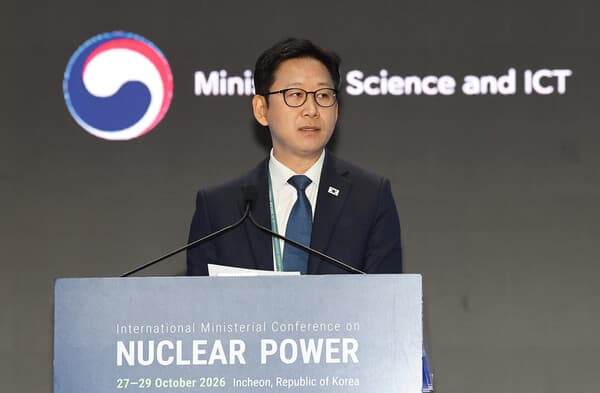
Baegyeonghun, Deputy Prime Minister and Minister of Science and ICT, delivers opening remarks at the opening ceremony of the International Atomic Energy Agency (IAEA) Nuclear Energy Ministerial Conference held at Songdo Convensia in Yeonsu District, Incheon, on Oct. 27. (Provided by Yonhap News Agency)
More than 800 nuclear experts and government officials from 60 countries gathered in Songdo, Incheon, to discuss future energy policy. The International Atomic Energy Agency (IAEA) Nuclear Energy Ministerial Conference opened at Songdo Convensia in Incheon on Oct. 27, creating a venue for high-level dialogue on the peaceful uses of nuclear energy and technical cooperation.
The conference, held in South Korea for the first time, is one of the IAEA’s flagship policy meetings and takes place every four years. According to the Ministry of Science and ICT, government representatives from 60 countries, eight international organizations, and officials from 85 domestic and overseas companies are attending to review the role of nuclear energy in achieving carbon neutrality and energy security.
Baegyeonghun, Deputy Prime Minister and Minister of Science and ICT, who is serving as chair, presented the safe development and demonstration of small modular reactors, or SMRs, as a key policy direction for South Korea in his opening remarks. He said the government plans to advance SMR technology in line with changing demand, including power supply for artificial intelligence data centers, industrial heat supply, and ship propulsion, while improving relevant laws and systems to support commercialization.
He also expressed South Korea’s determination to link the country’s manufacturing and construction capabilities with global nuclear demand and make a leap toward becoming a global production hub. Baegyeonghun stressed that, based on an independent regulatory system and IAEA international review recommendations, the country would raise safety standards while expanding international cooperation across the entire nuclear energy life cycle, from operation to decommissioning and waste management.
IAEA Director General Rafael Grossi delivered a video message instead because of a schedule to brief the United Nations Security Council. Grossi said support for nuclear energy from governments and financial institutions is expanding, and projected that under an optimistic scenario, nuclear power generation capacity would exceed 1000GW by 2050.
He said actual expansion in installed capacity would depend on project execution on the ground. To that end, he proposed key tasks including providing the resources needed for nuclear programs, maintaining capacity through long-term operation, training personnel and investing in supply chains, and communicating with local communities, while urging active use of the IAEA.
On the day before the conference opened, the U.S. Embassy in Seoul and participants held the Korea-U.S. Nuclear Industry Dialogue, where practical cooperation measures between companies from the two countries were discussed. On the U.S. side, major SMR companies including TerraPower and NuScale Power took part, while the South Korean side included key companies in manufacturing and construction such as Korea Hydro & Nuclear Power Co., Doosan Enerbility, and Hyundai Engineering & Construction.
The government said it would concentrate public-private capabilities through the Special Act on SMRs and seven seed projects. The conference will continue with high-level sessions and expert sessions discussing funding and ways to build social trust, before drawing up cooperation measures to improve the safety and efficiency of nuclear energy.
মূল প্রতিবেদনে যান ↗