In the passing away of Bengal master Jogen Chowdhury, India loses a figurative master who was more than a modernist, more than a guru of immense proportions, a translator of an island of narratives as well as a creator of surreal signatures, all centred on the expression and aura of human figures. The creator of idyllic still life studies, the painter of characters of pure caricature and satire sublime, each work of his was a litany of sarcasm, romance and rhetoric picked up from the annals of real life experiences, theatre, cinema and literature.
Wrinkles and Skull
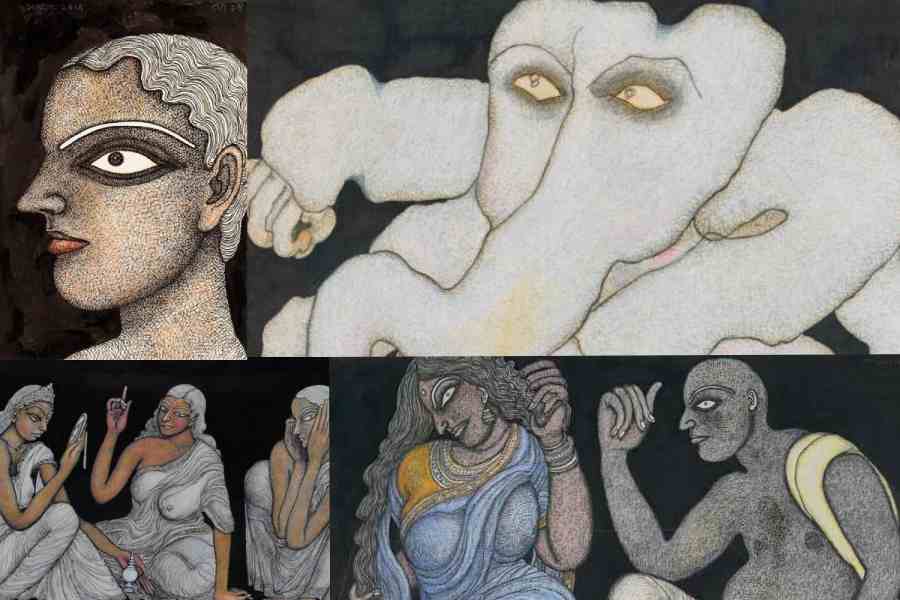
Whether in colour or monochrome, his love for the flowing line created its own ambience. The human figure in Jogenda’s hands was born of a hundred wrinkles, the heads and contorted distortions all filled with the monochromatic cross-hatching textures that he said he picked up when he was in Paris studying European Masters. But it was his featherweight touches of softened islands of expressionist elegance that never failed to fascinate.
The lady with the skull was an eternal study in compositional clarity and human narratives. In a voyeuristic scene, the woman stood undraped with her bulbous breasts; she does not face the viewer. Her profile showed her fine features, while it is the skull in her hands, threaded into its own solitude, that caught your gaze. The skull and her hair taut as a bun, along with her vastra that hangs limply from her torso, made for an enchanted scene. It was clear that Jogen had, over the years, been able to develop his own unique approach in the treatment of the figures in his canvases as well as sheets of paper. He spoke about how he drew inspiration from folk art sources, including Kalighat and Battala woodcuts.
Oldest tools and Picasso
His series of works on paper presented him as a skilled draughtsman who knew his anatomy as well as the tropical environs of Santiniketan that never failed to touch a chord. Grey Vase and In Search of a Dream were epic works. Unforgettable were his early works. Memories and dreams and desires were his elixir. His ability to balance the facile and the decorative, with tender distortions, all had their own rules of construction. For Jogenda torsos, limbs and fingers all had to follow a fluid and natural aura of curious contours that followed their own orbit of fantasy.
In 2007, when I spent three days in Santiniketan penning his catalogue essay for Abahoman he said: “The French Masters taught me observation and the need for knowing differences in expression. The crackled textures I saw even among printmakers, as well as charcoal studies. The art of knowing how to manifest human flesh in different shades, I learned from studying Picasso. I followed Picasso deeply and found that he was creating the human form by breaking so many hard and fast rules. I realised that in the human or the object, whatever we make, there has to be a certain identity of thought that flows from within. It cannot be someone else’s. Over time I also realised that it is the vibration in my body that came out as the contour. So this vibration became important in my language, and it became the composition as well as the conversation.”
Drama and dynamism
If India had a master who could draw endlessly on paper, it was Jogen. His Santiniketan environs always featured in his works. Drawing for him was an exercise of both absorption and fluid flow. “A drawing is about being able to cultivate the body and spirit... it is not only about a pretty picture. Working with the basic nature of a person is very much a characteristic of my work; I draw upon natural elements of people’s faces for inspiration,” he told me once.
The most vital component for Jogenda was his interpretation of the function of lines. His contours, meandering and coalescing, lent an aura of drama and dynamism to his works. Whether he portrayed two or three separate figures, using powerful, fluid lines and the pastel shades of cross-hatching with an accuracy and depth, it was the undulating contours of the figurative bodies as well as the profile of the faces he created that rendered a sense of rhythmic movement that was rare and resonant, if not animated.
Jogen’s Laxmi
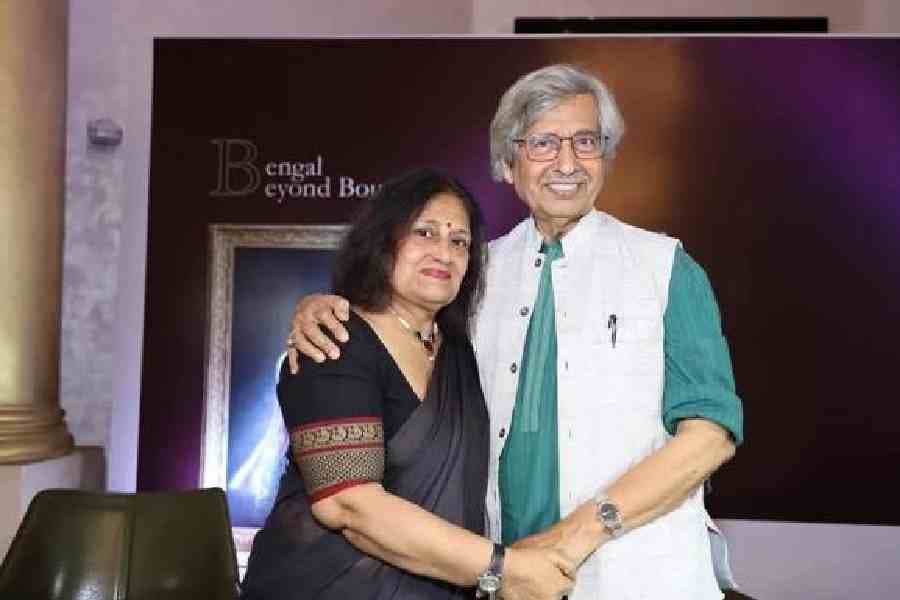
In the year 2023, when Jogenda requested me to curate Bengal Beyond Boundaries, I requested Rohit Gandhi and Rahul Khanna of Palette Art Gallery to loan me Jogenda’s Laxmi. Here was a drawing that stood as testimony to time. Between ritual and reality, this Laxmi demonstrates Jogenda’s referencing of local traditions and popular visual culture to comment on the complexities and contradictions of Bengali middle-class society. This drawing in fine lines is a perfect example of how he combines fantasy with reality to produce figures that are characters that belong to his own choreography.
In other works, his humans were sometimes grotesque but full of feminine characteristics and qualities — like the long hair, the almond-shaped eyes, the pencil-thin lips and sinuous curves. “The sheer range of characters, temperaments and manners that I observed in the people that I saw around myself fascinated me. I portrayed them from an essentially personal perspective. In my characterisation of these people, I crossed the bounds of realistic representation and let imagination take over,” he affirmed.
Even in his monochromatic wonders, we could see characteristics that exemplify how Jogenda controlled fluid contours of the faces he created and tightened them with cross-hatching and then heightened with touches of colour the distinct emotion of expression and individuality in his human studies. The absence of a background allowed us to focus purely on the subject, evoking a sense of human drama with a sense of solitude.
Master of Cross-hatched lines
Jogenda wove into his figures a spidery web of dense cross-hatched lines, which he fleshed out with hints of soft dry pastel. His words about his early days gave us an idea of how his past shaped his art. “We did not have electricity in our house and I had to read by the hurricane lantern. I had to fall back on black and white because we did not have enough light...We had a miserable state of living when we came to Calcutta as refugees… The crisscrossing lines, too, may be carrying traces of the environmental and mental complications of that time,” he explained.
The intricate crosshatching that he wove into his human figures and faces added an element of three-dimensional hues. The signature of the organic, as well as the troubles and trials of life too, came to the fore. With age, these works tell us that the most important foundation for art is knowing that lines must do all the talking.
Like a folk artist who found his own pathway, Jogen revelled in using a pen or pastel or even pencil directly on paper. His lines meandered magically across the white/cream surface of paper sheets, and his human forms took shape as if of their own volition, wanting to narrate their own tales in the figment of his own fiction. His passing away on Sunday on Pablo Picasso’s 145th birthday, brings back his words in 2007, quoting Picasso: “Everything you can imagine is real.”
Pictures courtesy: Aakrit Art Gallery and Jogen Chowdhury studio
Uma Nair is a Delhi-based art critic and curator