
A half-dozen or so volunteers count down in unison then shout “go” as a squad of mostly male 20- to 50- somethings hoist a big metal box from the bed of a pickup. The cheers of older onlookers mix with sounds of exertion as the cadre lowers the 300-pound bear box onto a section of gravel forest road.
“Aw, what’re you kids making such a fuss over?” chides former Roanoke Appalachian Trail Club (RATC) board member and shelter supervisor Homer Witcher. The 84-year-old wears a Los Angeles Dodgers cap over a handlebar mustache, vintage club t-shirt, work khakis, and hiking boots. “A blind man might mistake that thing for an elephant,” he teases.
Homer’s 21-year-old grandson, Brenin, fires a salute.
“What, you’re going to take that from a 111-pound slacker?” says Homer’s son, Bennett Witcher, 32. He winks at his father and smiles. The joke alludes to dangerous weight loss Homer suffered on a spring NOBO thru-hike attempt on the Appalachian Trail with his wife, Therese. The two had to quit and have only been home for a few weeks.
The banter only intensifies when Homer and Therese’s daughter, Taylor Peterson, 35, arrives with her two small children. By late afternoon, the team has used an AT side-trail to carry the bear box .3 miles and installed it at the Catawba Mountain Shelter.
“A lot of our family hangouts center around work hikes on the AT,” says Peterson. Homer and Therese have logged around 7,000 and 11,000 work-hours, respectively. Their children and grandchildren routinely pitch in.
For her and her brother, Bennett, the bond between trail and family was cemented early on. It stems, in large part, from a 2002 thru-hike they took with their parents. “A lot of people say thru-hiking the AT is transformative, and that’s exactly what it was for us,” says Bennett, who was 8 when the Witchers hit the trail. There was a distinct before and after that left a deep impression on their mutual and individual lives.
Origins of a Hiker Family
Homer and Therese discovered the Appalachian Trail early in their courtship. They shared a love of hiking and nature, but were oblivious to the iconic route. Then they encountered a sign on a walk in Shenandoah National Park in the early 80s.
“We were awestruck,” says Therese. The couple had walked countless miles on the AT without knowing it existed. The idea of a trail that was so long and had so much history seized their imaginations.
The two returned to their Roanoke-area home and dove into research. Books like Ronald M. Fisher’s The Appalachian Trail fanned their interest to an obsession. The reality of a 2,200-mile path dotted with hundreds of backcountry shelters and maintained by groups of regional volunteers felt radical. The Witchers wanted to experience that camaraderie firsthand. The desire led them to the RATC, where they started attending regular work hikes around 1983.
“The volunteer structure that supported the AT seemed so different from what you’d expect for a recreational asset of that size,” says Homer, who then worked as an administrator for a regional hospital group. He loved the way hikers, naturalists, and outdoorsmen banded together to set the stage for trekkers to have the best trail experiences possible. Pitching in to clear fallen trees, build stairs, and paint shelters helped Homer and Therese forge friendships. It also helped Homer balance the demands of an extremely stressful job. Two of his children from a prior marriage often tagged along, which created a family bond around the AT.
“We went from zero to all in pretty much immediately,” says Therese. “It felt like we’d found both a calling and a home away from home.”
When the Witchers weren’t working on the AT, they walked it. Section hikes became a staple of their weekends and vacation time. The couple also started driving hiker shuttles. By the time Taylor and Bennett were born, Homer and Therese had been working on and hiking the AT for a decade.
“We camped with them as babies and would often bring them on work hikes in carrier packs,” says Therese. By the close of 1999, both kids had tagged along for a few hundred work-hours and participated in a sizable chunk of the Witcher’s ongoing 1,400-mile AT section hike. Therese floated the notion of a family thru-hike after Taylor’s 8th birthday.
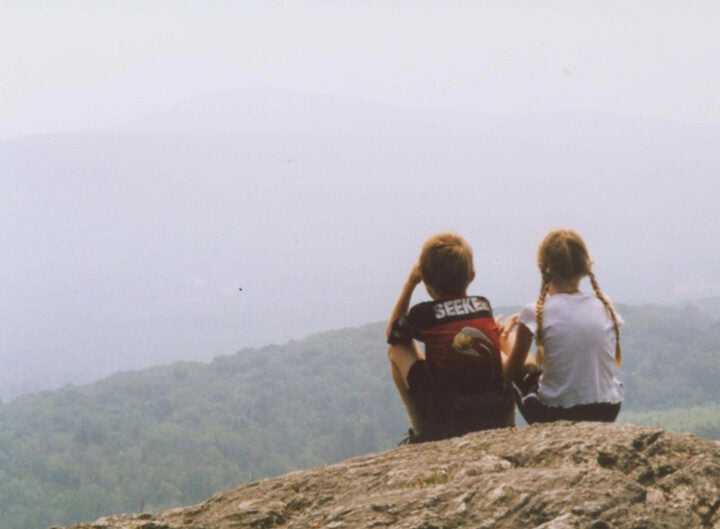
“We’d completed some pretty long and tough sections at that point, and both kids were extremely at home in the woods,” says Therese. Taylor could carry a 10-pound pack on her own and tackle double-digit days with relative ease. That made her feel confident the family could spend the next few years preparing and that Bennett, then 5, could do the same by the time he turned 8. More importantly, the children seemed to love the family adventures—even when the weather turned nasty.
“We always had so much fun, so we thought it would be a dream come true to hike the full AT together,” says Homer. Spending extended periods of family time on the trail felt so natural, it was easy to forget that most moms and dads considered the activity mildly insane.
The siblings responded with glee when their parents proposed a 2002 thru-hike. Homer and Therese went to lengths to explain what the trip would entail and ensure the children were fully onboard. They wanted the kids to understand they’d miss six months of school and be away from their friends. While starting was a commitment, they said, if anyone stopped having fun, they could quit and go home at any time.
“It was very much a conversation,” says Taylor. “Mom and Dad were adamant about making sure we understood we had a sense of agency and that our opinions mattered.”
For her and Bennett, the pros outweighed the cons. And the countdown began.
The Notorious Walking Witchers
Carving out time for the trip demanded considerable maneuvers. Therese convinced her husband, then 60, to take early retirement. She, meanwhile, took a leave of absence from her job as a medical technologist.
“It required some convincing, but my wife insisted that the stress was going to kill me sooner than later and that we could get along just fine without me working,” says Homer. Therese framed the trek as the opening chapter to a second act centered around family and the AT. Homer imagined a life sans office drama, budget gripes, and equipment shortages and said, “Count me in.”
Then there were the children. Therese talked to principals and arranged for standardized tests to be taken in advance. She also filed a notice of intent to homeschool with the school system and submitted curriculum plans so Bennett and Taylor—then 8 and 11—could learn on the trail. Last came strategies for what would happen if one or both of the children decided to call it quits.
“By then, Homer and I were set on walking the whole thing,” says Therese. Her AT-loving step-kids were both in their twenties and offered to serve as temporary guardians if one or both of the children chose to quit. “We felt pretty confident that wouldn’t be necessary,” Therese says. “But we wanted to have a definite plan, just in case.”
Bennet has zero recollection of the drive to Springer Mountain that March. But the rocky, 729-foot plunge of Georgia’s Amicalola Falls stands out in his memory like a Fourth of July grand finale.
“To my 8-year-old self, that waterfall was monumental,” says Bennett. “I was so excited and in such a state of awe. I remember being flooded with this overwhelming sense that we were on a grand adventure.”
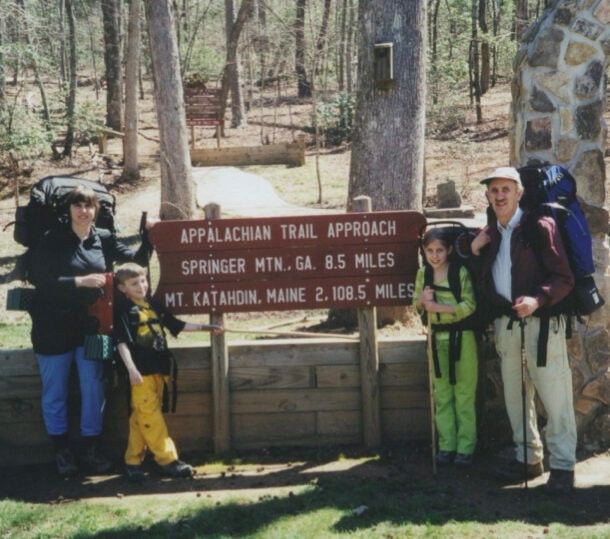
Still, it took the kids a week or two to adjust to what six months on-trail really meant. “There was this moment where it was like, ‘Oh, this is just what my life is now,’” says Taylor.
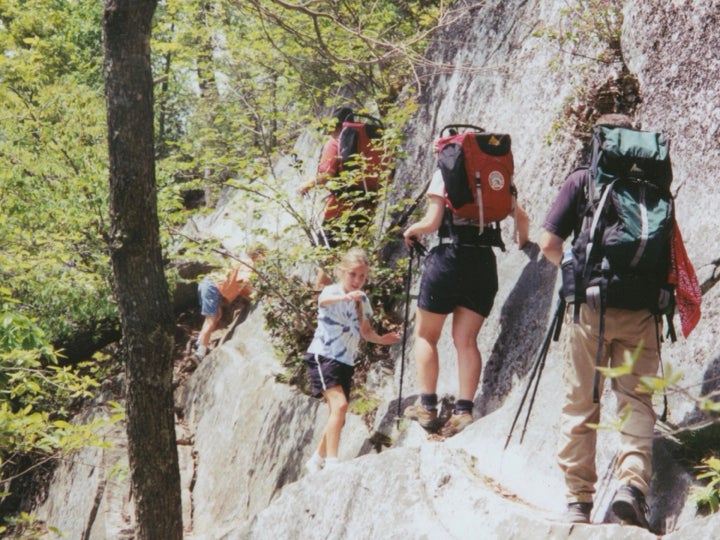
The family rose early and hiked a slow and steady 12 to 13 miles each day. The line between them and nature thinned to a sensory wash of birdsong, windblown leaves, rushing water, and silence. Cottonball clouds drifted through clear skies. Thunderstorms raged. Groves of fairytale rhododendron and dwarf oaks gave way to views that hilled into unfathomable distances. They set up camp, cooked dinner, pondered dancing flames or bright stars. Bedtime stories felt alive.
“One of the things I remember most was how Taylor and Therese developed a habit of singing together as we walked,” says Homer. “It was soft and magical, and, after a while, seemed almost like part of the forest. It filled my heart with so much joy—and that joy is what I feel when I think back on our hike.”
Another prominent feature of their walk was what came to be known as the “Witcher Wagon.” A full-family thru-hike was virtually unheard of at that time. Curious hikers would spot the quartet and fall in to ask questions. They’d often stick around.
“We shared miles with lots of different hikers along the way,” says Therese. When they stopped at their home in Daleville, Virginia, for instance, the troop was 16 strong. Part of that was Homer’s easy and avuncular sociability. Younger hikers—many of them lonely and missing home—seemed drawn to the sense of familial safety. But the kids were also a factor.
“They made so many friends it was wild,” says Homer. One trekker with painful shin splints jumped on the slow-moving wagon around Erwin, Tennessee, and continued for more than 500 miles. He’d babysit and parent the children’s imaginary twins, or play trail-inspired games of “I Spy.” Marriage was impending, however, and he left the trail at Shenandoah National Park. Tearful goodbyes ensued. “By then he was like a part of our family,” says Homer. They traded addresses and went on to exchange letters and Christmas cards for years.
“I look back on those friendships as an adult and it seems so incredible,” says Taylor. Nowadays, news and social media feeds can inspire distrust of everyone and everything. “But those experiences helped me feel safe and excited about meeting new people and getting to know who they are,” she says.
The parade of fellowship, adventure, and sights helped the miles go down easy. Ditto for a parental strategy of including the kids in decisions. They’d study maps, consider premade plans, and discuss potential tweaks as a family. Taylor and Bennett began to look ahead for trail towns like Damascus and advocate for extra miles here or there to create a near-o or zero day.
“We made a rule that we had to earn our days off in advance, not after the fact,” says Therese. The kids respected the imperative and sometimes traded big 18 and 20-mile days for opportunities to kick back in a nifty spot like Nantahala Outdoor Center.
“It was wonderful to see the kids take ownership of their experience like that,” says Therese. “We’d told them time and again to ‘hike your own hike,’ and they took that concept and ran with it.”
While good times dominated, there were some crucible moments. Therese’s came in Tennessee’s Bald Mountains. The family was making the long climb from Flint Gap to Lick Rock. It was cold and rainy. Her legs ached. She missed home and job worries stampeded through her brain like a crazed rhinoceros.
“Then I hear myself panicking, ‘What on earth was I thinking that we could do this?’” says Therese. The kids intervened immediately. “They said, ‘Mom, we’ve got this, we’ll do it together, one step at a time,’” Therese continues. A calm came over her; the bleak day looked suddenly beautiful. Her doubts vanished and did not come back.
Bennett’s moment came after a break near the end of Shenandoah National Park. The family took a zero to check in with friends and roadtrip to an amusement park. When it was time to get back on trail, he refused to leave the van.
“I realized how badly I missed my friends and that they were going on with their lives without me,” Bennett says. A Witcher Wagon member, Big Red, intervened. He palmed Bennett’s shoulder, smiled and said, “‘Come on, Rockslide, I’ll carry your pack.’ And just like that it was over. I heard my trail name and knew I wasn’t ready to quit.”
A Family Legacy
Both Bennett and Taylor say they had trouble readjusting to daily life after the thru-hike. Taylor entered a new middle school that was five or six times bigger than her elementary school. Classes had started and cliques formed. She felt distant from the other kids, uninterested in the TV shows, music, and he-said-she-said gossip that engrossed them. Even longtime friendships seemed off.
“I’d spent so much time around adults and experienced so much responsibility that I’d forgotten how to be a normal kid,” she says. “I didn’t know what American Idol was or the songs that were trending, so I felt really out of the loop and out of place.”
Bennett experienced similar difficulties. “I was fine with my old friends, because we shared interests and loved the outdoors,” he says. But making new pals was tough.
Luckily, the issues didn’t last long. Both children adjusted and came to see their amplified maturity as a boon. “I realized that being popular wasn’t something I wanted to spend my time and energy chasing,” says Taylor. She learned to follow her own inner voice, invest in personal interests, and seek out like-minded peers. Deeper relationships with her parents and brother, meanwhile, helped smooth transitions into teen years and early adulthood.
“We’d become extremely close and, as time passed, I realized how valuable and rare those relationships were among family members,” Taylor says. Spending so much time together on the trail taught the Witchers to share space and feel comfortable in silence. Helping one another persevere through an onslaught of mutual hardships opened the door to deeper honesty, trust, and communication.
“I can tell my brother and parents anything and know that I’ll have their support no matter what,” says Taylor. And Bennett feels the same. The family, they say, won that respect on the AT.
The positive impacts were not lost on Homer and Therese. They delight in anecdotes like a two-entry Christmas list filed by Bennett around age 11. “I asked him, ‘Isn’t there anything that you want?’” says Homer. “And he looks up at me and says, very matter of fact, ‘There are plenty of things that I want, but not much that I truly need. The trail taught me that.’”
Therese recalls Homer consoling Taylor after a high school breakup. He assured her this too would pass, that she’d make it to the other side and feel better. Taylor snapped out of the funk and replied, “I thru-hiked the AT, so I know I can handle this. But I’m going to pity myself for a few minutes before I do.”
The trek also reframed perceptions around trail work.
“I felt so much gratitude for the people and organizations that made it possible for us to have our once-in-a-lifetime experience,” says Homer. “I take deep pride that, in my own small way, I have and continue to play a role in creating that opportunity for others.”
But perhaps the biggest takeaway for Taylor and Bennett was a lifelong craving for and openness to adventure. Bennett has spent weeks at a time hiking on long trails in the Western U.S. and Swiss Alps. He’s logged countless miles on the AT and goes on frequent overnight paddling trips with Taylor. She walked a 1,000-mile stint after graduating college and had each of her two kids on-trail within months of birth. Plans for a summer 2027 hike of South Carolina’s Foothills Trail with her 3- and 6-year-olds are currently in development.
“For me, the AT has been such an incredible and generous teacher, and I want my children to have access to those lessons,” says Taylor. The trail tested her, as it tests all thru-hikers. But it helped her appreciate the rejuvenative beauty of nature, discover the value of family, and find out who she really was.
The post They Thru-Hiked the Appalachian Trail at Ages 8 and 11. Now They’re Giving Back to the Trail That Shaped Them. appeared first on Backpacker.