
Speaking at the Autumn Economic Forum 2026 on the morning of October 27, Truong Minh Huy Vu, Vice Chairman of Ho Chi Minh City People’s Committee, outlined the development direction for theVIFC-HCMC, highlighting the need to reform how financial resources are mobilised and allocated.
“The legal frameworks governing the IFC’s operations had now been completed. The VIFC-HCMC had also admitted its first 10 members, which operate in the form of holding companies,” Vu said
| Truong Minh Huy Vu, Vice Chairman of Ho Chi Minh City People’s Committee, outlined the development direction for VIFC-HCMC. Photo: Le Toan |
In the next phase, Vu said, the city will focus on two key areas: setting regulations for investment funds and fund management. “The procedures and regulations for admitting investment funds to Vietnam's IFC are expected to be issued in November,” Vu said.
Under the framework outlined by Vu, investment funds will be classified into three tiers, in line with models adopted by international financial centres such as Singapore, Dubai and Hong Kong. He said that the goal of the IFC was not merely to establish financial activities, but also to channel capital into the real economy.
“In the initial phase, the VIFC-HCMC will focus on mobilising and connecting financial resources to support development needs in the expanded Ho Chi Minh City and the southeastern region,” he said.
According to Vu, in the new development context, financial resources should be understood as more than just flows of money; they must also be linked to new operating methods, models and approaches. “Researching financial products and models attracting global interest is important for Vietnam as a whole, as well as for Ho Chi Minh City and the southeastern region in particular,” he added.
Following the expansion of its development area to include Binh Duong and Ba Ria-Vung Tau, Ho Chi Minh City has gained further advantages in industry, services, trade, the marine economy and logistics. Underground and airspace development also offer new opportunities for growth.
However, to fully realise this potential, the city needs appropriate mechanisms to mobilise resources, particularly financial models capable of connecting domestic and international capital flows with actual investment needs.
Marc Knapper, former US Ambassador to Vietnam, chairman of Knapper Global Advisors and a member of the advisory team for the VIFC-HCMC, said the city had a major opportunity to become one of Asia’s leading financial centres.
However, to realise this ambition, Vietnam needs to clearly define the role of its international financial centre within the country’s long-term economic development strategy.
“Autumn Economic Forum provides valuable opportunities to exchange views on Ho Chi Minh City’s development direction. I am so pleased at attending the event in the city, which is undergoing significant transformation and working towards its goal of becoming Vietnam’s international financial centre,” Knapper said.
He noted that technology and finance were evolving rapidly worldwide. Against this backdrop, the key question was not only how to develop fintech, but also how to build a financial system that was sound, secure and sustainable. Vietnam, he said, was well positioned to take part in this transformation.
Looking back at Vietnam’s development over the past four decades, Knapper said the country had made significant progress through international integration, manufacturing expansion and improvements in living standards. This process had lifted millions of people out of poverty, making Vietnam one of the standout development stories of its time.
“I am impressed by Ho Chi Minh City’s transformation every time he returned, from the energy of its younger generation and its spirit of innovation to the development of new infrastructure and the changing urban landscape. In his view, these changes demonstrated Vietnam’s considerable potential for further growth,” he said.
However, he added that the next phase of Vietnam’s development will bring different demands. Its goal of becoming a high-income country by 2045 will require the mobilisation of substantial financial resources to support economic development, the energy sector and the broader economic transition.
“Not every country managed to move beyond middle-income status and achieve a higher level of development. Against this backdrop, the VIFC-HCMC should be seen as more than a financial project. It should be regarded as part of Vietnam’s broader strategy to build the financial foundations for its future,” he added.
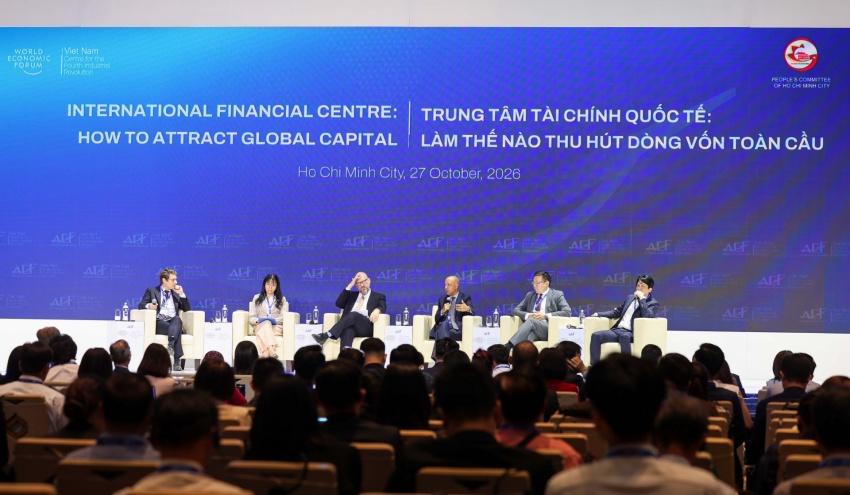 |
| Experts speak about the VIFC-HCMC. Photo: Le Toan |
 | Foundation focus stepped up for VIFC The Vietnam International Financial Centre is moving towards a new phase of development, with international standards, finance talent, green finance, and regulatory capacity emerging as key requirements for turning the country’s dual-city model into functioning markets. |
 | VIFC entrants need to build flexible structures as framework takes shape Vietnam’s International Financial Centre (VIFC) has begun rolling out its member registration portal and standardised procedures, providing investors with a clearer basis for exploring opportunities at the centre. Talking to VIR’s Vy Vy, Hoang Thuy Duong, partner and tax head at KPMG Vietnam & Cambodia, said that uncertainty over participation mechanisms, permitted activities, and future benefits remains a key concern for businesses. |
 | VIFC-HCMC membership offers access to Vietnam's capital market Membership of Vietnam's International Financial Centre in Ho Chi Minh City will open up significant opportunities for international financial institutions to access Vietnam's capital market, particularly in infrastructure and technology. |