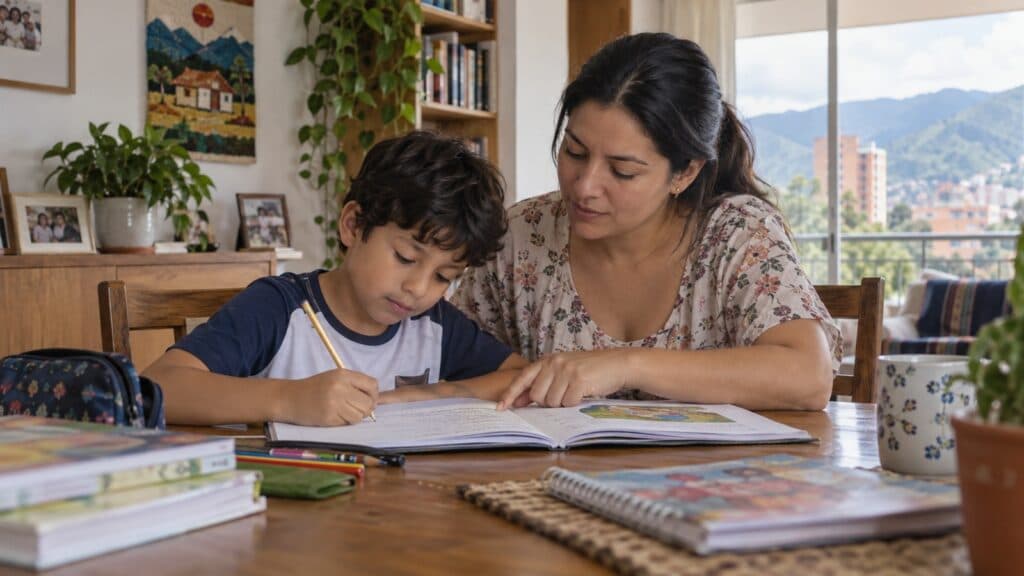
Homeschooling in Colombia remains difficult to measure because the country has no official figures or studies on how many children learn outside traditional schools.
In response to a June request from the Education Economics Laboratory at Pontificia Universidad Javeriana, the Ministry of Education said it keeps no national, regional or departmental statistics on homeschooling and has neither conducted nor commissioned a study on the practice.
The lack of data creates a blind spot for education policy. Without reliable figures, authorities cannot determine how many families choose homeschooling, why they choose it or how well children receive the education they need.
The issue is particularly significant because Colombia neither bans nor specifically regulates the practice, leaving families in what the laboratory describes as a legal gray area: parents can teach their children at home, but the education system does not formally recognize their studies.
Estimates from outside the government vary widely, making it difficult to establish the scale of homeschooling or compare its outcomes. Understanding the practice, the available Colombian figures and the approaches other countries take helps explain why the data gap matters.
What homeschooling means in Colombia
Homeschooling, or education at home, is a way of learning in which families or private tutors take responsibility for teaching outside a traditional school.
Parents can design the lessons themselves, hire teachers or enroll their children in a virtual school that provides classes and certificates. This explains why the term covers very different experiences.
Supporters value its flexible schedule, personalized learning and opportunities for greater independence, while critics worry about uneven quality, fewer opportunities to meet other children and difficulties getting diplomas recognized.
Research does not settle the debate because outcomes depend on parents’ education, family income, available time and social opportunities. As a result, Javeriana’s laboratory warns against presenting homeschooling as either a universal solution or an automatic risk.
— Buenas Noticias Uruguay (@BuenasUruguay) February 24, 2026
Top 9 de los países con mejores sistemas educativos de
Latinoamérica, según Education Rankings by Country 2025 de World Population Review.
Los sistemaseducativos mejor posicionados en Latinoamérica destacan por sus esfuerzos en calidad, acceso y escolaridad. pic.twitter.com/Ss5jACK0Sd
Colombia’s homeschooling numbers remain unclear
Colombia’s official enrollment system does not identify homeschoolers, so the laboratory developed its own estimate by counting students who reached sixth grade without a fifth-grade record from the previous year. It found about 178,000 children per year between 2021 and 2023, although it warns that identification errors may inflate the figure.
Outside the government, the Senate and a family-education network counted around 8,000 families in 2020, while a private provider estimated 30,000 in 2025. The figures therefore vary considerably.
Costs vary, too. One private school offers a homeschooling program for about US$536 a year, while another charges US$30 to US$33 a month for families in the lowest income brackets and up to US$135 for those in the highest. This raises concerns that access may depend on family income.
Children who leave homeschooling and want to rejoin formal school must take a validation exam. To address the data gap, the laboratory recommends a voluntary registry and the addition of questions about homeschooling to new surveys.
How other countries track homeschooling
Countries that allow homeschooling often combine educational freedom with some form of recordkeeping, highlighting what Colombia lacks.
The United States allows homeschooling in all 50 states, although rules vary by state. New Zealand requires registration and an annual declaration that the child receives an education equivalent to that provided at school, while Austria requires notification of authorities and annual assessments.
The United Kingdom does not require registration for most children, while Singapore requires prior approval and adherence to the national curriculum. Belgium requires periodic exams. In Latin America, Ecuador recognized homeschooling in 2013, while Peru requires prior registration. At the other extreme, Germany effectively bans homeschooling, and Portugal requires registration, exams and a degree held by the teaching parent.