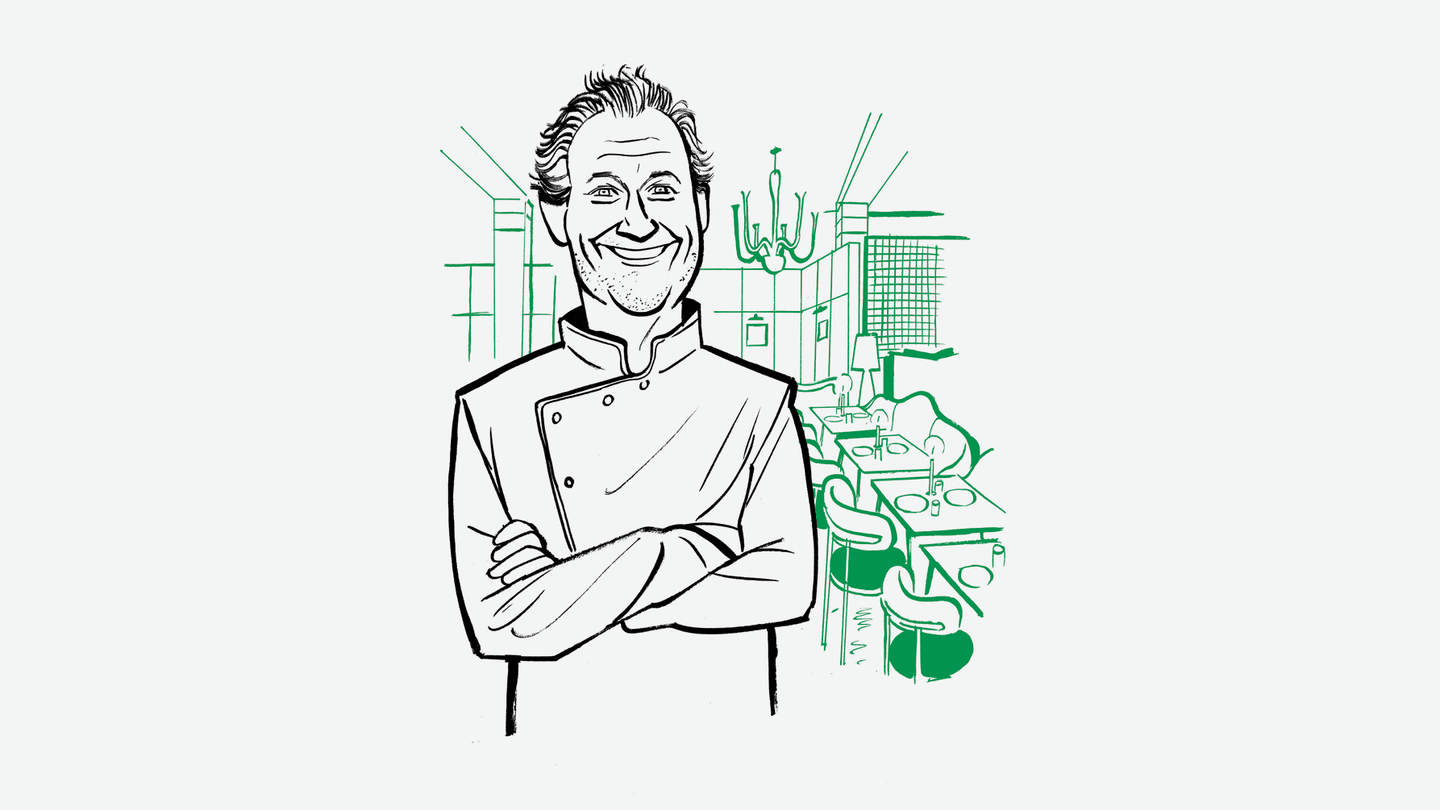
If you’ve watched a Hallmark movie, you’ve likely encountered the Robert Frost line “Home is the place where, when you have to go there, they have to take you in.” Which is a nice idea, unless you misheard and “home” is actually the new, seven-thousand-square-foot West Village restaurant Humm, where it’ll be nearly impossible to get a reservation for the foreseeable future.
But Humm is a decidedly homey, nostalgic place, with garnet, sage, and ochre velvet seats and a central hearth, which was not yet lit when Daniel Humm, the chef known for his decades at the helm of Eleven Madison Park—the standard-bearer for lavish tasting menus—surveyed the space a few weeks before its opening.
Humm said he believed that all his restaurants were “soulful” but noted that “everything on this menu is very recognizable—the roast chicken here is my mom’s roast chicken. She would stuff it under the skin with a bread-crumb-lemon crust, or on Christmas she made it with foie gras and truffles.”
In strolled the artist Francesco Clemente. He’d spent months painting the dining room’s ceiling with stars, trains, and clocks. In the eighties, Clemente had decorated the walls of the Palladium, a Steve Rubell night club. “I remember what my attitude was then, and it’s the same now,” Clemente said. “To make something that would feel as if it was there before the space, like something that maybe had been covered up over time.”
Humm’s father was an architect. “He introduced me to this idea of a Gesamtkunstwerk,” Humm said. “That’s what I think a restaurant is—the way Richard Wagner composed his sets.” When Humm was ten, his parents took him to the Musée de l’Orangerie, in Paris, and he wept in front of Monet’s water lilies. “I just didn’t know—was I sad or was I happy?” he recalled.
The artist Rashid Johnson, who’d also made works for the restaurant, showed up and wished Humm a happy (belated) birthday. Humm said that another painter pal, Rita Ackermann, had cooked goulash for him on the big day. Johnson’s birthday, meanwhile, was coming up—on it, he’d be cooking for Humm and his wife. “I make chili,” Johnson said. “Or I do, like, a pork-chop dish. It’s not like Daniel’s judging my fucking cooking.”
Johnson gazed at one of his own paintings, which hangs in the dark-red lounge and features outlines of houses. “I was making these works that were about the way we interrogate ‘home’ from a very simplistic position but also from a very complicated one, and how you think about that duality around neighborhood, collective housing, how we think about shelters, how we imagine ourselves inhabiting these spaces,” he said.
The trio settled in to draw on sheets of paper with circles printed on them, which Humm uses to come up with dishes.
“Is this the size of the plates?” Johnson asked.
“No, this is the idea of the plate,” Humm responded.

“Radiator spirit, we implore you to turn on and heat our apartment to a reasonable temperature that’s not too, too hot. . . .”
Cartoon by Sarah Kempa
Johnson grabbed a pencil and divided his “plate” into thirds, which he labelled “V,” “M,” and “C” (vegetables, meat, and carbs).
“I’m glad you didn’t say ‘protein,’ ” Clemente said.
Humm outlined two cutlets. “So, this is, like, a chicken,” he explained.
“I see a salad,” Clemente said.
“Francesco is very lucky because Alba, his wife, is one of the best cooks on the planet,” Humm said, as he added yellow mushrooms to his composition. “For me, a dish is like a feeling, really. Of course, visually, we want to do something pleasing, but I don’t think of a plate like a painting.” (Counterpoint: the artist Paul McCarthy purportedly declared, upon eating Humm’s celery root cooked in a pig’s bladder, “Oh, my God, I feel like I’m eating a painting by Robert Ryman.”)
Clemente mused, “One paints for the dead and cooks for the living.”
“When you make art, you’re in this conversation with a lot of dead people,” Johnson agreed.
Humm mentioned a portrait of his wife that hangs in their dining room at home. He said, “Francesco painted it for my proposal to her.” Humm had bought an engagement ring and shown it to Clemente to incorporate into the work in progress. “Are you sure she’s going to say yes?” Clemente had asked. Humm proposed in the artist’s studio, in front of the finished painting.
The men completed their drawings. Clemente described his plate as “autobiographical—depressed, in a panic.” Johnson had obscured his original “V-M-C” with swirling rainbow lines. “I make these characters, I think of them as souls,” he said.
Humm asked Johnson how he liked the velvet chairs. “You know what you want in a chair when you’re at a restaurant?” Johnson replied. “Not to think about the chair that you’re sitting in. So the fact that I haven’t noticed it is a very fucking good sign.” ♦