
- Key insight: When clients face health challenges, financial advisors may be overlooking some of the most important people influencing their decisions.
- Expert quote: "Advisors who are not taking into consideration who all is going to influence their client, who's important to them [and] what's important to them, they're kind of giving themselves and the client potentially a narrower view of their expertise." — Suzanne Schmitt/ Healthspan Wealth
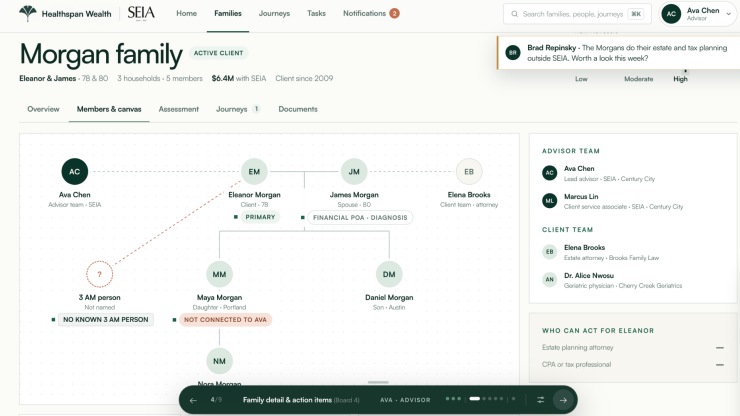
When a client has an emergency at 3 a.m., who do they call?
Processing Content
It's almost certainly not their financial advisor. But knowing who that person is — and who else plays a role in a client's health care decisions — could help advisors better serve clients as they age or face major medical challenges.
That's the idea behind Healthspan Wealth, a platform designed to save and organize health-related information tocoordinate care between family and professionals such as financial advisors, care managers and elder law attorneys.
The platform, which opened early access on Oct. 22 and aims to fully launch in the first quarter of 2027 once it receives SOC 2 certification from auditors, was co-founded by Thomas C. West, managing senior partner at Century City, California-based Signature Estate & Investment Advisors, and Suzanne Schmitt, who formerly led aging investor strategy at Fidelity. West will maintain his role at SEIA.
For now, the co-founders are inviting industry peers to "kick the tires" on their platform, see how their system is performing and provide feedback, Schmitt said. It was built with Anthropic's Claude AI tool.
The platform brings together information on different professionals, family members and others in a client's life and maps connections between them. Learning about these connections is a way advisors can continue to bring value as tools available to consumers, such as AI and others, compete with some of their traditional financial services, Schmitt said.
"Advisors who are not taking into consideration who all is going to influence their client, who's important to them [and] what's important to them, they're kind of giving themselves and the client potentially a narrower view of their expertise," Schmitt added.
West said he has already applied these lessons to his own advisory practice.
"Suzanne has done a great job of training me to start asking my clients, 'Who's your 3 a.m. call when something goes wrong?'" West said. "That particular data point isn't a regular one that a lot of times financial advisors are capturing. Or, 'Who are people that are influencing healthcare decisions, but might not be on the legal documents themselves?'"
Courtesy Healthspan Wealth
When circumstances such as health changes happen, families often don't see financial advisors as useful, sidelining them. But advisors actually could play significant roles for those families, West said.
Another goal is to reduce churn of assets away from the advisor, increase the chance the next generation will work with the same advisor and "capture more assets over more generations," West added.
Concerns about data privacy, security
To protect privacy, client data would not be stored by Healthspan Wealth, and using two of its five patents, personally identifiable information and personal health information would be redacted, Schmitt said.
"It's fair that all of us should feel nervous and be really selective and understand exactly what firms are doing to maintain our privacy," she added.
Clients are the ones who grant permission for data to be shared, she said.
West added that advisors, accountants, attorneys and care managers might be sharing information with each other anyway, and clients aren't aware of it, so one of the goals with Healthspan Wealth is to coordinate better to improve client outcomes.
Healthcare costs tend to grow during retirement, with long-term care costs potentially outpacing retirement income, and retirements are lasting much longer than they used to because of longer lifespans. As clients need support with caregiving for themselves or family, it is an area where advisors can step up and provide support.
"The market doesn't need more point solutions — we want to be the integrator that simplifies already busy lives for consumers and advisors and helps them start to see around corners," Schmitt said. "You don't understand what caregiving is like until you've been through it once or twice. We want to short circuit, if you would, the speed to trust, the speed to understanding."

Reporter
Zoe Sagalow covers tax and retirement issues for Financial Planning, bringing a decade of experience in financial policy and regulatory reporting to... Read full bio