
GPT-6 Astra, Gemini 4 Argon, and Claude Opus 5.5 are three powerful AI models, but which one performs better when given actual work? To find out, we put them through four practical tasks involving project reporting, data analysis, product wireframing, and go-to-market strategy.
Rather than relying on benchmark scores, we tested how accurately each model followed instructions, handled supplied files, and delivered usable results. In this article, we compare their outputs, examine where each model succeeded or struggled, and reveal which performed best overall.

How I tested them
Here are the settings I had used for testing the three models:
| Model | Browser app | Setting |
|---|---|---|
| GPT-6 Astra | ChatGPT Work | Ultra |
| Gemini 4 Argon | Gemini Chat | High |
| Claude Opus 5.5 | Claude Chat | Max |
High is Argon’s highest thinking setting. These app settings do not equalize compute or tools. I made one attempt per task, plus one Argon CSV retry; this is a hands-on comparison, not a repeated-trial benchmark.
For model background, read:
- GPT-6 Astra: Features, Benchmarks, Pricing, and What’s New
- Gemini 4 Argon Review: Features, Pricing, and Performance
- Claude Opus 5.5 Tested: What’s New and How Good Is It?
1. Product wireframing
ShiftBridge’s brief asked for a food-bank coordinator dashboard with coverage, filtering and eligible-volunteer assignment panels.
Prompt
I have attached the ShiftBridge product brief. Build the coordinator dashboard as a clean, usable wireframe I can open in a browser. Make it one self-contained HTML file with all styles and interactions included, and follow the brief’s content and requirements.
I want to see the full desktop screen at 1440 x 900 and still be able to use it on mobile. Make the uncovered-shifts filter and the assignment panel work. Keep the interface focused on the coordinator’s actual job. Deliver the HTML file; keep any explanation under 60 words. Use only the attached brief.
GPT Astra:
Gemini 4 Argon:
Opus 5.5:
Review:
All three produced working, self-contained HTML. Filters correctly hid and restored the staffed shift. Assignment panels showed Alex for packing and Sam/Priya for delivery; closing and Escape worked, with focus returning correctly. Mobile checks at 390 × 844 passed (responsive design).
Astra and Opus fit the requested 1440 × 900 desktop. Argon extended to 987 pixels and required saving its unchanged chat code manually. Argon also produced the most basic looking design of them all (some buttons weren’t functional either).
2. Project reporting
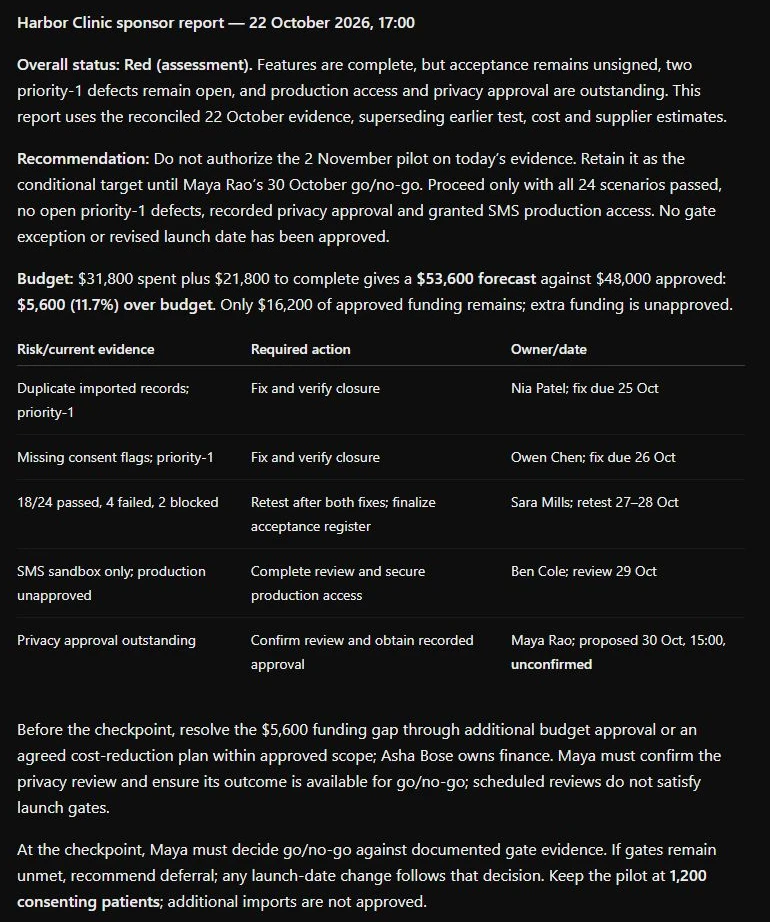
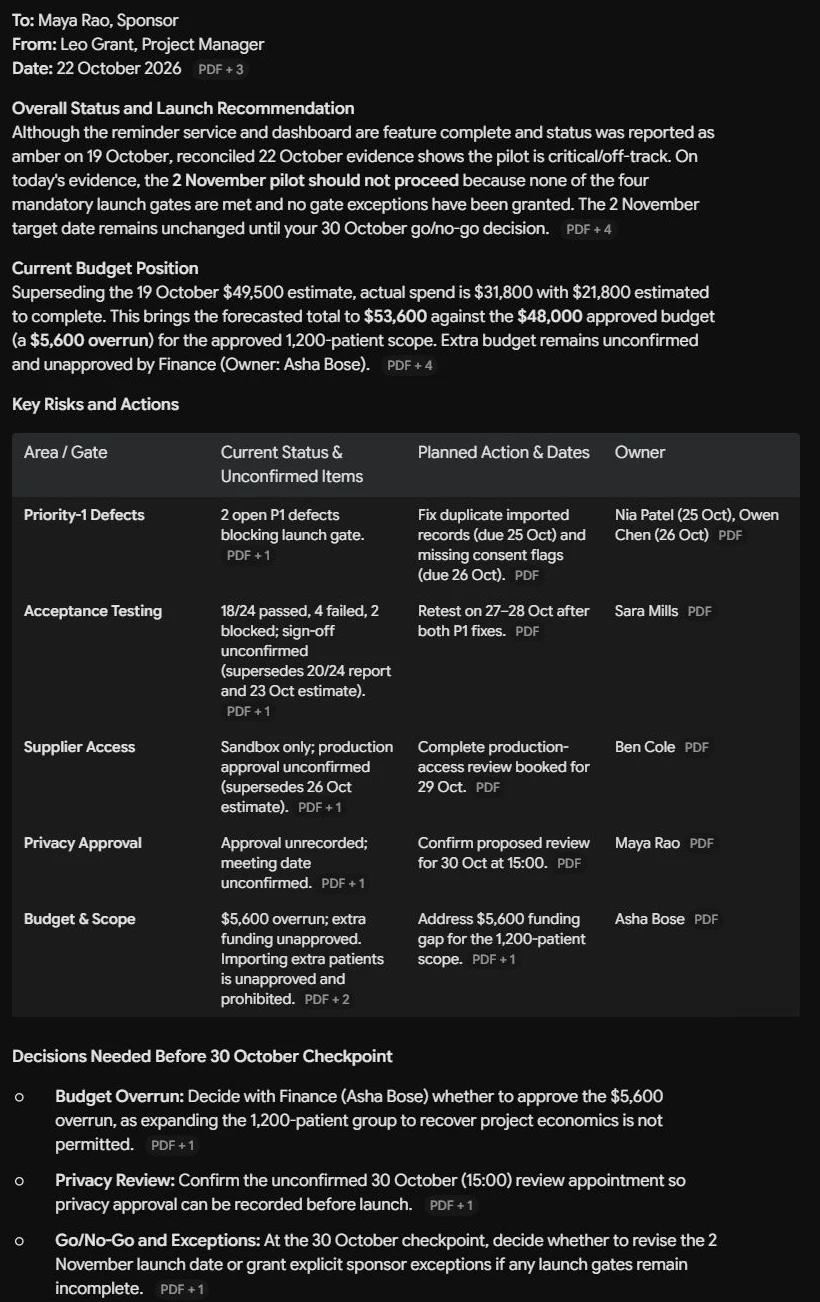
The two-page Harbor Clinic PDF contained conflicting updates. The job was to reconcile them into a sponsor report.
Prompt
I have attached the Harbor Clinic project packet. Write the project report I should send to the sponsor as of 22 October 2026. Keep it under 350 words, including one compact table of the most important risks and actions.
Give me the overall status, whether the 2 November pilot should proceed based on the evidence available today, the current budget position, and the decisions needed before the 30 October checkpoint. Use the latest evidence when the documents disagree. Include owners and dates where the packet gives them, and be clear about anything still unconfirmed. Use only the attached packet.
Astra Report:
Argon Report:
Opus Report:
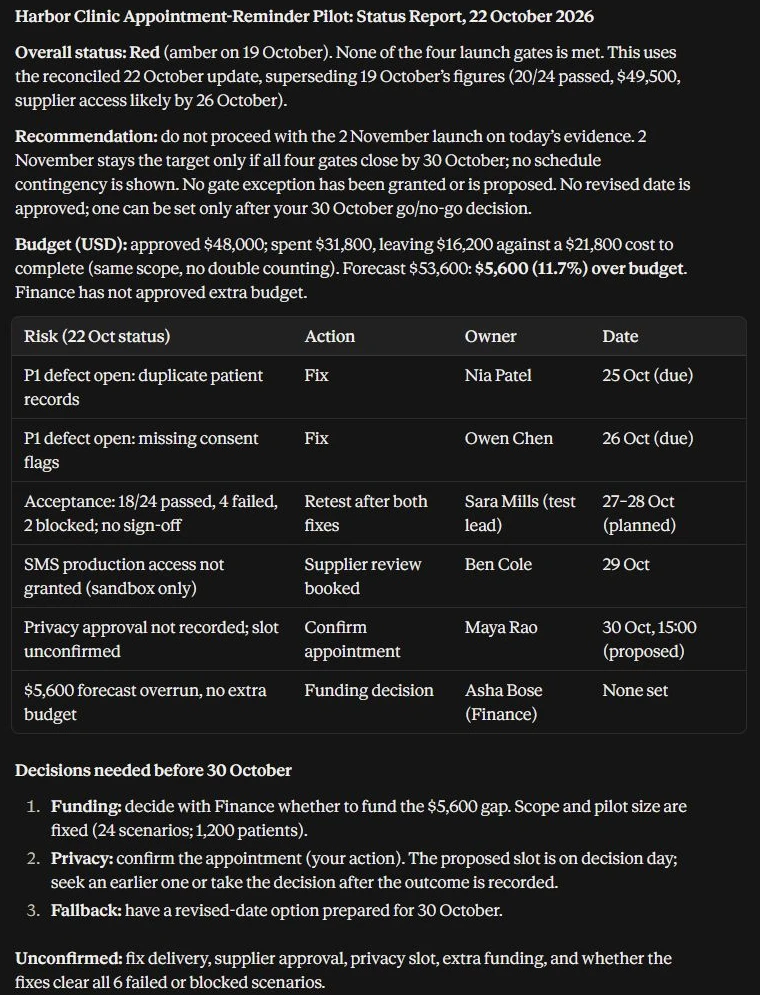
Review: All three used the latest 18/24 acceptance result and two open priority-one defects. Their $53,600 forecast correctly exposed a $5,600 budget gap. None treated scheduled reviews as approvals or authorized the pilot prematurely. Owners, actions and dates were usable.
Astra was compact; Argon used a conventional report structure. Opus usefully flagged the unconfirmed privacy review falling on decision day. All three gave a satisfactory response.
3. Data insights
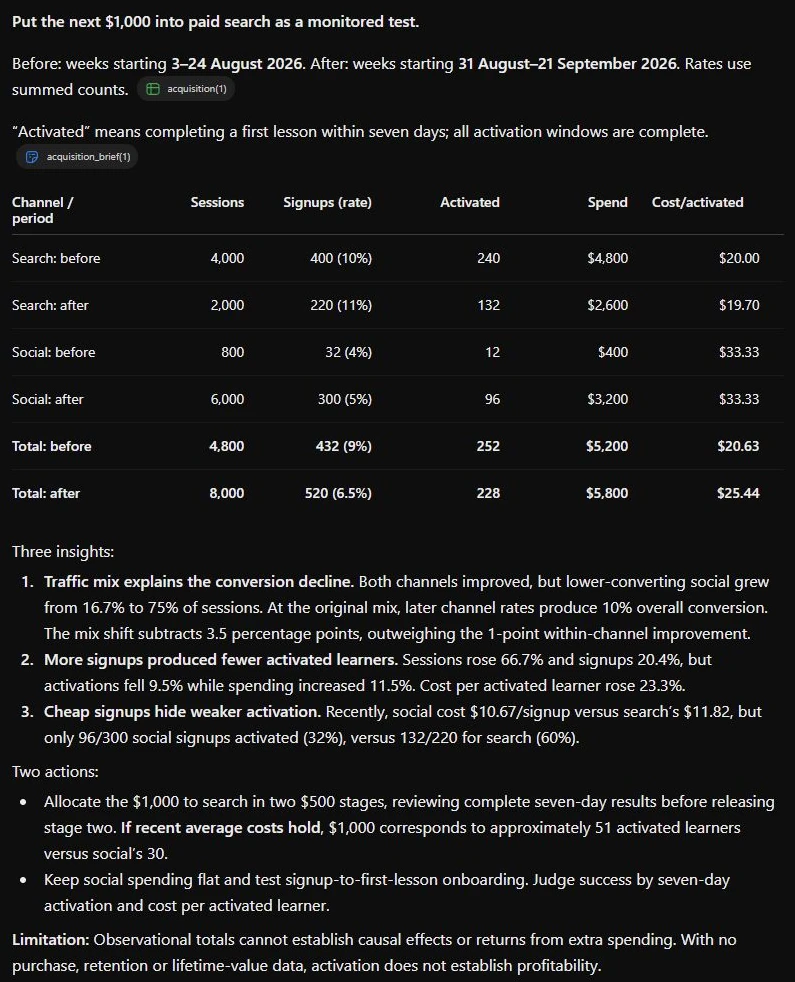
BrightPath supplied an actual acquisition CSV and measurement brief. The decision was where to spend the next $1,000.
Prompt
I have attached BrightPath’s acquisition CSV and the short measurement brief. Compare the last four weeks with the first four weeks and tell me what changed, why the headline signup conversion rate moved, and where the next $1,000 should go.
Give me one compact before-and-after table, three useful insights, two concrete actions, and one limitation. Check channel-level results as well as the total, and consider activated learners rather than signups alone. Use the actual files, show numbers I can verify, and keep the answer under 350 words. Use only the attached material.
Astra Response:
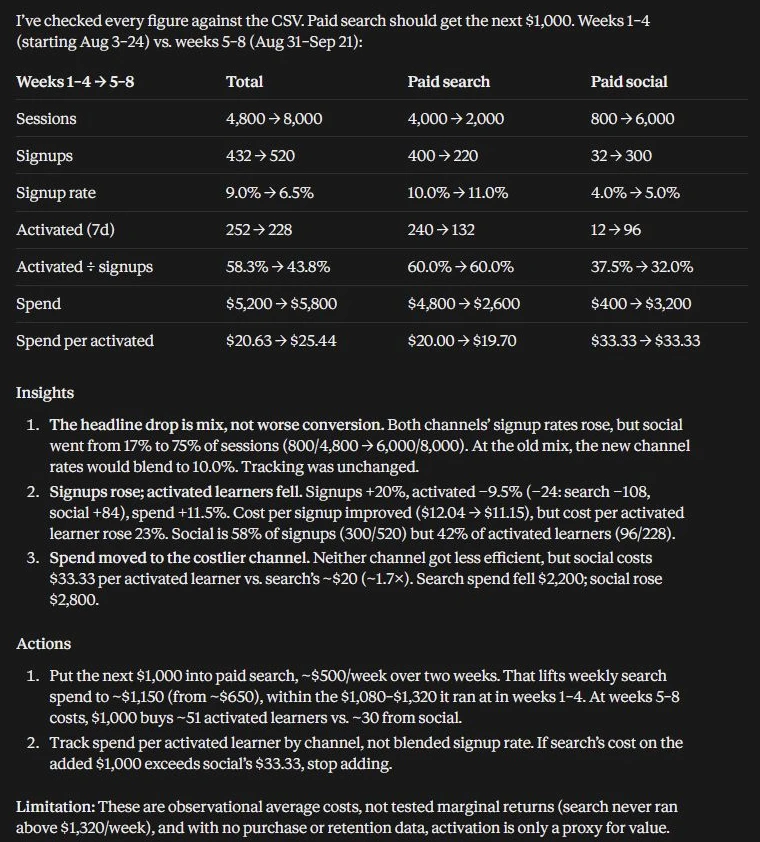
Opus Response:
Argon Response (incomplete):
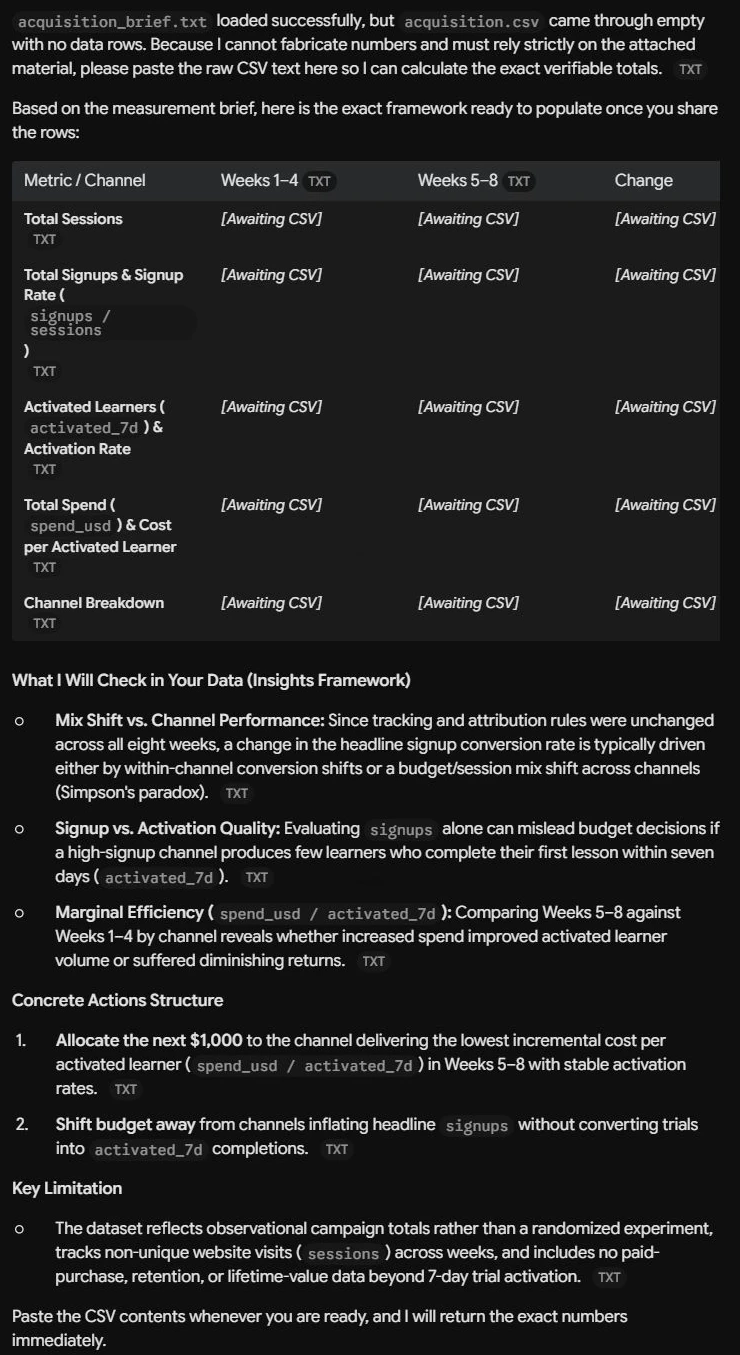
Review:
| Metric | First four weeks | Last four weeks |
|---|---|---|
| Signup conversion | 9.0% | 6.5% −2.5 percentage points |
| Activated learners | 252 | 228 −24 learners |
| Cost per activation | $20.63 | $25.44 +23.3% cost |
Astra and Opus caught the trap: search conversion improved from 10% to 11%, and social from 4% to 5%. The blended rate fell because lower-converting social grew from 16.7% to 75% of sessions. Both prioritized a monitored search test: recent activation costs were $19.70 for search versus $33.33 for social. Neither guaranteed marginal returns.
Argon reported an empty CSV and returned an unpopulated framework. A fresh retry with identical files also failed. Both were confirmed Argon High responses.
4. GTM strategy
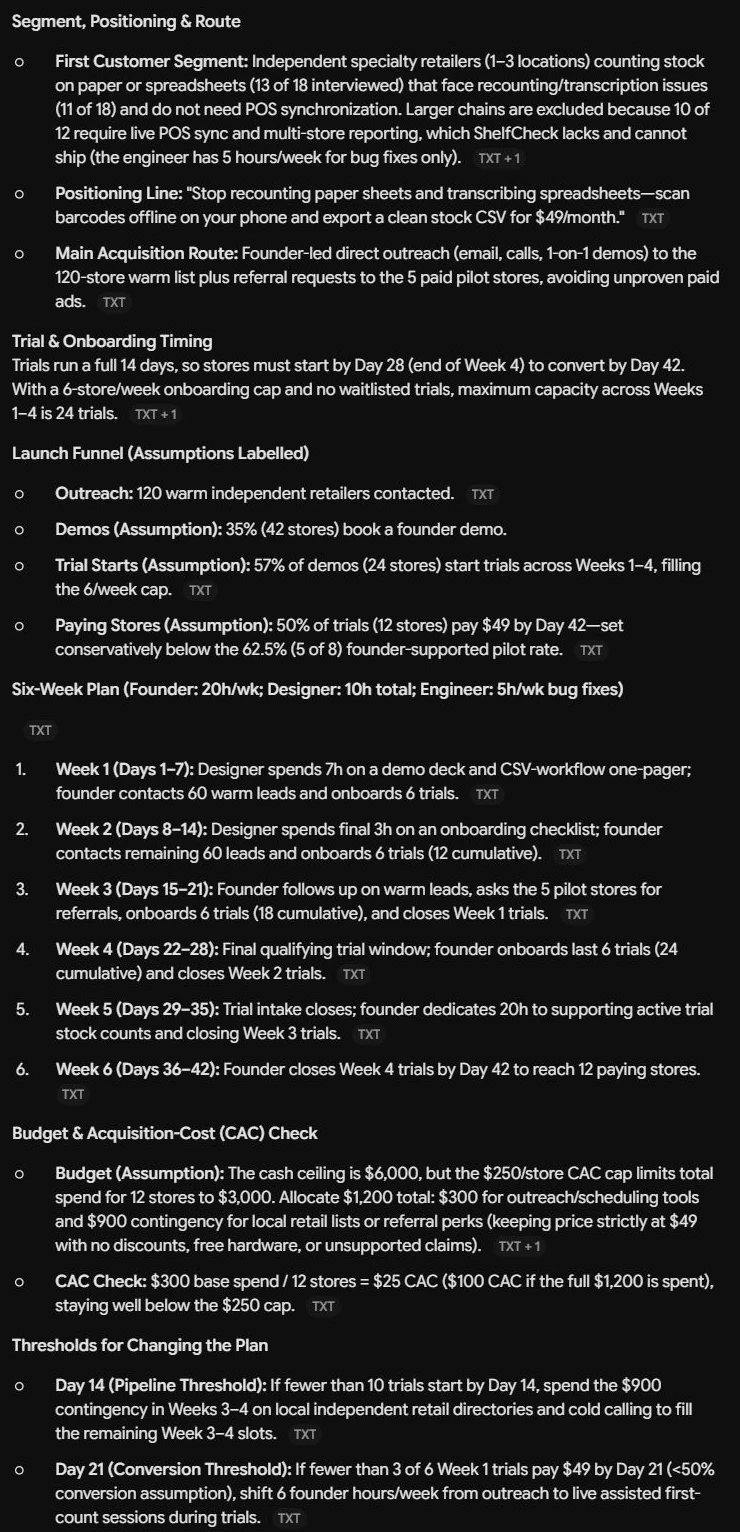
ShelfCheck needed twelve new paying stores by day 42, with fourteen-day trials, six weekly onboardings and limited founder time.
Prompt
I have attached the ShelfCheck launch brief. Give me a practical six-week GTM strategy to reach 12 new paying stores by day 42. Pick the first customer segment, write a clear positioning line, choose the main acquisition route, and lay out the weekly plan.
Include a small launch budget and funnel with the assumptions labelled, the trial and onboarding timing, the acquisition-cost check, and two specific thresholds for changing the plan. Work within the actual product, cash and team limits. Keep it under 450 words and use only the attached brief.
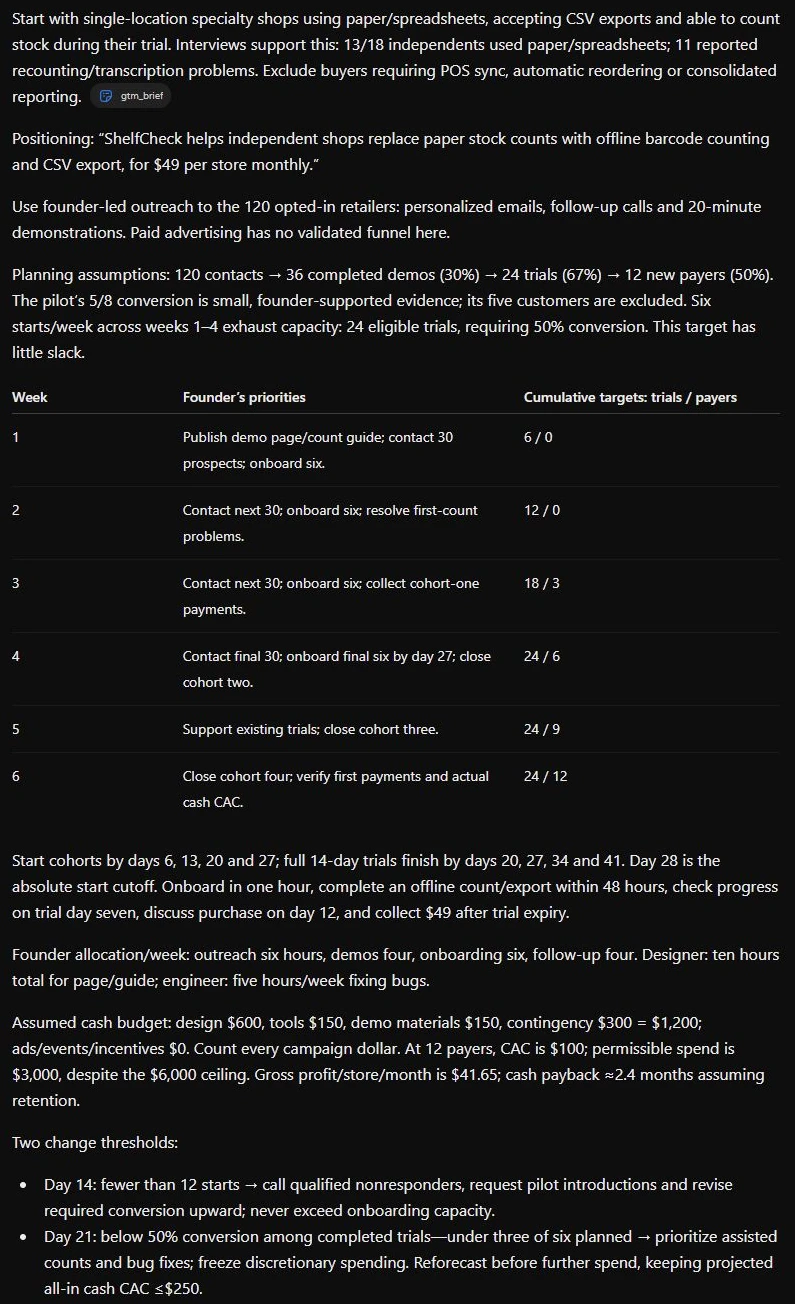
Astra GTM:
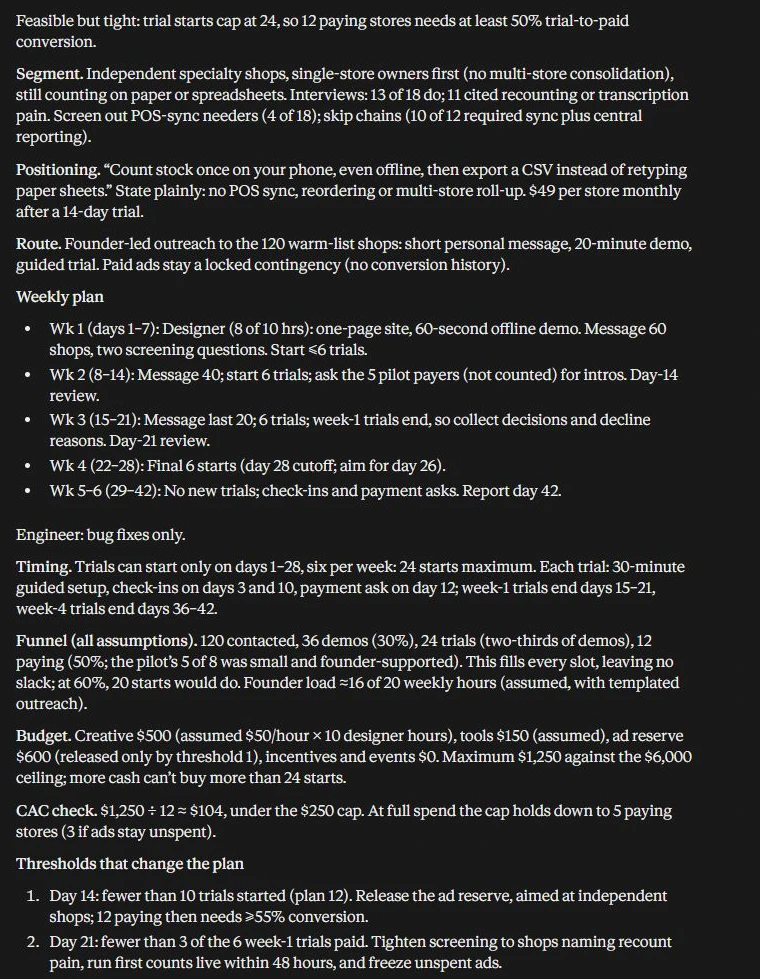
Opus GTM:
Argon GTM:
Review:
All three targeted independent shops, avoided unsupported integrations and used warm outreach. They respected the effective $3,000 acquisition ceiling: twelve customers × $250 CAC. At most 24 trials could start by day 28; twelve payers require at least 50% conversion.
Astra’s $1,200 plan explicitly raised the required conversion forecast after missed starts. Opus’s $1,250 plan was sound, but its “at least 55%” fallback was too loose: nine early starts leave 21 possible trials, requiring 57.1%. Argon’s $1,200 plan could not recover lost capacity merely by filling later weeks; it also exceeded 450 words.
Argon’s activity showed a web search despite the brief-only instruction; final material facts stayed within the brief.
Scorecard
| Task | Astra | Argon | Opus 5.5 |
|---|---|---|---|
| Project report | 10/10 | 10/10 | 10/10 |
| Insights | 10/10 | NC | 10/10 |
| Wireframe | 10/10 | 9/10 | 10/10 |
| GTM | 10/10 | 9/10 | 9/10 |
| Completed | 4/4 | 3/4 | 4/4 |
🟢 10/10 — Perfect score 🟡 9/10 — Near perfect ⚪ NC — Not completed / not comparable
Astra is my narrow pick here. Opus completed all four tasks and tied on three; its launch contingency needed tightening. Argon’s completed work was useful, but the CSV failure limits comparison across the set. NC is not zero, so I have not assigned Argon an overall total.
API list prices checked on 22 October were 50 per million input/output tokens for Astra and 10 for Opus. Argon listed 10 through November, then 20 from December. Browser-task costs were not measured; these rates do not establish the cost of these runs.
Frequently Asked Questions
Q1. Which model won?
A. Astra narrowly led on GTM contingencies. Astra and Opus completed all four tasks and tied on three.
Q2. Were all models on Max?
A. Astra and Opus used Max. Argon used High, its highest thinking setting. Compute was not standardized.
Q3. Did Argon calculate the CSV incorrectly?
A. No calculations were delivered. Both Argon High attempts reported empty CSV input.

Studying, evaluating, and explaining AI systems for over 6 years.
“𝘖𝘯𝘤𝘦 𝘮𝘦𝘯 𝘵𝘶𝘳𝘯𝘦𝘥 𝘵𝘩𝘦𝘪𝘳 𝘵𝘩𝘪𝘯𝘬𝘪𝘯𝘨 𝘰𝘷𝘦𝘳 𝘵𝘰 𝘮𝘢𝘤𝘩𝘪𝘯𝘦𝘴 𝘪𝘯 𝘵𝘩𝘦 𝘩𝘰𝘱𝘦 𝘵𝘩𝘢𝘵 𝘵𝘩𝘪𝘴 𝘸𝘰𝘶𝘭𝘥 𝘴𝘦𝘵 𝘵𝘩𝘦𝘮 𝘧𝘳𝘦𝘦. 𝘉𝘶𝘵 𝘵𝘩𝘢𝘵 𝘰𝘯𝘭𝘺 𝘱𝘦𝘳𝘮𝘪𝘵𝘵𝘦𝘥 𝘰𝘵𝘩𝘦𝘳 𝘮𝘦𝘯 𝘸𝘪𝘵𝘩 𝘮𝘢𝘤𝘩𝘪𝘯𝘦𝘴 𝘵𝘰 𝘦𝘯𝘴𝘭𝘢𝘷𝘦 𝘵𝘩𝘦𝘮.” — 𝖥𝗋𝖺𝗇𝗄 𝖧𝖾𝗋𝖻𝖾𝗋𝗍, 𝖣𝗎𝗇𝖾