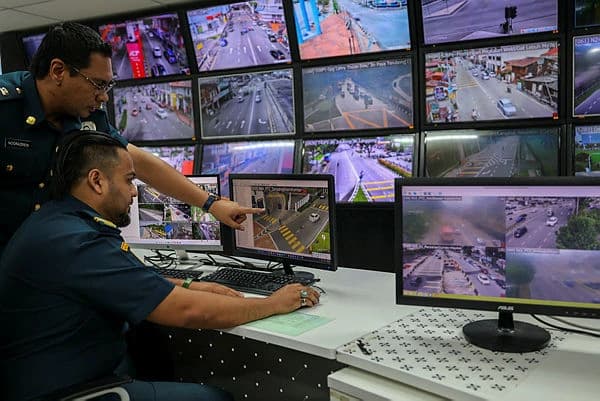
The AI City Initiative across nine local authorities is reducing traffic congestion and improving traffic flow with smart AI management.
KUALA LUMPUR: The AI City Initiative, implemented across nine selected local authorities (PBTs), has had a significant impact, particularly on traffic management, with the Penang Island City Council (MBPP) recording a 10 to 15 per cent reduction in traffic congestion.
The Digital Ministry said the initiative under the National AI Action Plan 2026–2030 had also shown positive results for the Ipoh City Council (MBI), improving traffic flow in congested areas and cutting waiting times from two minutes to 40 seconds through coordinated traffic-light timings.
The ministry said the initiative had led to the development of 28 projects across the nine participating PBTs, which serve as “living labs” and testbeds, with funding support from the 5G Enterprise and AI City Grant launched on Aug 13, 2025.
The nine participating PBTs are MBPP, MBI, Kuala Lumpur City Hall (DBKL), Petaling Jaya City Council (MBPJ), Putrajaya Corporation (PPj), Kuching North City Hall (DBKU), Jasin Municipal Council (MPJ), Johor Bahru City Council (MBJB) and Shah Alam City Council (MBSA).
The Digital Ministry said this in a written response today to a question from Tan Hong Pin (PH-Bakri) on measures to prevent duplication of projects and the development of siloed technologies in cities nationwide, as well as the potential of the AI City Initiative to revitalise older towns such as Muar.
Addressing concerns over project duplication and siloed technology development, the ministry stressed that not all 156 PBTs nationwide need to develop their own AI systems.
“The Digital Ministry will develop an integrated data platform comprising an AI Algorithm Bank and an AI Marketplace for shared use by all PBTs.
“This is to ensure that technologies, data and solutions that have proven effective can be shared to improve service delivery efficiency and advance the transformation towards an AI Nation 2030,” it said.
According to the ministry, the government is currently shifting from individual projects to an integrated AI City ecosystem, guided by the principle of “Build Once, Reuse and Scale”, in line with a directive by Prime Minister Datuk Seri Anwar Ibrahim at the Special Meeting on the Implementation of the AI City Model on April 10, 2026, and the establishment of the AI City Task Force in August this year.
The coordination effort includes a proposal to establish a National Command Centre (NCC) integrating AI analytics and Digital Twin technology, aimed at realising the “Thinking City” concept, under which cities would not only monitor their environments but also anticipate and proactively address issues.
On the implementation of the initiative in older towns such as Muar, the ministry said the Muar Municipal Council (MPM) had been recognised as a “Level 1: Smart City Early Adopter” under the Malaysia Smart City Rating Programme administered by the Town and Country Planning Department (PLANMalaysia), based on existing initiatives such as a Smart Command Centre and smart waste management systems.
“Therefore, the AI City Initiative has the potential to revitalise Muar by enhancing existing systems in phases, subject to local needs, data readiness and cooperation between the state government and the PBT,” the ministry said.