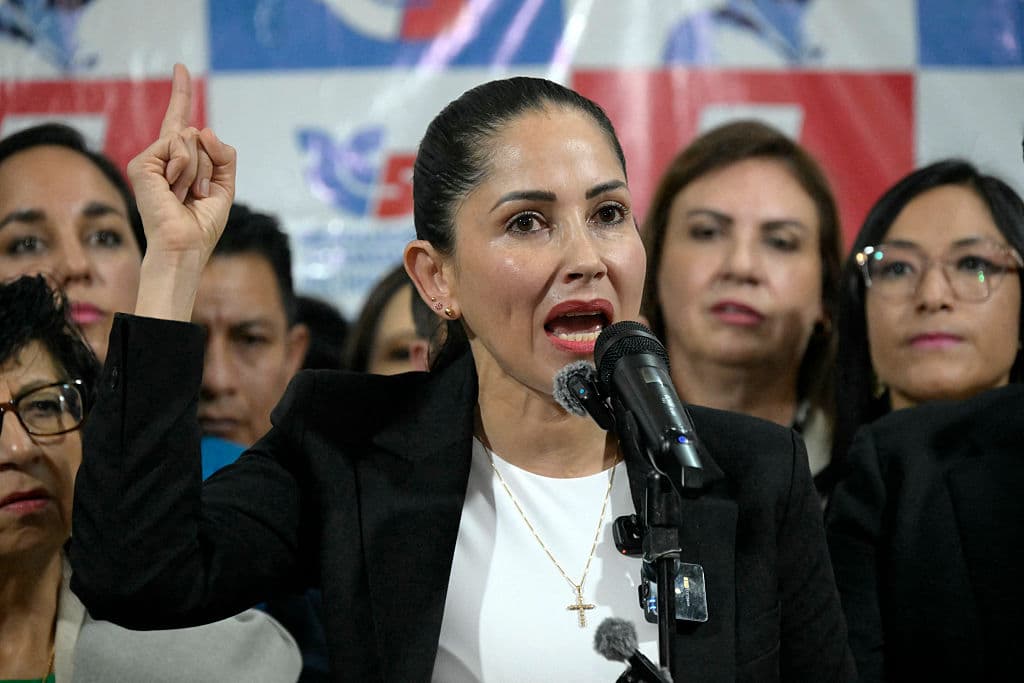
“I’d be lying to you if I told you that yesterday I didn’t double-lock the door, just in case they come to take us down in the middle of the night.”
Those were the of Jahiren Noriega, a member of Ecuador’s National Assembly, the day after the detention of Luisa González, the Movimiento Revolución Ciudadana’s presidential candidate in the country’s last two federal elections and the main opposition figure today.words
In Ecuador, where the separation of powers no longer exists, the use of lawfare by the far-right government of President Daniel Noboa blurs the line between democracy and dictatorship. For members of the Movimiento Revolución Ciudadana, the party aligned with the former socialist president, Rafael Correa, the political persecution is nothing new, and left-wing leaders and social movements across Latin America will surely recognize the playbook. But González’s detention last Thursday marks a shocking escalation in Noboa’s bold use of the courts to persecute opponents, and in Ecuador, a country with a rich history of protest that has been unusually quiet throughout his presidency, the Left faces its biggest test yet.
Bogus Corruption Charges
González was detained for alleged irregularities in the campaign financing of her presidential run in 2023. The case is being referred to as the Caso Laberinto — what the government describes as a labyrinth of money laundering. But it is more accurately the reopening of a previous case, the Caso Caja Chica, that was already adjudicated. That case was closed when Noboa’s government failed to prove its laughable accusation that González’s campaign contributions were linked to the Cartel de Los Soles, a group whose very existence is , and it resulted in nothing more than a fine that was paid to the Tribunal Contencioso Electoral, the specialized body that administers electoral justice in Ecuador.questioned
Having failed to draw a line between González and a group that might not even exist, the public prosecutor’s office is now shamelessly claiming that the courts were wrong the first time: money laundering did indeed occur, and Aquiles Álvarez, the mayor of Guayaquil, Ecuador’s largest city, is involved. Also a member of the Revolución Ciudadana, Álvarez was detained in February in the Caso Goleada, a farcical case in which he was accused of building a business structure to illegally generate profits. He remains imprisoned.
The reaction to González’s detention was immediate. Correa, who lives in self-imposed exile and was granted asylum in Belgium, was among the first to comment, : “In Ecuador, there exists a true dictatorship. It doesn’t respect the constitution, human rights.” He pointed out the timing of the arrest, as Ecuadorians will head to the polls in November for local elections. As part of the investigation that began with the Caso Caja Chica, the opposition is barred from the elections. They will take place amid an increase in crime, an energy crisis that is causing regular blackouts across the country, a drastic shortage of medicine in deteriorating hospitals, and regular .sayingprison massacres
“Whenever they need to get out of a crisis, they always come up with this kind of spectacle,” Orlando Pérez, an Ecuadorian journalist and writer.said
Gabriela Rivadeneira, who replaced González as the Movimiento Revolución Ciudadana’s president, was also quick to react, González’s detention as a “kidnapping.” Meanwhile, assemblyman Xavier Lasso that the targets aren’t limited to Correistas but extend to doctors, students, indigenous people, businesspeople, and journalists.describingwarned
The Arm of a Dirty Campaign
Julio César Cueva, Álvarez’s lawyer, sees a familiar pattern. “Curiously, the prosecutor’s office has this bad habit of turning cases into media spectacles first — arresting individuals, ruining them, destroying them publicly — only for those people to find out what they are being accused of after the fact,” Cueva after González’s detention. He added that the prosecutor’s office often has “one case for the media and another for the judges.”said
González and Álvarez are far from the only examples of Noboa’s persecution. The biggest trophy in the president’s cabinet is Jorge Glas, Ecuador’s vice president under Correa. Glas was accused in the Caso Reconstrucción de Manabi of misusing public funds related to the emergency caused by an earthquake. He was granted asylum in Mexico but, in a scene out of a movie and in brazen violation of international law, was from its embassy in Ecuador by police who invaded in the middle of the night. He is being held at Cárcel del Encuentro, a maximum security prison, and the conditions of his imprisonment have been described as systematic torture. His defense restricted access to hydration, significant loss of muscle mass, recurrent hunger, administration of medication by nonmedical personnel, and clear signs of malnutrition.abductedreports
“They’re going to bury González alive,” Correa . “Just as they’ve done with Aquiles Álvarez, just as they’ve done with Jorge Glas.”warned
The recent attacks raise several questions. Is Noboa persecuting González for the fruit shipments from the president’s family firm that were used for cocaine trafficking? Where is the investigation into the campaign financing inconsistencies related to Noboa’s party? Why is José Julio Neira, one of Noboa’s ministers, posting a detailed about the Caso Laberinto? Where is the separation of powers? Where is the international community?exposingvideo
These questions are of course largely rhetorical. Long gone are the days of Latin America’s military dictatorships, when the far right asserted control with soldiers in the streets. As Noboa is demonstrating, today’s authoritarians simply need to infiltrate a country’s democratic institutions and ensure the public prosecutor’s office answers to the executive branch.
“There is a new generation of coups d’état and attacks on democratic systems,” says Alexander Madrigal, an international political scientist, professor, and researcher at the Universidad Nacional de Colombia.
Forms of opposition persecution have innovated. In the era of military dictatorships, disappearances, direct actions by the state, undercover agents, etc., were a bad habit of Latin American regimes. But today we are arguably revitalizing new forms of political persecution and attacks on opposing ideas. And this is due to, or can be read as, the discrediting by the new Right. . . .
. . . we’re talking about the use of the state apparatus to judicially eliminate the opposition. This is also facilitated by support from the United States.
What’s Next for Ecuador?
There is indeed a labyrinth in Ecuador, but it isn’t the one Noboa refers to. Rather, it is a maze of courts, mainstream media, and violence set up by the far right — one that left-wing candidates must navigate in order to achieve electoral success. By ensuring the Left can’t win at the ballot box, Noboa’s government is creating the conditions that give rise to guerrilla groups. If Ecuador is to avoid that dangerous road, the Left will have to find a way to navigate the democratic institutions increasingly co-opted by Noboa’s government. It’s a future that’s difficult to imagine without the renewal of Ecuador’s vigorous protest culture, but one not unlikely given that Noboa may have finally overplayed his hand.
The road ahead is not for the faint of heart. Today’s far right in Ecuador is content to use the courts to harass and imprison left-wing leaders and bar the opposition outright. Against this backdrop, inspiration can be drawn from Assemblywoman Noriega, the member of the Movimiento Revolucion Ciudadana who double-locked her door.
“We have to continue,” she said. “We have to continue with firmness, with courage. I don’t think this country needs more martyrs.”
This article originally appeared in , a democratic socialist magazine publishing long-form essays and analysis on politics, economics, and culture. JacobinSubscribe to the print edition for $20 a year.