
Double gas production in six years. Triple it by 2035.

Subscribe now to read the latest news in your city and across Canada.
- Unlimited online access to articles from across Canada with one account.
- Get exclusive access to the Calgary Herald ePaper, an electronic replica of the print edition that you can share, download and comment on.
- Enjoy insights and behind-the-scenes analysis from our award-winning journalists.
- Support local journalists and the next generation of journalists.
- Daily puzzles including the New York Times Crossword.
Create an account or sign in to continue with your reading experience.
- Access articles from across Canada with one account.
- Share your thoughts and join the conversation in the comments.
- Enjoy additional articles per month.
- Get email updates from your favourite authors.
Create an account or sign in to continue with your reading experience.
- Access articles from across Canada with one account
- Share your thoughts and join the conversation in the comments
- Enjoy additional articles per month
- Get email updates from your favourite authors
Sign In or Create an Account
The Conservative party victory in the British Columbia provincial election on the weekend could have seismic ramifications for the Canadian oil and gas sector.
On the campaign trail and during his victory speech, B.C. Conservative party Leader Lorne Doerkson set out an aggressive plan to boost natural gas production in the coming nine years.
The party released a B.C. energy “superpower plan” last month that also aims to attract new investment into new liquefied natural gas (LNG) export developments in the province.

SUBSCRIBER EXCLUSIVE: FP West: Energy Insider brings you behind the oilpatch’s closed doors with exclusive insights from insiders every Wednesday morning.
By signing up you consent to receive the above newsletter from Postmedia Network Inc.
A welcome email is on its way. If you don't see it, please check your junk folder.
The next issue of FP West: Energy Insider will soon be in your inbox.
We encountered an issue signing you up. Please try again
After years of on-again, off-again conflict between neighbouring B.C. and Alberta over pipelines, a neighbourly approach to energy policy could be right around the corner, including over the proposed Pacific Link oil pipeline.
“Among my first calls as the premier will be to the prime minister and Premier (Danielle) Smith to get the Pacific Link working group moving,” Doerkson told reporters on Sunday.
“Our resources are the strongest hand that British Columbia holds, and we will, for sure, play them. We’re going to supercharge this economy.”
On Monday, Smith said she spoke with Doerkson over the weekend and the two leaders will meet in the coming months to “advance our shared priorities.”
“We discussed the strong economic ties between British Columbia and Alberta, and the opportunities to build on them together,” Smith said in a statement.
A change in tone by the incoming B.C. premier about energy development compared to the outgoing NDP government matters, say business leaders.
“In the past decade, the messaging has been very mixed, which of course doesn’t inspire confidence,” Business Council of British Columbia CEO Laura Jones said in an interview Monday.
“This is a fantastic opportunity for the West to work more closely together and with Ottawa on a shared vision that will level up prosperity for the country.”

British Columbia is the country’s second-largest natural gas producer.
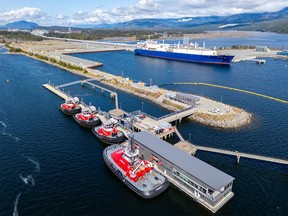
The LNG Canada project shipped its first international cargo of supercooled gas last year, accessing markets in Asia. Proponents in the Shell-led project announced plans last month to double LNG output at the facility in Kitimat, B.C., by the early 2030s.
Two smaller LNG projects are also being built, while a final investment decision (FID) on the larger Ksi Lisims development is drawing closer.
In 2025, B.C. produced about 1.5 million barrels of oil equivalent per day, with more than 80 per cent coming from gas, according to the Canadian Association of Petroleum Producers (CAPP).
That amounted to gas production of about seven billion cubic feet per day. Doubling or tripling that would require significant investment — primarily into the massive Montney formation in northeast B.C. — and would create thousands of jobs.
CAPP chief executive Lisa Baiton embraced the incoming government’s goal of tripling gas production and growing LNG exports, along with Doerkson’s comments about the Pacific Link pipeline, a project that’s backed by the federal and Alberta governments.
“Having a B.C. government that is openly supportive of that project certainly improves the odds of it advancing to FID and construction,” Baiton said Monday.
“I would say the new B.C. government is very much heading in the right direction. With LNG Canada Phase 2 starting construction, and the potential for more projects like the Pacific Link pipeline and the other LNG projects, we really are excited that there’s clear momentum for the oil and gas industry in B.C.”

Calgary-based Tourmaline Oil, the country’s largest natural gas producer, said it welcomed B.C.’s ambitions, “which adds additional momentum to Canadian natural gas growth.”
There’s plenty of resource in British Columbia, given the enormous liquids-rich Montney formation, along with the Liard Basin and Horn River gas plays in the province’s north, say industry experts.
The Montney made up about 22 per cent of all Canadian gas output in 2015, growing to 45 per cent in 2024. It could reach 63 per cent of all gas production by 2035, although that will depend on commodity prices and the country’s LNG export levels, according to a Canada Energy Regulator report.
Doubling production is certainly possible, said Rob Spitzer, who worked in B.C. for about three decades, including as former executive vice-president of Apache Kitimat Upstream.
“There is just so much gas there. The question will be economics and . . . can you get social licence to get that gas out of the Montney, Horn River or Liard to Kitimat or Prince Rupert, and be sent offshore,” he said.

A poll by the Angus Reid Institute this summer found 63 per cent of B.C. respondents supported the Pacific Link project, mirroring national support.
As the trade war with the United States has escalated, there’s majority backing in Canada for oil and gas exports.
“We’re realizing the ability to rely and depend on the United States as an economic partner is just not there,” said Shachi Kurl, president of the Angus Reid Institute.
“That has driven a sense of urgency around redefining our economic place in the world.”
The victory by the B.C. Conservative party may also signal a change in the policy debate surrounding oil and gas development in Canada, said Heather Exner-Pirot, director of natural resources, energy and environment at the Macdonald-Laurier Institute.
“Oil and gas energy has been maybe the biggest wedge issue in Canadian politics in the last 12 years, 15 years,” she said.
“I’m hoping that this is the end of oil and gas being the wedge issue, the polarizing factor in Canadian politics, and we can move on to something else, and that would be a huge win . . . for the country.”
Chris Varcoe is a Calgary Herald columnist.
FP West: Energy Insider brings you behind the closed doors of the oilpatch, with exclusive insights from insiders every Wednesday morning. Sign up now.
Join the Conversation
This website uses cookies to personalize your content (including ads), and allows us to analyze our traffic. Read more about cookies here. By continuing to use our site, you agree to our Terms of Use and Privacy Policy.