
Farsoon Europe GmbH and Apollo Automobil GmbH collaborated on the development and production of titanium exhaust pipes and exhaust tips for the Apollo Evo. Apollo contributed expertise in hypercar engineering and design while Farsoon provided additive manufacturing, Design for Additive Manufacturing (DfAM) and industrial production capabilities.
The project used additive manufacturing from the early design stages to integrate the component’s design, function and manufacturability. DfAM principles enabled the engineering teams to consolidate multiple parts into an integrated titanium component, reducing assembly requirements and subsequent manufacturing steps.
The first customer vehicle was unveiled at the 2026 Goodwood Festival of Speed. Named the Apollo Evo “Caribbean Dragon,” the vehicle features exhaust pipes with a Dragon Skin surface texture developed by Apollo and Farsoon for additive manufacturing. The texture is created during the build process rather than through a separate finishing operation. Apollo reports that the surface also helps distribute heat.
The exhaust tips were produced using Farsoon process parameters developed for the application. Machined details were added to achieve a chrome-like surface finish.
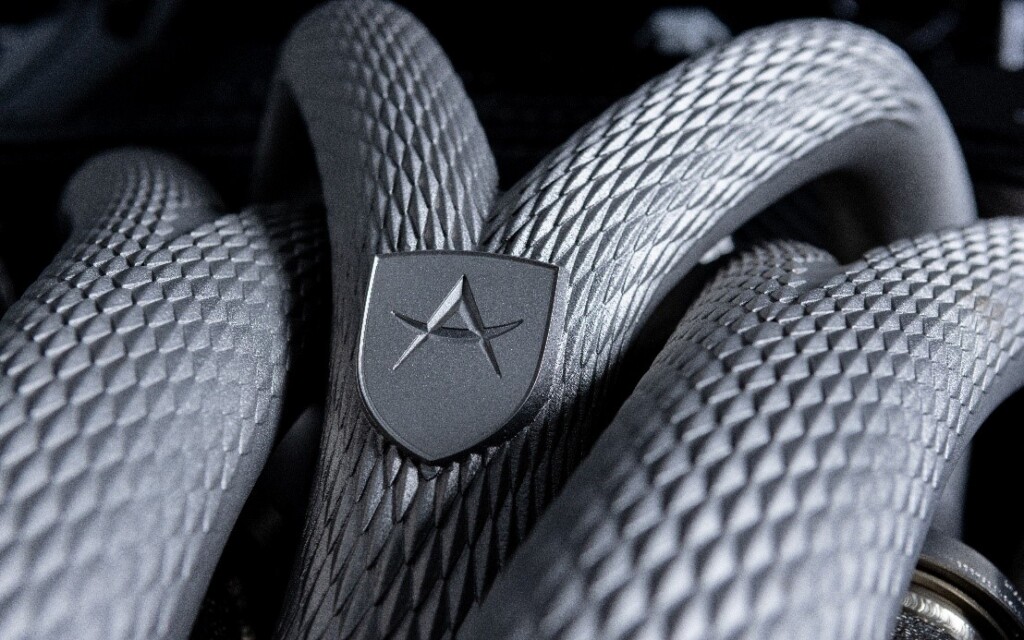
Farsoon manufactured the titanium exhaust pipes and exhaust tips on an FS811M-6 laser powder bed fusion (LPBF) system using TA15 titanium alloy, also known as Ti-6.5Al-2Zr-Mo-V. The process uses an increased layer thickness to support production of the exhaust components.
To manufacture the enclosed exhaust geometry, Farsoon used its Beam Shaping technology. The process enabled the pipes to be produced as single components without internal support structures, reducing post-processing and eliminating the need to weld together multiple separately manufactured sections.
The process was used to produce the titanium exhaust pipes and exhaust tips for all 10 Apollo Evo vehicles. The project demonstrates the use of additive manufacturing for complex, low-volume automotive production.
Farsoon supported the project beyond equipment supply by contributing application engineering and manufacturing expertise throughout product development. The collaboration combined Apollo’s vehicle development requirements with Farsoon’s additive manufacturing capabilities.
The development process was divided into multiple stages to manage technical risk and evaluate design options. Additive manufacturing allowed the teams to assess support-free designs in parallel and produce samples for milling tests and surface treatments, supporting the development process.
For more information, visit farsoon-gl.com.
The post Farsoon, Apollo develop titanium exhaust for Apollo Evo appeared first on Engineering.com.