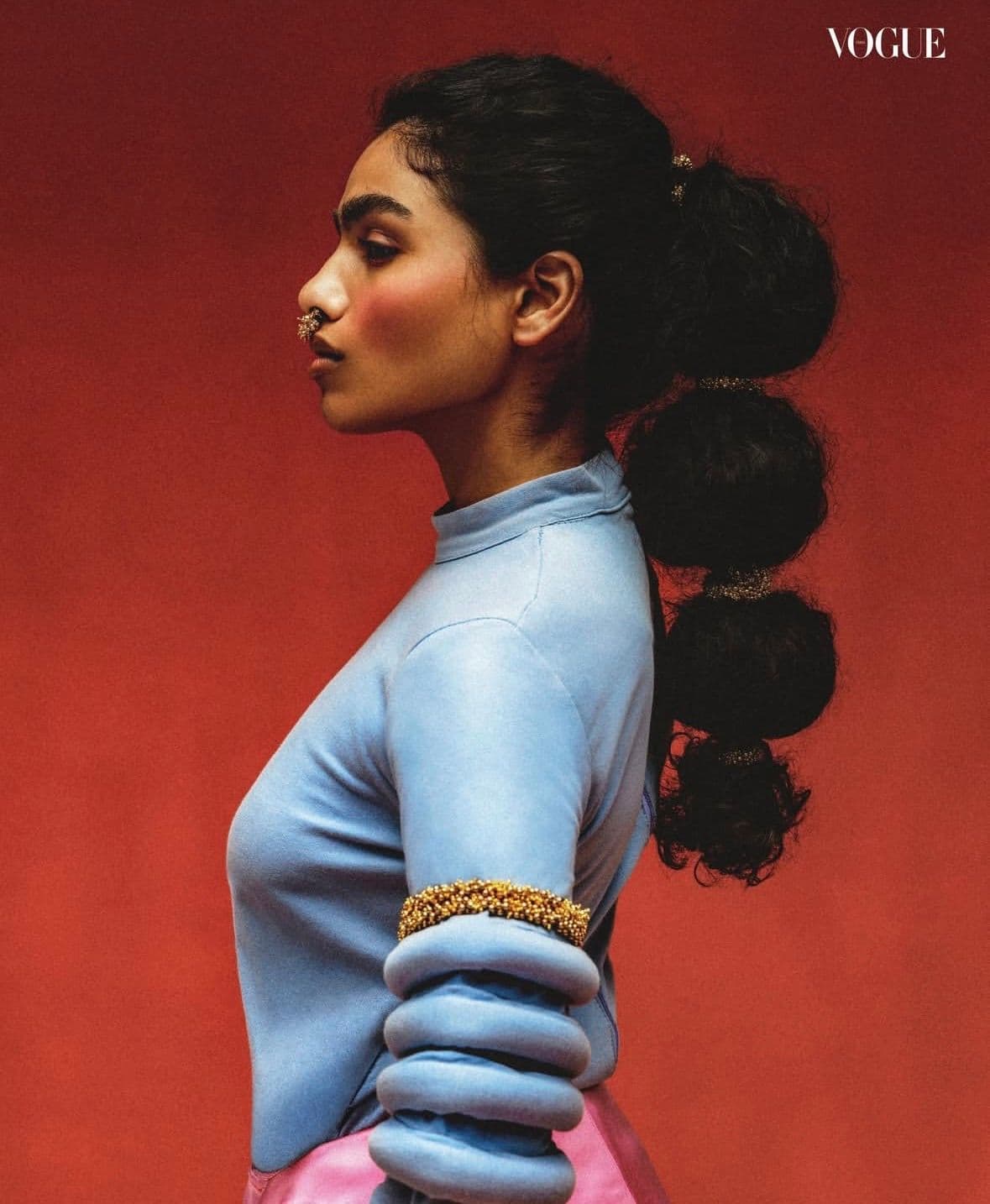
Big hair is back. Sabrina Carpenter's bouncy blowouts and Olivia Dean's voluminous curls have brought thick hair and fullness firmly into the beauty conversation. But while big hair might be a styling trend, the desire for naturally thick hair runs deeper.
According to a 2025 Mintel report, 38% of Indian consumers identified thinning hair as a concern. More recent findings from Mintel's 2026 haircare research suggest that Indian consumers, particularly women, increasingly associate hair damage with visible signs such as thinning and weakness. The growing focus on fullness raises an interesting question: when did having naturally fine hair become something we felt compelled to correct?
In India, where thick, long hair has traditionally been celebrated as a marker of femininity and beauty, the obsession is hardly new. The weekly champi, grandmother-approved oils and endless remedies for thicker locks have now made room for scalp serums, densifying treatments and sophisticated hair-growth formulas.
But is thicker hair necessarily healthier hair? Not according to principal scientist and director, scientific communications at P&G Global. The distinction, he explains, lies partly in understanding the difference between thickness and density. “Thickness refers to the diameter of individual strands, while density concerns the number of hairs growing in a given area of the scalp.”
"What's intuitive sometimes in representing good hair is to use imagery of hair that is fuller," Khoo tells Vogue. “It may not be easy to tell though whether that full hair is due to thick hair or thin hair. If the hair is dense, it can look equally as voluminous.” It's a distinction often lost in the beauty aisle, where fuller-looking hair is frequently presented as healthier hair.
What matters more, he explains, is the health of the scalp and the hair itself. "The scalp health determines the quality of the hair," he says, comparing the scalp to soil and hair to the plant growing from it. An unhealthy scalp can affect hair quality, while untreated conditions such as severe dandruff may contribute to weaker, finer strands that are more prone to breakage.
None of this means naturally fine hair is unhealthy or that improving hair health must involve making it thicker. Hair type, texture and density vary naturally; a glossy blowout tells us little about what is happening at the follicle.
Perhaps the more interesting question is why we continue to measure healthy hair against a single aesthetic. At a time when women are increasingly embracing their natural curls, coils, cropped cuts and fine strands, the insistence on thickness feels a little outdated. Khoo offers a useful comparison with body image: "There can be all kinds of shapes and sizes but if you're healthy, it shouldn't matter."
Maybe it's time we afforded our hair the same freedom.
Also read:
16 flattering haircuts for thick hair, no matter your texture or length