
The Finnish Government granted the operating license to Posiva for the encapsulation and final disposal facility for spent nuclear fuel in Olkiluoto. It is the first such repository in the world, under construction for 22 years. Despite the approval, it is not yet launching operations.
Commissioning is underway for the first long-term nuclear waste disposal complex, located in southwestern Finland. More than four decades after the project was launched, the Onkalo facility in the municipality of Eurajoki now has the operating license.
The Finnish Government issued it to Posiva. It is owned by nuclear power plant operators Teollisuuden Voima Oyj (TVO), based in Eurajoki, and Fortum, which has headquarters in Espoo, just outside of Helsinki.
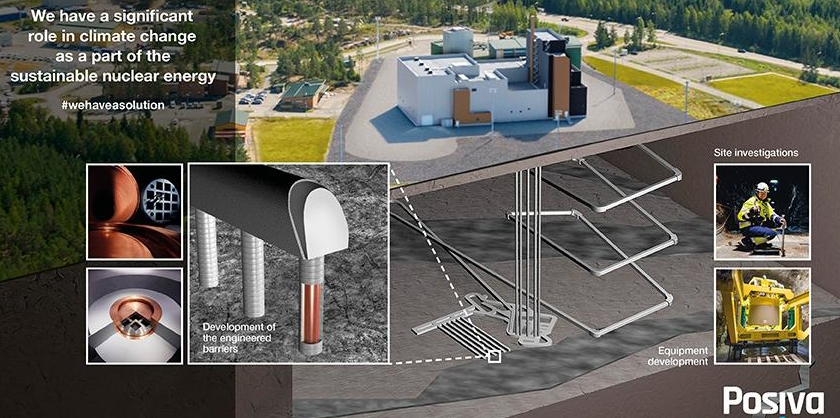
Onkalo consists of 3,300 capsules more than 400 meters underground, carved into seismically stable rock. Total uranium capacity is 6,500 tons. When filled up, a century from now, the tunnel needs to be permanently closed.
Construction began in 2004 in Olkiluoto. It is an island hosting the eponymous nuclear power plant, run by TVO. The investment is valued at EUR 1 billion.
Safety sets pace
The operating license doesn’t imply an immediate launch, though. Before final disposal begins, the company must carry out testing and inspections for the Radiation and Nuclear Safety Authority (STUK) to verify and approve. The body issued the safety assessment in August.
Posiva is tasked with the management of the spent nuclear fuel generated by its owner companies. It said the repository would be active for more than a hundred years.
Onkalo is equipped to receive spent nuclear fuel for more than one century
“This solution has not been built because it was easy. It was built despite not being easy. Because it is the responsible thing to do. And because it is the right thing,” said Posiva’s President and CEO Ilkka Poikolainen.
Only safe final disposal is possible, which is why the firm will take the time to complete the final stages with care, he pointed out.
Completing nuclear energy lifecycle
The long-term safety of final disposal relies on the multi-barrier principle. The spent nuclear fuel is isolated from people and the living environment deep in the bedrock by means of multiple mutually complementing engineered and natural barriers.
Posiva said its work has set an example to countries developing their own final disposal solution. The know-how is exported to 19 different countries by Posiva Solutions.