
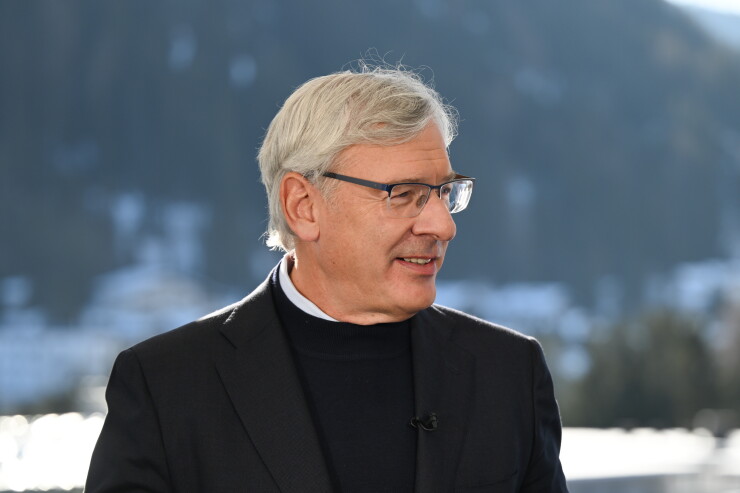
Chris J. Ratcliffe/Bloomberg
- Key insight: RBC is hoping for the best by investing in projects that hinge on better U.S.-Canada relations, while also preparing for the worst by building loss provisions and taking other protective steps.
- Expert quote: "We're investing in growth, not decoupling." — Dave McKay, CEO of RBC
Processing Content
Over the past two years, economic relations between the United States and Canada have sharply deteriorated. As the two nations hit each other with tit-for-tat tariffs, Prime Minister Mark Carney famously called the situation a "rupture, not a transition," requiring a long-term reduction in Canada's dependence on the U.S.
The head of Canada's largest bank, however, remains optimistic.
"It's not a decoupling," Dave McKay, CEO of the Royal Bank of Canada, told American Banker. A reduction in trade between the two countries? "It's hard to see that happening, because it's been so beneficial to both sides."
RBC has a large stake in both nations' economies. The Toronto-based bank's U.S. businesses took in a net income of $826 million in U.S. dollars during the quarter that ended July 31, about 19% of the lender's bottom line in that period.
And the CA$2.5 trillion-asset bank continues to bet on a future that involves more U.S.-Canadian cooperation, not less. RBC has helped finance a number of oil and gas pipelines connecting the two countries. And in August, it announced the creation of a Global Transaction Banking unit, combining RBC's digital cash-management platforms in the U.S. and Canada.
"We're putting our money where our mouth is and investing in technology linkages that help companies operate more seamlessly in North America," McKay said. "We're investing in growth, not decoupling."
This has not been an easy time to have faith in that future. Less than a month into his second term, President Trump imposed 25% tariffs on almost all U.S. imports from Canada, to which Canada responded with its own 25% tariffs on American goods. Since then, the two countries have been locked in an on-again, off-again trade war, dragged out by sporadic pauses and exemptions.
In August 2026, negotiations dramatically broke down. Rather than give in to American demands — including, allegedly, having a say in Canada's tariffs on other nations and in its laws promoting the French language — Carney said Canada would survive by "becoming stronger and less dependent on America."
"Last spring, I warned that America is trying to break us so that they can own us," Carney said at the time. "And I promised: 'That will never, ever happen.' We are keeping that promise."
And yet McKay does not seem particularly worried. After all, he pointed out, there is already a free trade agreement in effect between the two nations — the United States-Mexico-Canada Agreement — and it doesn't expire until 2036.
"There's been posturing in the media on both sides," McKay said, but "business is saying, 'Let's just continue to build together.'"
Battening down the hatches
As for Carney's trade strategy, McKay embraces half of it. The CEO hopes Canada will ramp up business with other trade partners, as the prime minister has suggested — but without reducing its exchange of goods with the U.S.
"Diversification drives prosperity," McKay said. "We don't want to diminish our trade with the United States. We want to grow it — as we want to grow our trade with Europe and Asia."
But this sunny attitude somewhat belies the fact that RBC has taken significant precautions. In May 2025, a month after Trump announced his "Liberation Day" tariffs, RBC announced that it had increased its provisions for credit losses by 54%. At the time, McKay explicitly said this was to guard against a potential economic downturn caused by the trade war.
"We knew that would cause us … to miss expectations, but we still took them at the end of the day, because that's what the scenarios advise us," he said during a May 2025 earnings call.
Stephen Boland, a bank analyst at Raymond James, said there's no doubt RBC has readied itself for a downward spiral in trade relations.
Canadian banks "have got to be very careful about lending to companies that have big U.S. exposure, because you never know what's going to happen there," Boland said. "All of a sudden, Trump can turn around and tax or tariff a certain business line that hadn't been contemplated before."
And provisions are not the only protection RBC has from the tariff fallout. Over the years, the bank has vastly diversified its operations, drawing profits from areas that are far less reliant on the U.S. In the most recent quarter of 2026, for example, wealth management and capital markets each earned more net income than commercial banking.
"The biggest part of RBC now is not actual loan growth," Boland said. Royal, as the company is known in Canada, "is very much diversified away from just being a pure banker."
So even as McKay emphasizes the best possible outcomes, his bank is well positioned for the worst.
"I think maybe because it's Royal, it's the biggest bank, he's trying to be optimistic," Boland said of McKay. "But they are definitely prepared for a worst-case scenario."
The City National factor
McKay has also been dealing with the fallout from business challenges in the U.S. that coincided with the mini-banking crisis of 2023. City National Bank, the Los Angeles lender that RBC acquired in 2015, suffered a number of severe setbacks three years ago, including hundreds of million of dollars in losses and a $65 million fine from American regulators.
More recently, however, City National has become a comeback story.
"City National is doing exceptionally well," the CEO said. He asserted that the trade issues have had "very little impact on City National or U.S. business, for the most part."
City National has, in fact, mounted a steady recovery over the past three years. In the Canadian bank's most recent quarter, the U.S. unit took in a net income of $184 million, up from $114 million in the same period of 2025 and $52 million in 2024.
"It's been a big improvement," Boland said. "I think improving the operations has happened — that's been a three-year process — and now they're really focusing on driving the loan growth."
The most important step in that turnaround, McKay said, was hiring a new leadership team. During the pandemic, City National crossed the $100 billion-asset mark so suddenly that its leaders weren't yet ready for the new regulatory standards they faced, he said. So RBC brought in two Fifth Third Bancorp veterans to right the ship: Greg Carmichael, who became executive chair of City National, and Howard Hammond, who took over as the U.S.-based bank's CEO.
"I needed a different management team who had built a regional bank, versus a community bank," McKay said. "That changed everything."
Read more:
- Inside Fifth Third's 'innovation economy' ambitions
- Truist axes 'leadership center' as new CEO scrutinizes bank
- Wells Fargo prevails in pay fight with former CEO Tim Sloan
- BMO's top US executive to depart in leadership shuffle
But even under that new leadership, could City National suffer from the uncertainty and expense of a crumbling trade partnership? Boland's answer is "not yet" — but tariffs aren't the only U.S. policy that can hurt Canadian banks.
"I think the big question mark right now is going to be what's happening over in Iran and fuel costs — how does that impact your customers?" Boland said. "We haven't seen that yet, but I think that's going to start impacting behavior heading into 2027."
As for trade, McKay says he can't imagine the two North American countries breaking off such a long and mutually beneficial relationship. Perhaps high tariffs will persist in specific industries, he said, such as car manufacturing. Or perhaps the situation might change due to "a transition in leaders of the country or parties in control of Congress." But the two nations have too much to gain from each other, he said, to simply give up and accept the "rupture."
"When you talk about energy security, and data security, and technology security, and defense security, I think alliances are everything," McKay said. "I keep coming back to what Winston Churchill said: The only thing worse than fighting with your partners is fighting without your partners."

National Reporter
Nathan Place is a national reporter at American Banker. A native of New York City, he has worked for more than a decade in both print and video... Read full bio