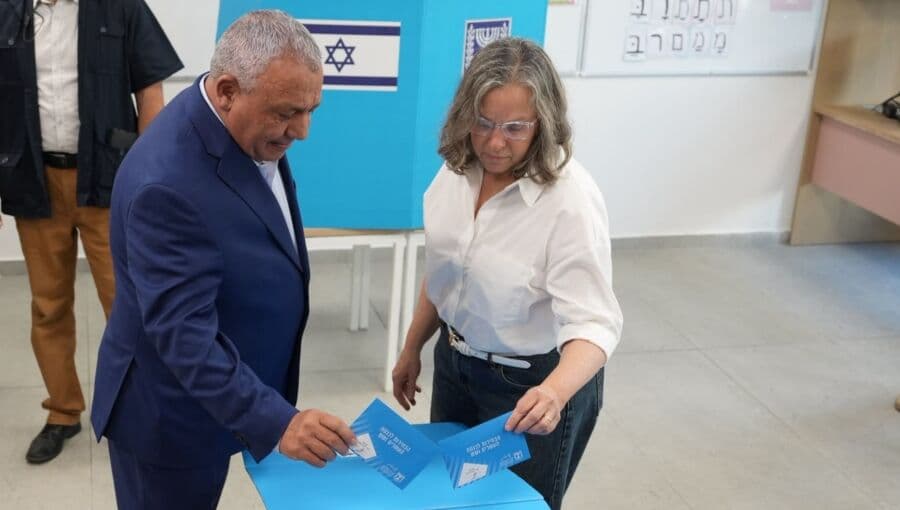
Israel faces a crucial legislative election on October 27, stirring excitement and anxiety among many voters.
The first election in the post-October 7 world, this vote is essentially a referendum on the incumbent government led by Prime Minister Benjamin Netanyahu.
The central question surrounding this election appears to be whether it marks the end of Netanyahu's reign, with the security failures surrounding the October 7, 2023, attacks at the centre of the conversation. While Netanyahu and his coalition partners have sought to earn public trust by pointing out Israel’s economic and security recovery following the attacks, his opponents have kept focus directly on the fateful day, with full knowledge that the current prime minister has opposed the establishment of a state inquiry into the security failure.
All indications suggest this election will have one of the highest voter turnouts in Israel’s history, with both sides of the political aisle clearly galvanised as they push their blocs to victory. Israel’s Central Elections Committee reported that as of 12:00 pm local time, the national election turnout stood at 31.5%, the highest figure since 1977. Of 7,331,981 eligible voters, 2,309,587 had already voted.
Speaking with voters on the ground, IntelliNews learned that excitement and anxiety filled the electorate's hearts, given the enormity of the occasion.
“I just think that the country needs new leadership and a new approach to all current issues we’re facing,” Jarred, an operations manager at a tech company in Tel Aviv, told IntelliNews.
Ella, a Tel Aviv resident pregnant with her first child, said she decided to vote for Naftali Bennett, part of Eisenkot’s opposition bloc. “We can’t elect the same government and expect different results. Time for change,” she told IntelliNews.
Shlomi, a software engineer from Ramat Gan, had a contrasting view. “Blame for October 7 cannot be squared entirely on Bibi’s [Netanyahu’s] shoulders. The army failed to respond. We can only blame Netanyahu for things that he was aware of.”
“Something that he [Netanyahu] was aware of was what happened after the attacks,” Shlomi continued. “The current government led a strong military campaign against Hamas, Hezbollah and Iran and is still fighting. Bibi is creating a new Middle East.”
Caro, a mother of three from Ashkelon, feels that the elections are negatively affecting her personal life.
“I find myself feeling increasingly uneasy and unsettled,” Caro told IntelliNews. “There has been so much stress in the air in the lead-up to the elections. Emotions are running high, conversations turn into arguments, and it sometimes feels as though our political opinions have become something that divides us rather than something we can discuss openly.”
“I have felt this tension in my own home,” she continued. “My husband and I hold opposing political views, and although we should be able to disagree, the tension has found its way into our household. At times, it seems that we simply cannot agree, and something that is happening on a national level begins to affect the atmosphere in our most personal space. It is unsettling to feel that politics can create distance between people who love each other.”
Caro also said the election's effects are spilling over onto her son.
“My son is voting for the first time in this election, as a soldier. I find myself thinking about what this moment means for him and for his generation,” she explained. “These are young people who are serving their country and carrying real responsibilities. What kind of country are we asking them to defend, and what kind of future are we offering them in return?”
She also voiced her opinion of Netanyahu, explaining: “I believe our Prime Minister should take responsibility for the war and its consequences, and that this responsibility should include stepping down. Leadership must come with accountability, especially during times of such profound national loss and upheaval.”
“I want to see a different set of priorities for Israel. More investment in education, welfare, healthcare, and the people who need support. I want us to focus not only on security in the immediate sense, but also on building a healthier, more equal, and more resilient society for the future,” she concluded.
Daniel, born in Los Angeles to an Israeli family, told IntelliNews about the election's significance, given his decision to move to Tel Aviv, where he has built a hi-tech career.
“Today's election feels like a major turning point in our nation's history, and as an Israeli-American who chose to build my life here, I don't just feel it as a citizen casting a vote,” Daniel explained. “I feel it as someone whose future, and whose children's future, is being decided.”
He added that he will be voting for Gadi Eisenkot.
These Israeli voters' conflicting views appear representative of the electorate at large, which remains highly split along political lines.
According to an aggregate of polls published over the seven days leading up to election day, compiled by Kan News, Netanyahu’s Likud party averages 22.1 mandates, narrowly edging out Eisenkot’s 21.3 mandates.
This poll of polls indicated that the Netanyahu bloc averages 53 seats, the opposition bloc averages 51 mandates, and the Arab parties total 14 seats, meaning no political bloc is close to the crucial 61-seat majority needed to form a coalition in the 120-seat parliament.