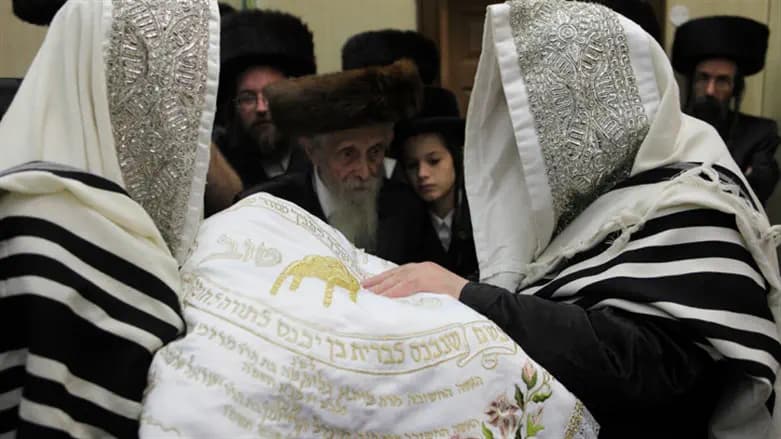
We end Lech Lecha with the Brit Milah of Avraham and his family, and start Vayerah with recuperation from it. From strict action comes a passive waiting for visitors who materialize as angels. These dovetailing parshiot capture the dialectics of man's ability to grow spiritually through physical action, as opposed to angels who have no potential for growth.
Fittingly, the Torah says three people were “nitzavim," standing by Avraham. These were angels. Their description frames their limitations. They are static, capable of standing, but not growing. Their essence lies in their ability to carry out missions but do nothing transformative within themselves.
Contrast this with the man of free will who decides whether or not to carry out G-d’s commandments. Whether to carry out a painful Brit Milah or not. Whether to absorb or not absorb the pain of a Brit Milah, which leads to a spiritual infusion of G-d.
Man can further spiritualize his actions by hastening to perform them. As Avraham was a zariz, rising early to carry out the word of G-d.
Such a predicament requires us to contemplate the idea of growing through action. Unlike angels, if we walk to shul, we get a reward. If we learn Torah, we’re elevating our essence. Every act of free will, if positive, gives us the keys to open a world above that awaits us. Action as opposed to stagnation: that’s the man-angel model.
For additional writings by the author, see Steven Genack, Articles, Anecdotes & Insights: Genack-Genechovsky Torah (Gefen Publishing House, 2023), available here.