
Spread the word
The Chartered Institute of Project Managers of Nigeria (CIPMN), which operates under the supervision of the Federal Ministry of Industry, Trade and Investment, has announced plans to publish the names of licensed project managers and establish a system for tracking professionals responsible for project delivery in the country.
The Registrar-General and Chief Executive Officer of the institute, Mr Henry Ifeanyi Mbadiwe, said the development was part of efforts to address abandoned projects, improve accountability and curb unprofessional practices.
Verification of professionals
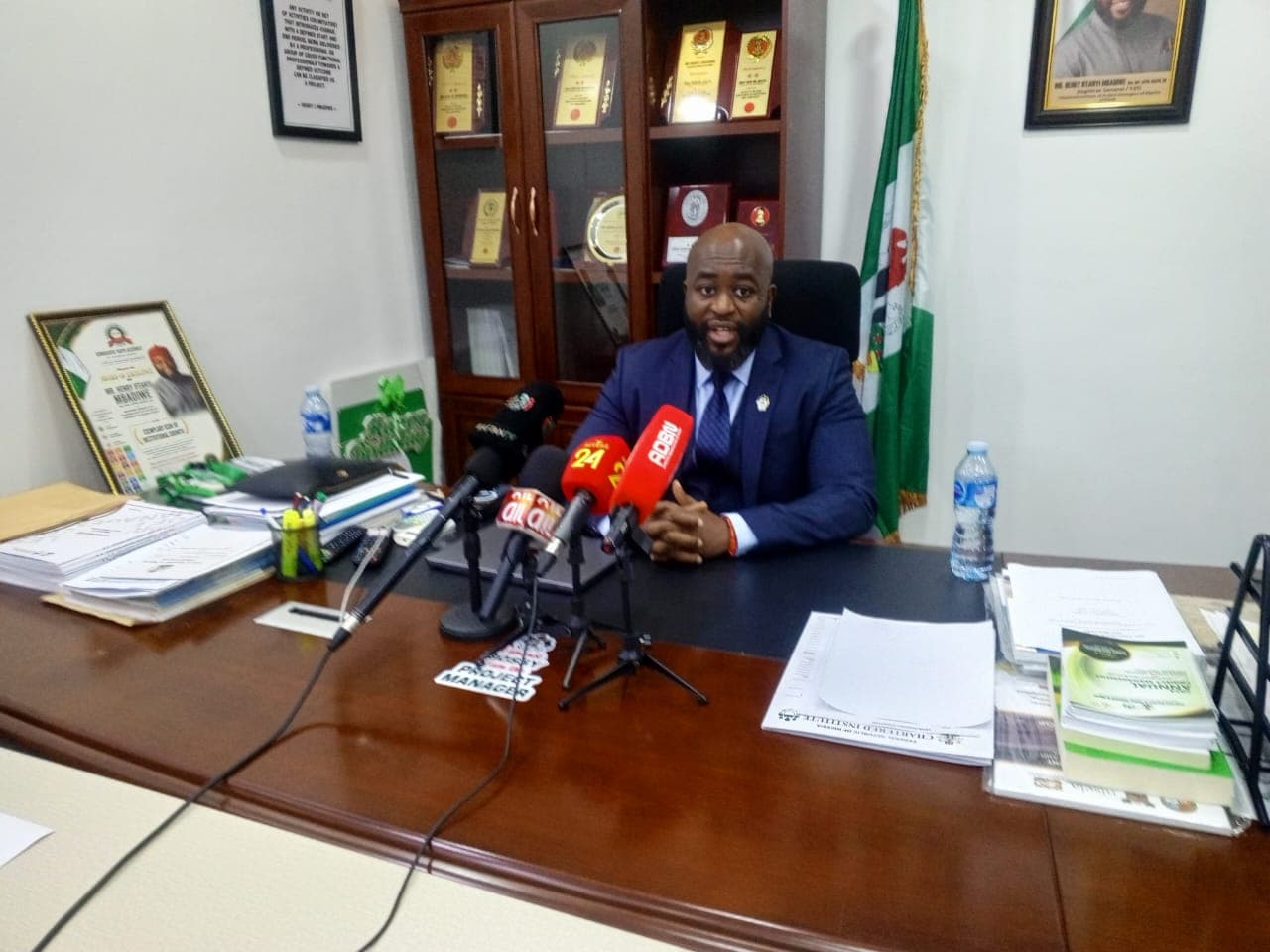
Speaking during an interaction with journalists in Abuja on Monday, Mbadiwe said the initiative would enable members of the public, government agencies and employers to verify the professional status of project managers and identify those responsible when projects fail.
He said the institute was developing a system through which project managers and the projects under their supervision could be identified and monitored.
“Every project has a licensed project manager who reports to CIPMN and whose details and projects can be tracked through the system we have built,” he said.
According to him, the system would make it easier to establish responsibility when buildings collapse or other projects fail, rather than allowing those involved in their execution to escape accountability.
“If a building collapses anywhere, you can call us, and we will tell you the name of the project manager who managed that building. That is the person you publish. Let the person explain why it happened, and then we will open an investigation,” he said.
Mbadiwe disclosed that the institute planned to publish the names of licensed project managers, alongside those who had registered with it but failed to meet their professional obligations.
He said the move would help distinguish properly licensed practitioners from individuals who falsely presented themselves as project management professionals.
“In November, I told my team that we would publish the names of every licensed project manager. We will also publish the names of individuals who have joined the institute but have failed to meet their obligations, so that they cannot go around claiming to be project managers when they are not,” he said.
The CIPMN chief executive explained that members of the public would be able to visit the institute’s website and search for the names of individuals claiming to be licensed project managers.
Regulatory framework
He maintained that the institute’s regulatory framework required project managers operating in Nigeria to obtain the appropriate licence, warning that individuals and companies that disregarded the law could face legal consequences.
“The law also says that if a company hires someone who is not a licensed project manager, both the person hired and the company that hired them are committing a crime,” he said.
Mbadiwe urged journalists to support the enforcement of professional standards by verifying the credentials of individuals who publicly claimed to be project management experts.
“So, you are our partners. If you hear anybody talking too much on television about being a professional, call them out. Call them out. I will back you up 1,000 per cent,” he said.
He identified weak enforcement by ministries, departments and agencies (MDAs) of government as a major obstacle to effective regulation of project management in Nigeria.
According to him, government institutions responsible for awarding contracts and approving projects should ensure that the professionals leading their execution are duly licensed.
He argued that compliance with the law would enable the institute to identify the individuals responsible for federal, state and local government projects without necessarily having to conduct physical inspections of every project.
“If somebody wants to obtain a no-objection certificate from the Bureau of Public Procurement (BPP) or clearance for a contract award, and the law is enforced, do you not think we would know the project manager responsible for every federal government project in Nigeria?” he asked rhetorically.
Mbadiwe said the same requirement should apply to state and local governments, as well as private-sector projects, insisting that public institutions should not make excuses for failing to comply with existing regulations.
“The real issue is that MDAs are not making it easy to regulate project management in Nigeria and ensure that project management professionals operate within the law,” he said.
He added that licensed professionals would be more cautious about accepting improper instructions because their licences and reputations could be at stake.
“If you are a licensed project manager delivering a project and you know that what you are being asked to do is wrong, you will think twice because your licence and reputation are at stake,” he said.
The CIPMN chief executive also disclosed that the institute was working towards establishing a more reliable national database of abandoned projects and the financial losses associated with poor project planning and execution.
He put the preliminary estimate of waste associated with abandoned and poorly delivered projects at between ₦12 trillion and ₦17 trillion, while acknowledging that the figures were broad estimates requiring further investigation.
He explained that the estimate covered projects dating from Nigeria’s inception to the present and was not limited to federal government projects.
“It is a very sketchy estimate. What you should actually have asked is: what period does it cover?” he said, adding that the figures were difficult to calculate accurately because of the volume of projects undertaken across the country over several decades.
Collaboration to identify funded projects
Mbadiwe said the institute intended to collaborate with the Federal Ministry of Budget and Economic Planning and governments across the federation, including local government authorities, to identify projects that had received budgetary allocations but were never completed.
“One of our plans going forward is to work with the Ministry of Budget and Economic Planning and governments across the federation, down to the local government level, to examine projects that were appropriated for but never completed,” he said.
He expressed optimism that a comprehensive exercise could begin next year, with the aim of producing more reliable figures on abandoned projects, the number of project managers operating in Nigeria and the financial losses associated with poor project delivery.
He said the findings would be made available to the public after the exercise, adding that the institute would continue to update its records as more information became available.
Collaboration with NUC on curriculum
On efforts to strengthen professional training, Mbadiwe disclosed that CIPMN had collaborated with the National Universities Commission (NUC) to develop a Core Curriculum and Minimum Academic Standards (CCMAS) for project management programmes in Nigerian universities.
He explained that the collaboration was intended to address the absence of a standardised project management curriculum within the university system and ensure that graduates acquired relevant professional knowledge.
“One of the first things we did was work with the NUC to create that curriculum. Now that the project management curriculum has been adopted by the NUC, universities are beginning to use it to teach project management,” he said.
According to him, the curriculum has provided the institute with an opportunity to engage universities nationwide and promote professional development among students before they enter the labour market.
He listed Coal City University, Enugu; the Federal University of Technology, Akure; and the Federal University of Technology, Minna, among institutions with which the institute was working directly.
Mbadiwe said CIPMN was also encouraging universities to establish arrangements through which project management students could obtain institute membership upon graduation, enabling employers to recruit graduates with recognised professional credentials.
He described the initiative as an important step towards building a competent workforce capable of delivering projects more efficiently and reducing avoidable losses.
Impersonation challenges
The registrar-general also raised concerns about the activities of individuals and organisations allegedly impersonating CIPMN and issuing project management certificates without proper authorisation.
He described the development as a serious challenge to the institute’s regulatory responsibilities, warning that unsuspecting Nigerians could be deceived by organisations using its name to issue purported professional qualifications.
“We have people who have established sham organisations, using the name CIPMN and issuing project management certificates in Nigeria. That is impersonation and criminal activity on a scale I have not encountered before. It is actually shocking,” he said.
Mbadiwe disclosed that the matter had been brought to the attention of the Presidency, the supervising minister, the police and the Ministry of Justice, expressing hope that the relevant authorities would take appropriate action.
He advised members of the public seeking to verify the institute’s identity or the credentials of project management professionals to use its official website, cipmn.gov.ng.
He said the alleged impersonation highlighted the challenges confronting professional regulation in Nigeria and underscored the need for stronger enforcement of existing laws.
Operational independence
On the institute’s operational independence, Mbadiwe said CIPMN had generated its revenue internally over the past three years rather than relying on government appropriations.
He explained that the arrangement had helped the organisation carry out its regulatory responsibilities without undue financial pressure or interference from external interests.
“I think what that does is prevent the situation where ‘he who pays the piper dictates the tune.’ We can do our work and enforce the law without anybody disturbing us,” he said.
Mbadiwe maintained that the institute’s responsibility was to regulate project management professionals impartially, irrespective of their political, institutional or other affiliations.
“Our responsibility is to regulate project managers in Nigeria. Everybody who is not getting on board is working against that mandate, and I am not going to be comfortable with that,” he said.
He expressed confidence that sustained enforcement, improved university training, professional licensing and cooperation from government agencies would help address the persistent problem of abandoned projects and strengthen accountability in Nigeria’s construction and project delivery sectors.
Spread the word