
LOS ANGELES — Founded in 1966 by Sydney B. Felsen and Stanley Grinstein, Gemini G.E.L. has long been one of the crown jewels for printmaking. To celebrate its 60th anniversary, Gemini invited curators Susan Dackerman and Helen Molesworth to mine the archive for the exhibition (Almost) Every Year: Sixty Years of Printmaking at Gemini G.E.L. Although the exhibition covers almost every year, the curators were primarily interested in how, as a workshop, the venue served as a place for dialogue among visiting artists and for tinkering outside normal routines or comfort zones.
As the chronology reveals, Gemini opened with a bang, bringing in celebrated New York artists such as Josef Albers, Man Ray, Robert Rauschenberg, Jasper Johns, Claes Oldenburg, Frank Stella, and Ellsworth Kelly. At the same time, they recognized the achievements of Los Angeles’s own growing artist community by inviting David Hockney, Ed Ruscha, Ron Davis, and Bruce Nauman. By the 1980s, women worked at Gemini, starting with Dorothea Rockburne and Vija Celmins, followed soon after by Susan Rothenberg and Elizabeth Murray. Today, as the curators noted in the gallery talk, Gemini’s artist list is distinguished by its gender equality.
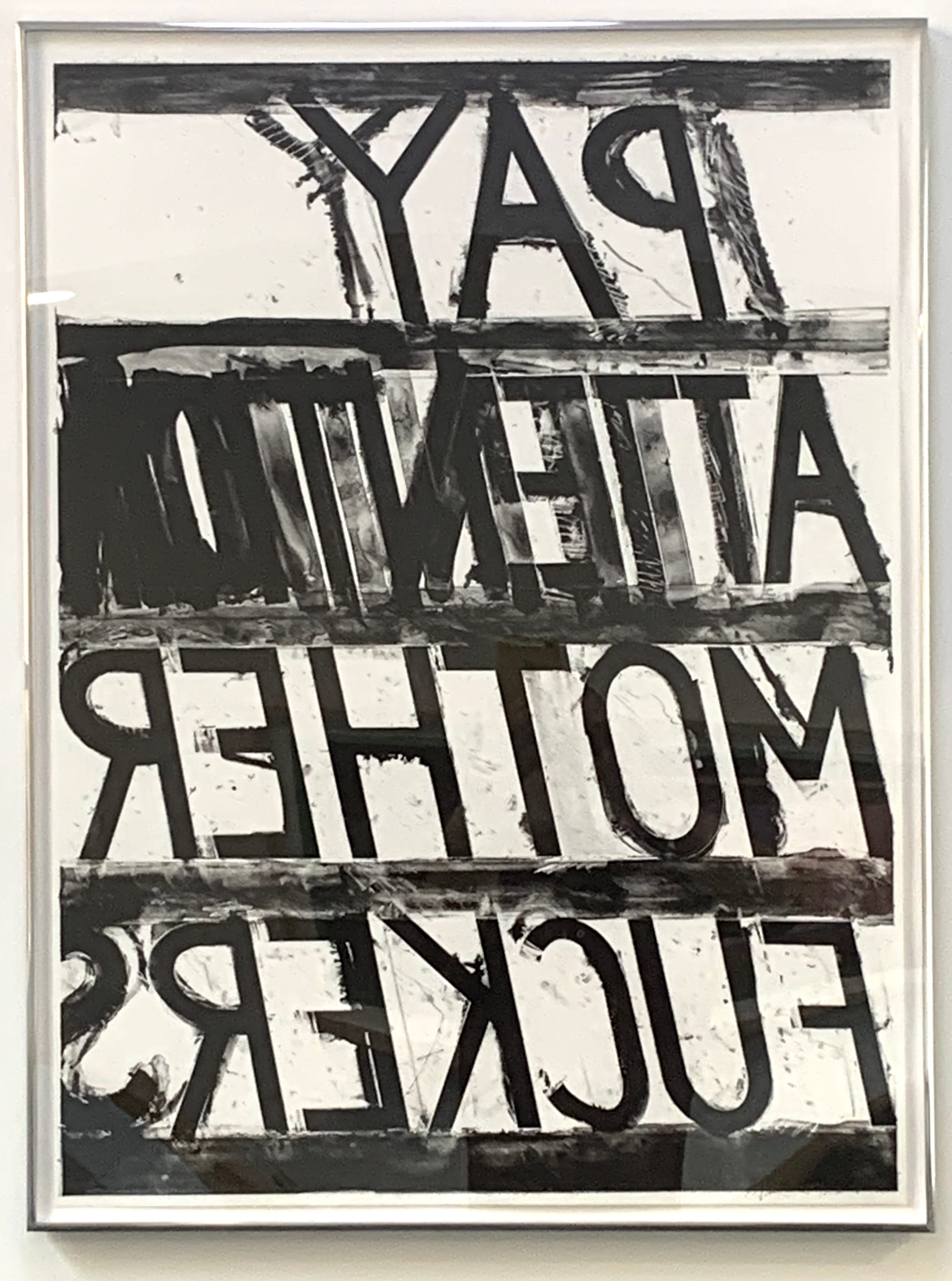
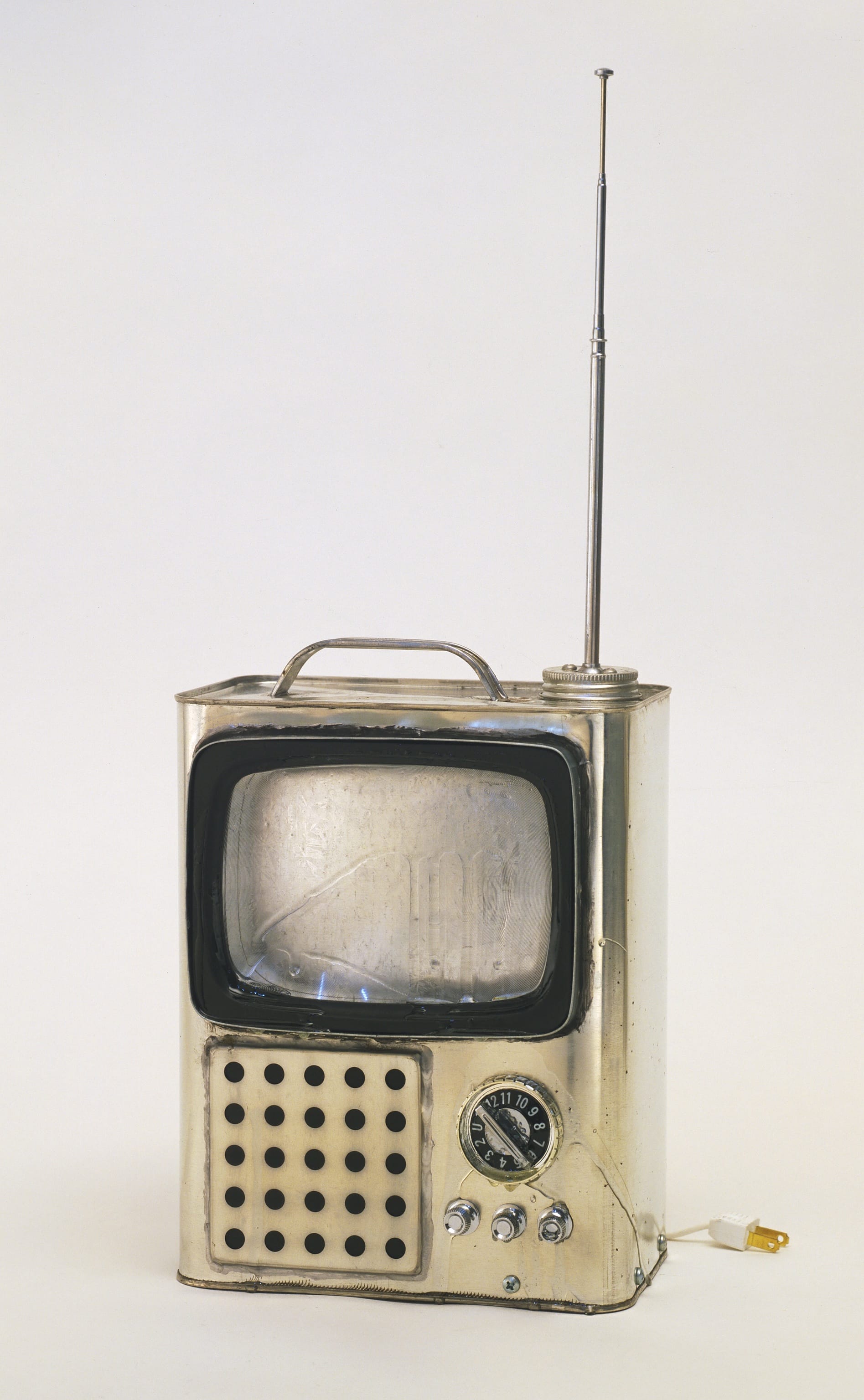
Bruce Nauman, “Pay Attention” (1973), 1-color lithograph (photo David S. Rubin/Hyperallergic) (left); Edward and Nancy Kienholz, “The Econo-Can” (1977), metal with frensel lens system (photo courtesy Gemini G.E.L.) (right)
Mutual interests among resident artists are nicely illustrated through juxtapositions that show Stella and Kelly exploring shape and color, Rauschenberg and Johns toying with found object imagery, Rothenberg and Richard Serra taking the color black to the extreme, and Toba Khedoori, Julie Mehretu, and Analia Saban examining linear matrices. Several works stand out because the artists cleverly defy our expectations. For example, Joel Shapiro and Richard Tuttle, both known for their unique approaches to predominantly minimal sculpture, opted for exuberant, polychromatic palettes and complex configurations in their screenprinted geometric abstractions.
The best examples of experimentation push the boundaries of what we consider a print. In 1969, Oldenburg molded polyurethane to replicate an automobile profile in relief, perhaps influenced by the Southern California Finish Fetish art of the period, while Johns printed an image of a lightbulb on lead, turning something fragile into a durable, permanent object. Pushing conventions even further, Edward and Nancy Kienholz turned ordinary gasoline containers into sculptures resembling television se ts, and, more recently, Allen Ruppersberg created a multi-colored screenprint on a 20-foot-long perforated piano-player roll which he divided into four separate sections. Titled after a traditional Southern gospel hymn that was once recorded by Johnny Cash, “Great Speckled Bird” (2013) takes a nostalgic look at classic Americana. The imagery consists of reproductions of lyrics from age-old songs, handwritten by the artist on vintage motel stationery.