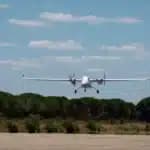
Portuguese firm Tekever – Portugal’s seventh unicorn company after a funding round pushed its valuation past one billion pounds/ euros/ dollars, and which specialises in drones equipped with artificial intelligence – has announced the sale of unmanned aerial systems to the United States Special Operations Command (USSOCOM), without disclosing the value of the deal.
The systems “have successfully completed a validation and acceptance testing programme, supported by specific training activities, with an extensive flight campaign carried out at various locations”, states the company, which has not disclosed the number, model or specific configuration of the systems acquired.
According to a press release issued today, the systems in question are designed to provide intelligence, surveillance and reconnaissance capabilities in demanding operational environments, through a modular architecture that integrates the aerial platform, mission-specific equipment, communications and operational software utilising Artificial Intelligence (AI).
According to Tekever, the acquisition represents a further step in its long-term commitment to the United States and the US special operations community.
Quoted in the press release, Tekever’s Chief Executive Officer (CEO), Ricardo Mendes, described the acquisition as a milestone in a relationship built up over time through trials, dialogue and collaboration with USSOCOM teams.
The technology company also highlighted that its development model is based on collecting data and feedback during flights, which it uses to improve its systems and meet operational needs.
Tekever is a multinational technology company with facilities in Portugal, the United Kingdom, France, Germany, Estonia, Ukraine and the United States, and employs over 1,500 staff. In the summer, it announced a €470 million contract to supply drones to the British army, and more generally, it is described online as holding ‘major government and agency contracts to supply autonomous uncrewed aerial systems (UAS) across Europe’.
Source: LUSA

Natasha Donn
Journalist for the Portugal Resident.