
The nation needs a realistic agreement with the U.S.
See more Toronto Sun on Google — save as a Preferred Source

Subscribe now to read the latest news in your city and across Canada.
- Unlimited online access to articles from across Canada with one account.
- Get exclusive access to the Toronto Sun ePaper, an electronic replica of the print edition that you can share, download and comment on.
- Enjoy insights and behind-the-scenes analysis from our award-winning journalists.
- Support local journalists and the next generation of journalists.
- Daily puzzles including the New York Times Crossword.
Create an account or sign in to continue with your reading experience.
- Access articles from across Canada with one account.
- Share your thoughts and join the conversation in the comments.
- Enjoy additional articles per month.
- Get email updates from your favourite authors.
Create an account or sign in to continue with your reading experience.
- Access articles from across Canada with one account
- Share your thoughts and join the conversation in the comments
- Enjoy additional articles per month
- Get email updates from your favourite authors
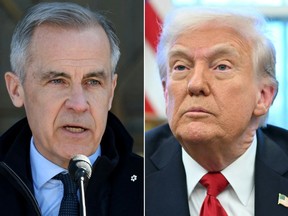
With trade talks between the U.S. and Canada reportedly on again, Prime Minister Mark Carney’s argument that no deal is better than a bad deal ignores the reality that no deal is a bad deal for Canada.
Recommended Videos
That’s because in the real world, “elbows up” is a slogan, not a strategy.
What Canada needs is a trade deal we can live with.
Major sectors of our economy — autos, steel and aluminum to name just three — hard hit by tariffs, cannot simply replace the importance of the U.S. market.
That’s true no matter how many so-called trade deals Carney signs with other countries.
As Graeme Gordon wrote in The Hub in April: “The prime minister highlighted his many foreign trips in his first year in office as evidence that his government is finding new markets for Canada to sell to, and also to drum up his goal of $1 trillion in new investment in Canada by 2030 — something business experts believe will be difficult to achieve, ironically, without a stable trade deal with the U.S.”
Fact-checking Carney’s claim of signing 20 new trade deals, Gordon said 16 are actually “frameworks, memorandums of understanding and letters of intent for future talks for a trade agreement of some sort down the road.”
Even the four binding deals will take years to bolster the Canadian economy.
To be clear, it’s a good idea for Canada to pursue non-U.S. markets, but when it’s promoted as a viable response to lacking a stable trading relationship with the U.S., it’s misleading.
A year ago, Carney boasted in the House of Commons about getting “an even better deal” on trade with the U.S. than the Canada-U.S.-Mexico Agreement on trade.
Today his government is taking the more realistic position that there will be new tariffs in any trade deal with the U.S., whether it’s a bilateral agreement with the U.S. on sectoral tariffs, or a trilateral deal between the U.S., Mexico and Canada under CUSMA.
As reported by the Toronto Star, Carney’s lead trade negotiator, Janice Charette, told a Toronto economic conference last week that the government’s goal now is to get the lowest U.S. tariffs possible on the widest range of goods.



Join the Conversation





This website uses cookies to personalize your content (including ads), and allows us to analyze our traffic. Read more about cookies here. By continuing to use our site, you agree to our Terms of Use and Privacy Policy.