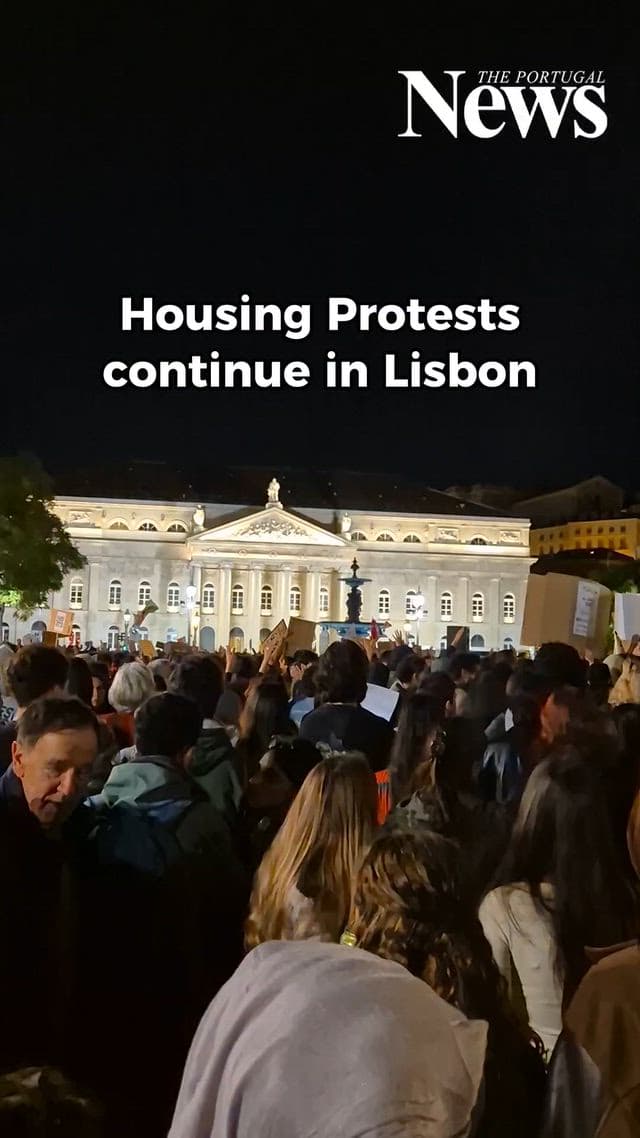
Protesters will gather outside the Justice Campus to support those detained during police operations before holding another public assembly in the city centre.
Lisbon’s Acampada movement will hold a solidarity vigil outside the city’s Justice Campus on Monday afternoon, 9 November, then return to Rossio Square for a public assembly at 7pm, as protests over housing costs continue following a forceful police operation at the weekend.
The vigil, scheduled for 1.30pm, aims to support demonstrators detained during police interventions on 20 and 25 October, who are due to face judicial questioning on Monday and Tuesday.
In a social media appeal, the organisers called on individuals and solidarity groups to attend in support of those they say were subjected to police violence.
Watch the full video of the protests here 👇👇👇
As reported by Diário de Notícias, the movement has shifted its immediate focus to supporting the detainees after days of demonstrations demanding more affordable housing.
Protesters arrested
These latest arrests followed simultaneous police operations in Lisbon and Porto during the early hours of Sunday, 25 October, when officers moved to clear camps set up by housing activists in Rossio Square and Praça D. João I, after demonstrators refused orders to leave and remove their tents.
Police used batons and dogs during the dispersal, which followed more than two hours of tension, as protesters maintained that their actions were protected by the constitutional right to demonstrate.
According to the Public Security Police (PSP), they arrested 31 people on suspicion of disobedience, 25 in Lisbon and six in Porto, reporting 33 people injured across the two cities, including 27 in Lisbon and six in Porto.
The PSP said the operation was necessary because the camps remained in place over the permitted time limits and without the required authorisation, and because they damaged public property.
In a statement, the police stressed that the right to peaceful assembly must be exercised within the legal framework governing the use of public spaces. The force said its actions were guided by the principles of legality, proportionality and necessity.
The weekend operation followed an earlier intervention in Lisbon on 20 October, when authorities detained 55 people during the removal of tents from Rossio, which are also part of the judicial proceedings scheduled for this week.
Housing crisis
These protests have raised awareness of the difficulties faced by people struggling to find affordable accommodation, particularly in Portugal’s major cities.
The demonstrations began in Porto on 10 October before spreading to Lisbon and other locations, gaining momentum after Parliament approved, in principle, the Government’s proposed changes to the urban rental regime on 30 September.
RTP reports that protesters have called for more public housing, an end to evictions and demolitions without alternative accommodation, restrictions on property investment funds acquiring homes, and affordable rents.
The organisers have argued that access to housing should be treated as a fundamental right rather than primarily as a market commodity.
Despite the police clearances, the movement has indicated that it intends to continue its campaign. Following a popular assembly on Sunday night, the Lisbon camp decided not to rebuild its tents immediately, instead prioritising solidarity actions and further organisation.
The return to Rossio for Monday evening’s assembly will give participants an opportunity to discuss next steps.
Police response
The police intervention has prompted contrasting reactions across Portugal’s political spectrum, with opposition parties questioning the use of force and the Government’s response.
Left-wing parties have criticised the operation and called on Prime Minister Luís Montenegro to explain the circumstances behind the dispersal, urging President António José Seguro to address the situation.
The Socialist Party, the Communist Party and the Left Bloc have argued that the housing crisis requires political solutions rather than restrictions on the right to protest, while Livre has also called for parliamentary scrutiny of the police operations, including the methods used and the safeguards applied to protect fundamental rights.
The Liberal Initiative has similarly criticised the use of force, arguing that police repression cannot compensate for failures in public housing policy.
In contrast, Chega defended the police intervention, maintaining that the authorities had to restore order and enforce the law, while also criticising Montenegro for not publicly addressing the situation.
The Social Democratic Party (PSD), which supports the Government, defended the operation, arguing the police response was proportionate, as Interior Minister Luís Neves also backed the PSP, saying the use of physical force was intended to ensure compliance with the law.
For the Acampada movement, Monday’s vigil and assembly mark the next stage of a campaign that organisers say will continue despite the removal of the camps.