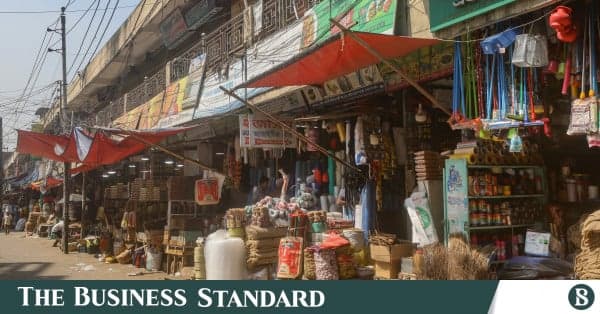
"Thatari Bazar got its name because thata (lightning) once struck the place," Shafi Mia explained. "And Kaptanbazar? That name came from the kaptas — the local thugs who used to gather here."
Shafi Mia runs a tea stall outside Kaptanbazar Complex. Nearby, Munna once sat with his box camera, alongside Aziz, Moksud and six or seven others, waiting for customers. They quit the business twelve to fifteen years ago, and some have since passed away.
Back then, people relied on box cameras for instant photographs, often needed for official work at government offices. Three copies cost just Tk20, making Kaptanbazar's camera men a convenient solution for those in a hurry.
Kaptanbazar's electrical market spans three adjoining buildings — Kaptanbazar Complex, City Corporation Market and Poura Market — with an estimated 800 to 1,000 shops, according to Shafi Mia.
In this sprawling maze of shops, it seems there is hardly an electrical need that Kaptanbazar cannot meet.
Inside, the market offers every kind of lighting, from chandeliers and LEDs to tube lights and streetlights. Shops also sell electrical fittings and accessories, including sockets, switches, circuit breakers, distribution boxes and switchboards.
Where goats arrive before dawn
Dulal Mia, too, has set up shop on the footpath, though his spot lies right in the heart of Kaptanbazar. Ask him about the market, and he'll tell you there's hardly anything you can't find here. Clothes, perhaps, are the one exception. Everything else is available, he says, and usually at prices a little lower than what you'd pay at the shops in your own neighbourhood.
But Kaptanbazar has a different kind of life after dark.
The market is busy enough during the day, yet it is at night that things truly come alive. From three in the morning, trucks begin rolling in, loaded with chickens and goats. And among all the goods that change hands here, one thing draws particular attention: goat meat.
There are some twenty-five to thirty shops selling it in the market, and every day, somewhere between 2,500 and 3,000 goats are slaughtered here. The cooks from some of Dhaka's well-known eateries, including Al-Razzak, Star Hotel, and Haji Biriyani, come to Kaptanbazar to buy their meat.
Yet, surprisingly, fresh meat is not what sells the most. Live goats are in even greater demand. They arrive here from all across the country, making their way from distant corners of Bangladesh to this bustling marketplace in the heart of Dhaka.
Along the main road stand the goat-meat shops of Mayer Doya, Akbar Store, and Lat Mia. Their signboards proudly announce: "No. 1 goat meat sold here."
But what exactly does No. 1 goat meat mean?
The answer, it turns out, lies in the kind of meat they sell. This is pure goat meat, the shopkeepers explain, with no buck or ordinary goat meat mixed in. And purity comes at a price. At these shops, a kilogram costs Tk1,400 — somewhat more than the usual rate.
The traders behind the egg trade
Dulal Mia recalled the traders who once dominated Kaptanbazar. Men like Abu, Anwar and Taj Mahmud were market heavyweights. He said traders from Sandwip dominated the goat trade, those from Laksam the egg business, Munshiganj natives the electrical trade, and Kishoreganj traders the hardware business.
Dhaka has two major egg wholesale hubs: Tejgaon and Kaptanbazar. Established in 1996, the Kaptanbazar Egg Traders Multipurpose Cooperative Society Ltd. now has 65–70 wholesale shops, handling hundreds of thousands of eggs daily.
The egg market sits right at the intersection of Thhatari Bazar and Kaptanbazar, two markets pressed so close against each other that, without their signboards, you might struggle to tell where one ends and the other begins.
Thhatari Bazar, however, has little in the way of markets beyond a few auto-parts complexes. But it does have something else to take pride in.
Inside the local Shib temple stands a banyan tree, its sprawling canopy casting shade over a vast stretch of the surrounding area. Quietly rooted in place, its branches spreading far and wide, the tree is undoubtedly one of Thhatari Bazar's greatest treasures.
"Business is slower than before. Rising prices are our biggest problem, and we can't compete with packaged tea. A kilogram that cost Tk200 two years ago now costs over Tk300. Hawkers buying from us earn barely Tk250–300 a day. We used to sell 25 sacks of 50 kilograms daily; now we sell just four or five." Babulal, tea trader
From Captain Ford to Kaptanbazar
The mystery behind the markets' names, however, remained unsolved. A few more people were asked, but none could offer a satisfactory answer.
The desperate search for an explanation led to Muntassir Mamoon's Smriti Bismritir Nogori, where a possible account of the names could be found.
"The origin of the name Thhatari Bazar remains unknown," the book states.
"After 1850, the area gradually began to develop into a residential neighbourhood. Nazir Hossain has written that the word thhatari means a large wheel. Perhaps chariots were once built here, and the craftsmen who made their wheels were known as thhataris. The name may have originated from them. However, this explanation is difficult to accept without reservation."
The book goes on to mention that Kaptanbazar came into existence around the same time. It was established, the author writes, by Captain Ford.
Wikipedia also links the name Kaptanbazar to Captain Ford. According to its account, "Gord Bazar" gradually evolved into Kaptanbazar as the name passed through generations.
The market has another claim to fame, too. Located near Gate No. 2 of Gulistan, in the area beneath the Jatrabari Flyover in Dhaka, it is widely known as the city's largest pigeon market.
Every Friday, pigeon traders and enthusiasts gather here, buying and selling birds priced between Tk500 and Tk20,000.
But Kaptanbazar offers much more. Its hardware shops stock everything from hinges, padlocks and nails to ropes, tarpaulins and polythene sheets. Packaging shops sell floor mats, belts, clips and carton tape, while household stores offer everyday essentials such as tawas, woks, rolling pins, machetes, boti knives and wooden stools.
Memories of ice and a bygone Dhaka
A hurricane lantern hanging inside the Rashid Repairing Store caught the eye. The shopkeeper said it was for display, as locally made lanterns were no longer sold. A few Chinese-made ones remained, occasionally bought by collectors nostalgic for old-fashioned things.
Rashid Repairing Store, however, is better known for something else altogether: stoves. The shop has built a reputation for making pressure stoves, gas stoves, and blowlamps, locally known as bhulu lamps. It stands near Nawabpur Government High School, an institution established in 1935 at 4 Kaptanbazar.
The school has its place in the memories of the late educationist and National Professor Anisuzzaman, who enrolled in its ninth grade in 1949. In his autobiography, Kal Nirabadhi, he recalled the familiar journey from home to school:
"From our home in Shantinagar, we used to walk to our school in Kaptanbazar. Abba's doctor's chamber was very close to the school, on Station Road. A little farther along, just beyond the chamber, stood Dhaka Railway Station, which most people referred to as Fulbaria Station."
His recollections offer a glimpse of a bygone Dhaka. Near the school, he wrote, stood the Dhaka Ice Factory. Large blocks of ice were brought out to the gate, broken into smaller pieces, and sold to customers. Whenever the ice was broken, little fragments scattered in every direction.
During tiffin breaks, Anisuzzaman and his classmates would gather by the factory gate, picking up the scattered pieces of ice. No one ever objected.

Once famous for its Pangas fish
Kaptanbazar is believed to have first emerged as a market towards the end of British rule, sometime in the 1940s. In those days, the captains of ships docked at Sadarghat would make their way here to shop. But it was only after the Partition of 1947 that the market really began to flourish.
Before long, Kaptanbazar had become a trusted destination for Dhaka's residents looking to buy beef and chicken. Back then, finding beef in Dhaka was no easy matter; there were very few places other than Kaptanbazar where people could reliably buy it.
The fish market here, too, has a long history. It was particularly renowned for its pangas fish, which earned the market a name of its own among fish buyers. The pigeon market is equally old. Even during the Pakistan era, pigeon enthusiasts would travel from far and wide to buy and sell birds here.
The shops also dealt in premium-quality cardamom, saffron, raisins, and other dried fruits, selling them at wholesale prices.
The tea trade took root here during the Pakistan era as well. The warehouses brought in different grades of tea directly from auction centres and sold them to buyers. Among the varieties available were Orange Pekoe and Fannings, two distinct grades of tea.
Orange Pekoe is a black tea made primarily from young leaves and buds, with the leaves kept whole rather than broken into smaller pieces. Fannings, on the other hand, consists of tiny tea particles — smaller than broken-leaf tea but larger than the fine powder known as tea dust.

The slow decline of the tea trade
Kaptanbazar still has a handful of tea warehouses, but business is no longer what it used to be. Only eight to ten remain, including Rose, Kazi, and Kamal Tea House. At Rose, Babulal has watched the trade change.
"Business is slower than before," he said. "Rising prices are our biggest problem, and we can't compete with packaged tea. A kilogram that cost Tk200 two years ago now costs over Tk300. Hawkers buying from us earn barely Tk250–300 a day. We used to sell 25 sacks of 50 kilograms daily; now we sell just four or five."
Once, tea moved through these warehouses by the ton. Now, with packaged brands tightening their grip on the market, the old wholesale trade is struggling to keep up.
Dhaka has only one other hub for wholesale tea: Babubazar.
Brokerage houses inform warehouses in advance about auction dates and tea quantities. On auction day, warehouse representatives buy the tea and return it to their premises, from where it is distributed to retailers and hawkers across the city.
A living portrait of three eras
Kaptanbazar shops stock a variety of medicinal ingredients, including bhringraj (false daisy), kalokeshi powder, sandalwood powder, rosemary, anantamu (Indian sarsaparilla), liquorice root and dried red roses. Shopkeepers seem well versed in their uses.
Also known as keshraj, bhringraj is valued in Ayurvedic hair care. Sandalwood powder is prized for its cooling effect on the skin and is often mixed with rose water, milk or honey to make face packs. Rosemary is used to aid digestion and as a spice by those seeking to lose weight.
The shopkeepers may not be physicians, but they know their herbs well. Many follow these recommendations, carrying home remedies whose uses have been passed down through generations.
Herbs and home remedies are just one small part of the trade that keeps Kaptanbazar going. The market's daily turnover, by one estimate, comes to around Tk10 crore.
Just how much money changes hands here? Ask around, and the answers grow bigger with each conversation. Some put the daily turnover at Tk1 crore; others say it runs into hundreds of millions.
The obvious place to look for a reliable figure was the Kaptanbazar Shop Owners' Association. But its members had reportedly been missing for some time. After the mass uprising of 2024, they had gone into hiding, leaving the question unanswered.
A few conversations with shopkeepers eventually yielded a rough estimate: around Tk100 crore changes hands in Kaptanbazar every day.
Most buyers come to Kaptanbazar for wholesale goods, and many transactions rely on trust built over years of dealing. Here, familiar faces and a trusted word can matter as much as price.
While much of Dhaka sleeps, Kaptanbazar is already awake. Traders gather over tea, business begins, and as daylight spreads, the crowds thicken and the market grows louder.
There is something here that goes beyond buying and selling. It is a meeting place for the old and the new, a living portrait of three different eras sharing the same streets.