
5 Min Read

(Source: Leszek Kobusinski/Alamy Stock Photo)
Charter Communications fired back in a court case that could determine how the broadband operator can use the terms "fiber broadband network" and "fiber-powered" in its marketing, its website and its communications with customers.
On Friday (October 23), Charter filed its response to an AT&T-led lawsuit in front of a Texas district court alleging that the operator's use of those terms amounts to false advertising that misleads customers. In its motion to dismiss the case, Charter argued that there's nothing false or misleading about Charter's use of those terms and therefore the case should be tossed out.
AT&T's complaint, filed in late August, zeroes in on Charter's use of those terms to describe its widely deployed hybrid fiber/coax (HFC) network. AT&T argued that Charter is using that language to affix a "fiber halo" to its marketing of broadband, and that Charter's use of those terms to describe HFC is causing "irreparable harm." AT&T has asked the court to declare that Charter has engaged in unfair competition and to levy actual and "enhanced" financial damages on Charter.
Related:AT&T goes to the mat over Charter's use of 'fiber-powered' label for HFC
Much of the case centers on network architectures, with AT&T arguing that Charter's use of "fiber-powered" to describe HFC crosses a line. HFC networks deploy fiber to the node, and then use coaxial cable to connect homes and small businesses that are being served off the node. Charter has been using the term "100% fiber" to describe fiber-to-the-premises (FTTP) networks, which the operator is deploying in greenfield areas, including rural areas that are being aided by government subsidies.
Here's an example of how Charter currently explains and illustrates those differences on its website:
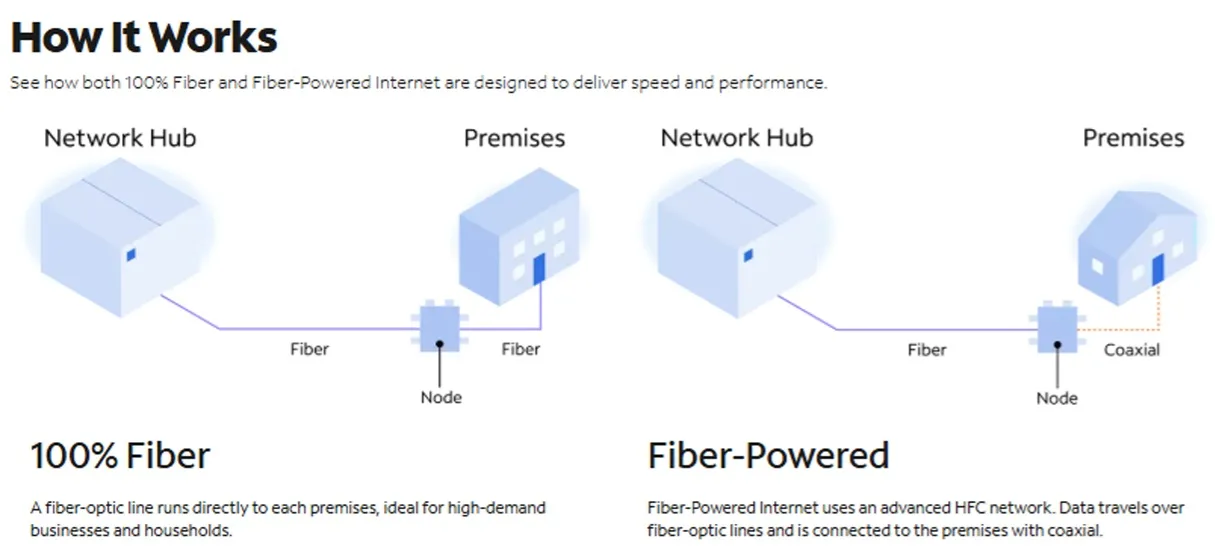
Screen capture of Charter website diagram illustrating and describing its 'fiber powered' and '100% fiber' architectures that Charter included in its motion to dismiss the AT&T lawsuit. (Source: Screen capture taken by Light Reading on October 23, 2026.)
AT&T's complaint against Charter emerged months after an ad watchdog ruled on the issue. It also enters the picture amid heated broadband competition between telcos and cable operators. AT&T's home broadband is led by fiber as the company aims to build fiber to 60 million homes and businesses by 2030. Charter is building FTTP in targeted areas alongside upgrades of its widely deployed HFC network.
AT&T argument centers on customer perception of 'fiber-powered'
AT&T's argument focuses on how it believes consumers perceive the language Charter is using to describe its HFC network. Charter counters that AT&T failed to supply any facts showing that consumers would read "fiber-powered" to mean exclusively fiber.
Related:Charter-Cox deal is a wrap, with 'Spectrum' brand to take over in mid-September
"By failing to allege any facts that explain why reasonable consumers would conclude that "fiber-powered" means 100% fiber, AT&T has not given the Court a basis to make that same inferential leap," Charter told the court. "AT&T's lawsuit is based on a theory of falsity that makes no sense and is belied by its own factual allegations." Charter also filed a proposed order to dismiss AT&T's complaint "with prejudice" (meaning the case would be permanently closed and can't be refiled.)
Charter: We're not hiding anything
Charter, which recently completed its merger with Cox Communications, believes that it's on solid legal footing, noting that it has been clear in describing the differences between the two architectures.
A "reasonable consumer," Charter held, would understand that Charter's HFC network incorporates fiber technology but is not composed exclusively of fiber components. Charter also argued to the court that it's not plausible, despite AT&T's claims, that Charter's use of the "fiber-powered" would be material to a consumer's purchasing decision.
Charter also disagreed with AT&T's allegation that Charter purposefully is deceiving consumers by "hiding" details about HFC, pointing to diagrams it displays on its website to illustrate the technical distinctions between its use of "fiber-powered" for HFC and "100% fiber" for FTTP.
"A company bent on hiding its coaxial connection does not illustrate it, explain it in an FAQ, and disclose it on-screen in its advertising," Charter told the court.
Let's consult the dictionary
Charter, which markets services under the Spectrum brand, also argued that the use of the word "powered" is not a synonym for "100%" or "exclusively," but is rather a "component part of a product or service."
Charter held that there's "no clear standard on what 'powered' means" in this context, and that the use of that word does not spell out what percentage of Charter's network is comprised of fiber.
Charter went as far as to point to a Cambridge Dictionary definition of the word "powered," which includes this usage example: "Most computers are now powered by Intel chips." Charter believes that example shows that its use of "fiber-powered" to describe its HFC network is accurate because fiber does "play a critical role" in delivering broadband to Charter customers.
"That sentence does not suggest that Intel chips are the computers' sole source of energy; indeed, Intel chips are not an energy source at all. Instead, it means that Intel chips play a key role in making the computers work," Charter explained.
AT&T complaint stems from ad watchdog decision
AT&T originally raised this issue with National Advertising Division (NAD). In March, NAD announced that Charter/Spectrum "voluntarily modified disclosures in connection with its 'fiber-powered' claims." Specifically, NAD said Charter agreed to discontinue its reference to HFC in its ad disclosures related to Internet services powered by fiber and to "clearly and conspicuously" disclose that such services are not delivered through a fiber-to the-home infrastructure.
But that apparently was not enough to placate AT&T, which followed with the lawsuit.
The use of fiber language in advertising not a new issue. Comcast and Verizon tangled over Verizon's use "100% fiber optics" to describe its Fios platform more than a decade ago. Time Warner Cable (now part of Charter) got into a couple of similar scrums with Verizon over the years.
The AT&T-Charter case is now back in the court's hands, and it's possible that there will be more back-and-forth before the court determines next steps. The result of the case could determine how extensively Charter (and possibly other cable operators that primarily use HFC) can reference fiber in their marketing and other types of communications with customers.
About the Author

Senior Editor, Light Reading
Jeff Baumgartner is a Senior Editor for Light Reading and is responsible for the day-to-day news coverage and analysis of the cable and video sectors. Follow him on X, LinkedIn and Bluesky.
Baumgartner also served as Site Editor for Light Reading Cable from 2007-2013. In between his two stints at Light Reading, he led tech coverage for Multichannel News and was a regular contributor to Broadcasting + Cable. Baumgartner was named to the 2018 class of the Cable TV Pioneers.