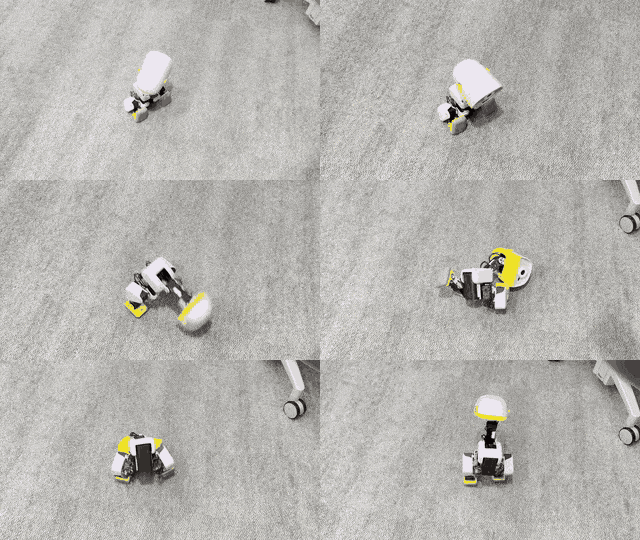
A robot that waddled along quacking like a duck picked itself up after toppling onto the floor. The machine, which mimics a duck's shape and gait, is the Microduck, developed by French firm Pollen Robotics. The robot has drawn global attention after Nvidia Chief Executive Jensen Huang demonstrated it himself, and that spotlight has now turned to Robotis (108490.KQ), the South Korean robotics company supplying its core actuators.
Robotis said on the 26th at its headquarters in Seoul's Gangseo district that it had signed a contract to supply about 750,000 actuators for the Microduck, the duck-shaped robot made by Pollen Robotics. Pollen Robotics put current demand for the Microduck at 50,000 units, with each robot carrying 15 Robotis actuators. The deal is worth about 3.5 billion won ($2.4 million).
Pollen Robotics is a robotics developer under Hugging Face, the artificial intelligence platform company. Pre-orders surged after Huang demonstrated the Microduck on the 21st. Matthieu Lapeyre, co-founder and chief executive of Pollen Robotics, said about 15,000 additional orders came in within three days of Huang's demonstration, adding that actuator demand next year is expected to reach at least 1 million units.

Pollen Robotics attributed the Microduck's popularity to its consumer-friendly design and affordable price. The robot was originally developed as a platform for reinforcement learning in robotics, but it has recently gained attention as a companion robot for general consumers. Lapeyre said he expects the Microduck to serve as a robot that lives alongside people in daily life, much like a pet.
Pollen Robotics has used Dynamixel, the Robotis actuator brand, in its earlier robot development as well. Dynamixel was also used in Reachy Mini, a small robot the company developed previously. Lapeyre said the company has used Dynamixel for a long time and chose Robotis because it trusted the company's ability to deliver high performance in a compact form.
Robotis expects the Microduck deal to broaden its actuator business into the consumer robot market. Kim Byoung-soo, chief executive of Robotis, said the company had found it difficult to publicize its supply deals because its business had centered on business-to-business sales, but the Microduck has allowed Robotis to showcase its technology widely. The CEO added that the project matters because the company is supplying core components for a popular robot, and said Robotis would do its utmost on production and quality control.
Revenue from the contract is expected to be reflected in earnings from next year. Robotis's production facility in Magok has annual capacity of about 500,000 actuators and is currently running at full tilt. The CEO said that producing additional actuators for the Microduck would require adjusting existing order volumes, and that the company expects to be able to meet rising demand from the second quarter of next year, when capacity expands.
