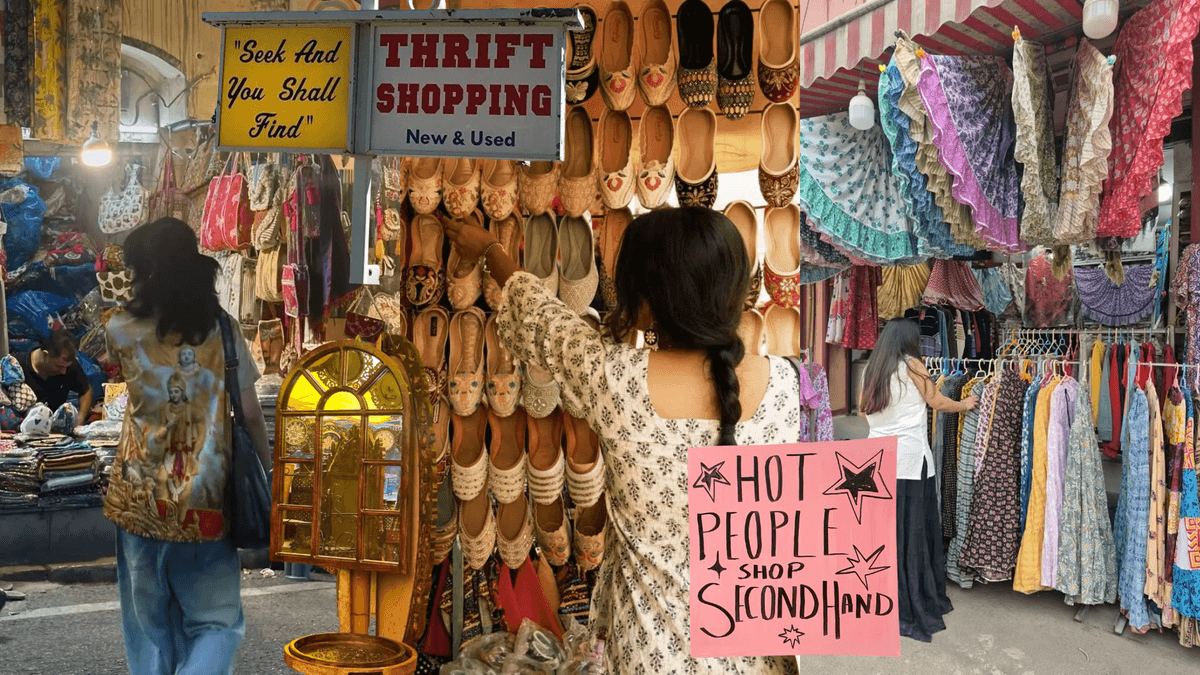
Welcome to the golden age of thrifting, where the best fashion finds don't always come with a label or a link
Thrifting has gone from something people did because it was cheap to something you do because you have taste. Somewhere between lockdown, Instagram thrift drops and the collective realisation that buying the same top as everyone else is a little boring, second-hand shopping got a serious rebrand.
During the pandemic, when physical shopping disappeared and Instagram became everyone's mall, India's online thrift scene really took off. Sellers started dropping tiny collections through Instagram, buyers started hunting for vintage pieces from their bedrooms, and suddenly the phrase 'pre-loved' sounded considerably more appealing than 'someone else's old clothes'.

And now, several years later, we're very much still digging.
Google Search data shows that interest in thrifting in India has hit an all-time high over the past year. Searches for 'how to thrift' have jumped 850%, while 'thrift store near me' has risen 600%. People are searching for everything from Y2K streetwear and vintage sarees to jackets, jeans, bags and even furniture, with Guwahati and Jaipur among the cities seeing breakout interest.
Which makes sense. Because, yes, thrifting is cheaper. But if saving money were the only attraction, we'd simply call it shopping on a budget and go home.
The real thrill is the find.
There is something deeply satisfying about pulling a jacket out of a crowded rack and knowing you probably won't see five other people wearing it next week. About finding an old sari with a print that somehow looks more interesting than anything currently hanging in a high-street window.
And then someone asks:
“Where did you get that?”
“Thrifted.”

The New Luxury Is A Little Bit Of Mystery
Fashion has become very, very good at making sure we can all have the same thing.
See a top on Instagram? There's probably a link in the bio. Spot a jacket on your favourite celebrity? Give it a few days and there will be a Meesho version. Fall in love with a microtrend on Monday and by Friday there are approximately 900 versions of it available online.
Convenient? Absolutely. Interesting? Debatable.
Thrifting offers the opposite experience. You don't always know what you're going to find, where it came from or whether you'll ever see another one. That unpredictability is part of the appeal. It also explains why vintage has become such a flex. There is a particular pleasure in owning something that doesn't immediately announce where you bought it, what season it is from or which algorithm convinced you to want it.
The best thrift finds can feel almost suspiciously personal. A vintage football jersey. A tiny beaded bag. A '90s leather jacket. An old silk saree. A pair of jeans that somehow fit perfectly despite appearing to have been designed for a completely different era.
We Want Clothes With A Little Bit Of Lore
Part of the current fascination with vintage is that people aren't just buying an aesthetic. They're buying a little bit of history.
Y2K is back, but so are old-school jerseys, vintage sarees, retro bags and silhouettes that have already had their first lives. Google's search data reflects just how broad that curiosity has become, with vintage clothing and Y2K styles seeing strong interest alongside more traditional thrift categories.
It helps that thrifting is also incredibly internet-friendly. A good thrift find is practically born for a story. There's the hunt, the reveal, the 'look what I found' post, the styling video, the inevitable comments asking where it came from. Instagram didn't invent thrifting, but it certainly knew how to make a ₹500 jacket that looks like it cost ₹5,000 feel like an event.
Most interestingly, everyone's version of a good find is different.
One person's perfect thrift score is a faded band tee. Another wants a 1970s saree. The category has stretched from clothes into furniture and homeware because, at the end of the day, the appeal is the same. Find something good. Find something different. Find something that feels like you. The internet may have made shopping incredibly easy, but thrifting brings back a little bit of the hunt.
You don't necessarily know what you'll find before you go in. You might leave with nothing. You might find the best jacket you've ever owned for ₹800. You might spend an hour digging through clothes and emerge with one deeply questionable belt.
That is part of the fun. We're used to shopping being frictionless. Search, click, pay, delivered. Thrifting puts a tiny bit of chaos back into the process.
When everything is available all the time, finding something that isn't feels special.
Also Read:
Fashion Hauls Are Officially Embarrassing. Someone Forgot To Tell The Algorithm