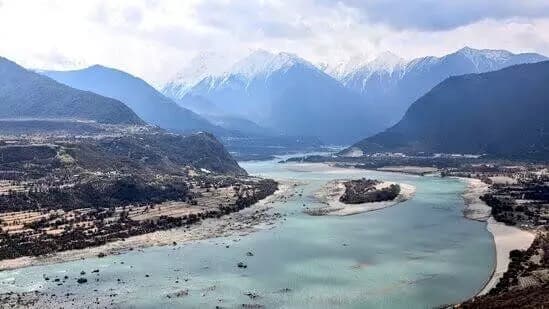
Beijing, Oct 26: Chinese researchers have warned that the Yarlung Tsangpo River in Tibet, which flows into India as the Brahmaputra, could experience increased runoff and heightened flood risks over the course of this century.
The findings come as China builds what is expected to be the world's largest hydropower project on the river, at an estimated cost of USD 168 billion.
Researchers from the Chinese Academy of Sciences and Yunnan University used tree-ring width chronologies from the southeastern Tibetan Plateau to reconstruct the river's runoff history from 1325 to 2020.
Combining the reconstruction with climate data, they developed a model projecting that river runoff could increase under future climate scenarios, alongside a possible rise in high-runoff events such as floods.
“These results provide a long-term perspective on hydroclimatic variability in the Yarlung Tsangpo River and a scientific basis for assessing future water-resource risks,” the researchers said in a paper published in the journal China Science Bulletin on October 8, the Hong Kong-based South China Morning Post reported on Monday.
The team said projected changes in runoff should be factored into the planning of water-resource development and storage infrastructure, as well as assessments of transboundary water risks.
The Tibetan Plateau has been warming at about twice the global average rate, affecting its ice cover and hydrological cycle, the researchers noted.
Changes in the river's hydrological regime could have implications beyond the plateau, influencing drought and flood patterns in South Asia.
“In recent years, with the ongoing warming of the climate, the hydrological regime of the Yarlung Tsangpo River basin has been undergoing significant changes,” they said.
The findings come amid wider concerns about the engineering and geological challenges facing China's mega-dam project.
In July, Chinese geologists warned that an active fault line directly beneath the planned project could threaten its structural stability.
In a paper published in the journal Sedimentary Geology and Tethyan Geology, the researchers urged engineers to strengthen slope stability and install retaining structures to mitigate the risks of landslides and collapses, the South China Morning Post reported.
The vulnerability of the Himalayan region to mountain hazards was also underscored by the August 26 flash floods along the China-Nepal border.
Triggered by an ice-and-rock avalanche and the subsequent collapse of a temporary river blockage, the disaster killed nearly 1,500 people and left more than 5,500 missing in Nepal and China, according to reported figures.
The mega project is being built in Medog, also known as Motuo in Chinese, in a deep Himalayan gorge where the Brahmaputra makes a sharp U-turn before flowing into Arunachal Pradesh and then Bangladesh.
China's Foreign Ministry has previously defended the project, saying it would not affect downstream countries and that safety concerns had been addressed through decades of studies and safety measures.