
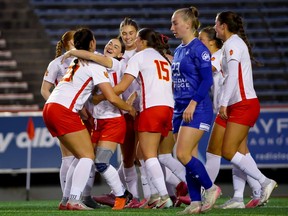
Before they took charge of the University of Calgary soccer programs, Diogo Raposo and Ramon Mifflin knew the Dinos from the other sideline, as one of the teams they least liked to see on the schedule.

Subscribe now to read the latest news in your city and across Canada.
- Unlimited online access to articles from across Canada with one account.
- Get exclusive access to the Calgary Herald ePaper, an electronic replica of the print edition that you can share, download and comment on.
- Enjoy insights and behind-the-scenes analysis from our award-winning journalists.
- Support local journalists and the next generation of journalists.
- Daily puzzles including the New York Times Crossword.
Create an account or sign in to continue with your reading experience.
- Access articles from across Canada with one account.
- Share your thoughts and join the conversation in the comments.
- Enjoy additional articles per month.
- Get email updates from your favourite authors.
Create an account or sign in to continue with your reading experience.
- Access articles from across Canada with one account
- Share your thoughts and join the conversation in the comments
- Enjoy additional articles per month
- Get email updates from your favourite authors
Sign In or Create an Account
“We hated playing the Dinos,” said Raposo, an assistant coach with the MacEwan University Griffins before he joined Troye Flannery’s staff with the Dinos women’s team in 2018. “We hated being on that old field. They were well-coached, athletic and hard to play against. At MacEwan, we were a very young program, so something we always strived for was to one day be like Calgary.”
Mifflin, now the Dinos men’s head coach, saw the same thing from across town, where he cut his teeth in Canada West men’s soccer with the Mount Royal University Cougars.

Your weekday lunchtime roundup of curated links, news highlights, analysis and features.
By signing up you consent to receive the above newsletter from Postmedia Network Inc.
A welcome email is on its way. If you don't see it, please check your junk folder.
The next issue of Noon News Roundup will soon be in your inbox.
We encountered an issue signing you up. Please try again
The Dinos had a veteran group back then, and the rivalry carried off the field.
“At Mount Royal we were always competing with them to try and recruit the same players,” Mifflin said.
Over the last decade, the Dinos men’s and women’s soccer teams have gone from tough opponents to championship contenders, a rise built on an identity set by their head coaches, a tight bond among players and a blossoming local soccer scene.
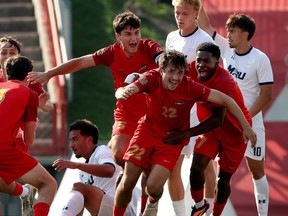
This season, both teams finished first in Canada West’s Prairie Division for the first time in the same year. The women (12-2) won their third straight division title, while the men (9-3-2) tied a program record for regular-season wins.
Two coaches, two identities
Mifflin comes from a footballing family. His father, also named Ramon, started for Peru at the 1970 World Cup and had a long professional career that included stops in Argentina and Brazil, where he became close friends with Pelé, and later joined him in the United States.
Mifflin followed in his father’s footsteps, building a professional career in the U.S. and his native Peru, which he credits with shaping his coaching philosophy and the Dinos’ playing style.
“We are a team that is possession-based, that treats the ball well,” said Mifflin, now in his third year at the helm. “There is a nice identity of playing good technical football. We like to put on a good show to the fans and show the league that this is a well-prepared, good football program.”
Raposo, now in his fifth year as Dinos head coach, credited Flannery with instilling a high standard but admitted his own upbringing in Rhode Island may have rubbed off as well.
“We like being blue collar. It is in our DNA year after year; maybe it is a reflection of how I was brought up,” Raposo said. “We want to give players freedom of decision-making in possession; we want them to love the ball. But we also pride ourselves on being defensively responsible and disciplined.
“I joke with recruits that we are typically in the top three in yellow cards, and that’s not because we’re dirty, but because we’re the hardest-working.”
A clear identity has allowed each program to remain a contender despite the constant turnover university programs face. The Dinos women’s team turned over 10 players who either graduated or didn’t return from last season, while the men’s team lost 13 from a year ago, including All-Canadian Owen Antoniuk, just weeks before the season began.
“All these ingredients have put together a first-place finish in the Prairies,” Mifflin said. “Everyone goes, ‘Oh, you lost 13 players last season,’ and I’m like, ‘But we have really good young players.’”
A year-round team
As with any successful team, culture has played an important role on and off the pitch for both soccer programs.
As a senior defender on the women’s team, Jaden Tomaszewski has seen her team evolve and adapt each year as players come and go, while maintaining the high standard expected of them.
“With the togetherness we have, everyone on the team has a role, regardless of what that looks like,” said the fifth-year arts student. “We play 18; there are players who do not dress, but whether you are in the stands, on the bench, or on the field, we all have that equal role to play.
“Even when players are in positions where they are not able to play, the value we provide each person makes everyone feel part of the team.”
That bond doesn’t just get built in the fall. When Mifflin joined the Dinos, he heard a common sentiment from his new team: a desire for a year-round training program.
Mifflin and Raposo both serve as directors at Calgary Blizzard, a club that fields teams in the Alberta Premier League (APL), which runs through spring and summer. Mifflin leads Blizzard’s men’s APL team, creating a seven-month season where players can develop physically and technically and build chemistry that carries into the Canada West season.
“This could really play to our advantage if we start in April and carry on into the season,” Mifflin said.
Many Dinos women play for Blizzard too, but for Raposo the club is an important recruiting pipeline, much like Flannery’s ties to Calgary Foothills were before him.
“I have done something similar with Blizzard where you are recruiting players you know, trust, and they would run through a wall for you,” Raposo said.
In 2025, the Blizzard men won the Alberta championship, earning a place in the 2026 Canadian Championship and the right to face CF Montreal of Major League Soccer, the top tier in Canada and the U.S.
Many current and former Dinos featured in the club’s first appearance in the national tournament. The semi-pro side fell 5-0 to the MLS club at Stade Saputo in May, but the match put Mifflin’s squad on one of Canadian soccer‘s biggest stages.
The Calgary advantage?
As the city heads into winter, it is hard to believe Calgary has become a soccer hotbed in Canada. Those long winters may be part of the answer.
“If you look at the best teams in Canada West, there are players from Calgary everywhere. The clubs here do a very good job of producing technical players but also athletic players,” Raposo said. “When you look at British Columbia, you get a lot of athletes who can play 11v11 year-round. We are unique in that, indoors, players play 7v7 or futsal, so I think you see a difference technically.”
Tomaszewski has also noticed the growth since her days in minor soccer.
“When I was young, it was not a very big sport locally,” she said. “Especially with the last few World Cups, the sport has just been growing so much around the city.”
Once desperate for a home of their own, the Dinos soccer teams now consistently play their home games at McMahon Stadium, whose amenities have earned the program the right to host the 2027 U SPORTS Women’s Soccer Championship.
In September, UCalgary also kicked off fundraising for a new on-campus stadium, a fit-for-varsity training, competition and event facility.
“I am so excited for the next generation — especially the young women in sport — who will get to experience that and feel like we are on the big stage for once and not always feeling like you’re playing on someone else’s stage,” Tomaszewski said.
Playoffs at McMahon
Both Dinos soccer teams will host playoff games at McMahon Stadium on Friday.
The men will play in the second of two quarterfinals at 4 p.m. against the Thompson Rivers University WolfPack. A win will send them to Sunday’s conference semifinal against the winner of the other quarterfinal between the University of Alberta Golden Bears and the University of the Fraser Valley Cascades.
The Dinos women will face a familiar foe in their Canada West quarterfinal on Friday at 7 p.m. For the third straight year, Calgary matches up against the University of Victoria Vikes. The two sides have split their last two post-season meetings, with the Dinos escaping with a 1-0 victory last year at McMahon Stadium. A Calgary victory would see the Dinos host the Canada West Final Four next weekend.
Whatever happens in the playoffs, Mifflin believes the programs are only getting started.
“We are laying the bricks to show people where we are headed,” he said.
Join the Conversation
This website uses cookies to personalize your content (including ads), and allows us to analyze our traffic. Read more about cookies here. By continuing to use our site, you agree to our Terms of Use and Privacy Policy.