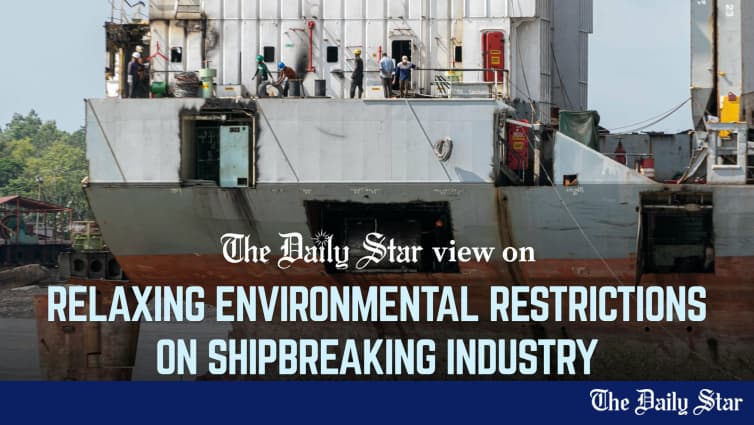
The government’s recent decision to downgrade shipbreaking yards from “red” to “orange” category, potentially easing the environmental assessment requirements, is a dangerous move that may backfire. In fact, we fail to see how this move could be justified when recent incidents raised the need for stricter safeguards. In an industry widely known for being occupationally and environmentally hazardous, risking workers’ safety and known environmental damage is indeed baffling.
The stakes are quite clear. Even with the existing safeguards, at least 150 workers have been killed and 264 injured in shipbreaking accidents in Chattogram’s Sitakunda—where most of the country’s shipbreaking yards are located—between 2015 and 2026 (till October), according to records maintained by the Bangladesh Institute of Labour Studies (BILS). In August this year, 10 workers died from toxic gas exposure while dismantling a scrapped ship at Ferdous Steel Ship Recycling Yard. Ferdous Steel was one of the 23 “green” yards, which means it had checked all the safety boxes on paper. However, safety deficiencies were identified during an inspection six months before the accident. Ferdous Steel was also flagged by the authorities for repeatedly flouting labour law. If even certification cannot guarantee basic safety, the government should be strengthening monitoring rather than relaxing scrutiny.
Under the Environment Conservation Rules 2023, shipbreaking activities and yards fall under the red category because of their potential impacts on the environment and human health. The existing approval process includes an environmental impact assessment (EIA), public consultation, and scrutiny by the Department of Environment. Reclassifying the industry may make the EIA discretionary rather than obligatory, depriving regulators and the affected communities of a crucial means of assessing risks. Industry representatives argue that environmental clearance takes around 90 days and imposes financial costs. These concerns certainly deserve attention, but the solution is making approvals faster and more transparent, not lowering safety standards. Moreover, a decision affecting coastal ecosystems, public health and workers’ safety should not have been made without consulting the relevant experts.
Lowering safeguards to boost industrial growth and attract investment can never be a solution. Strict enforcement of the existing measures is essential, including regular independent inspections, adequate protective equipment, effective emergency response and meaningful penalties for violations. A competitive shipbreaking industry should be measured by its ability to protect the workers and the environment, not by the speed and volume of business it brings in.