The film and television production industry has spent the past several years navigating real headwinds. Productions have followed cost savings overseas, technological innovation has evolved from a talking point to a daily reality on set and in the writers’ room and a widening field of state and international incentive packages has pushed some markets into what looks more like a race to the bottom than a rebound. For studios still operating on the old build-it-and-lease-it model, that shift has been hard to ignore.
Soundstages aren’t going anywhere. What’s changing is who succeeds with keeping them full, and it’s the operators nimble enough to keep pace with that mantra who inevitably pivot to new ideas. Demand for physical production remains strong in certain key regions of the U.S., but the assumption that four walls and a lease are enough on their own no longer holds. The campuses built to flex with the changes are the ones pulling ahead.
“I still believe in physical production. I believe there will remain a need for boxes that cater to those types of productions,” said Shawn Papazian, president and CEO of The Fields Studios in Chicago. “At the same time, it’s essential to shift flexible design details into a basis and not just building to a pro forma that you think you can financially achieve. Doing something that can work as a campus environment and can host a variety of different creative endeavors is essential.”
Papazian frames that shift in practical terms: a facility that can pivot on short notice with soundstages that host a scripted drama one season and an immersive event the next. “This can be everybody’s sandbox,” said RoseMary Prodonovich, general manager of The Fields Studios. “We want to be the epicenter of creative culture in Chicago.”
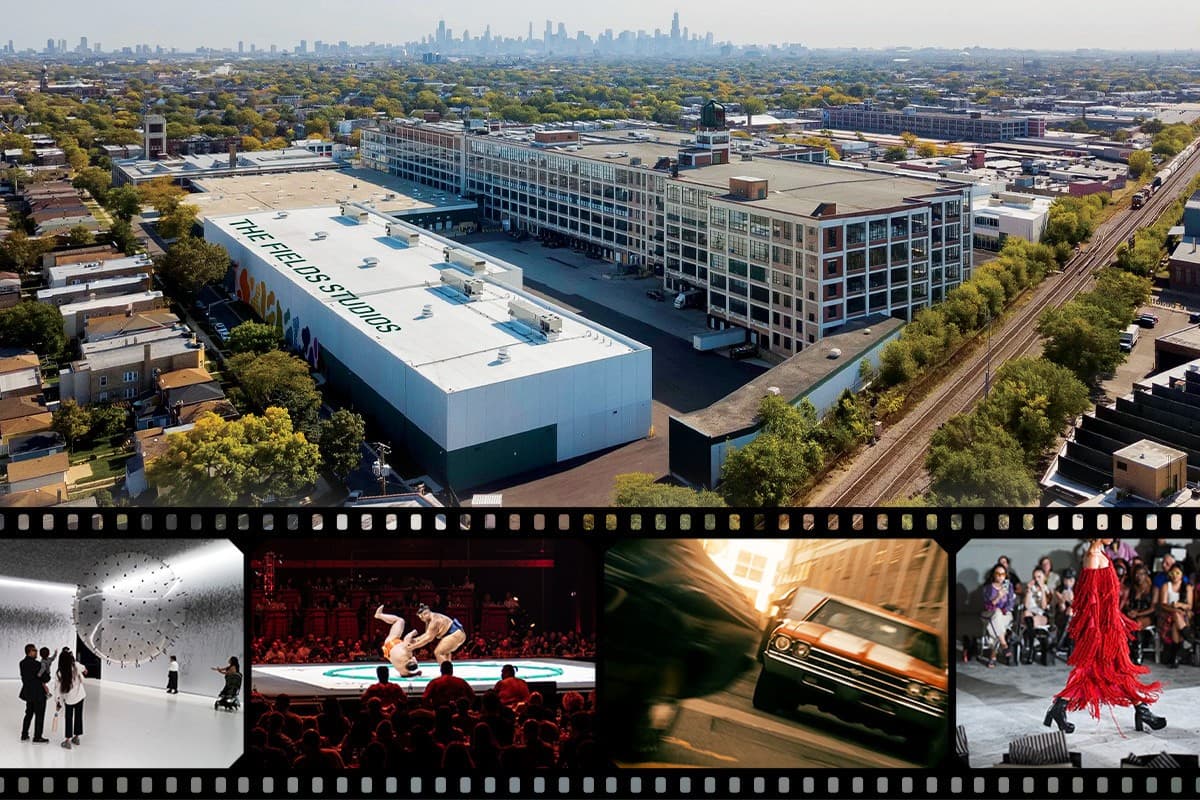
The Balloon Museum, a large-scale art experience from Lux Entertainment, is currently occupying five stages at The Fields Studios. “Managing a production like ours — complex, large-scale and technically demanding with thousands of audiences weekly — requires a strong, reliable partner capable of working in true synergy. With The Fields Studios, we found exactly that,” the company said, pointing to the campus’ “operational flexibility, highly professional team and outstanding stage quality along with their city and state relationships” as central to the partnership.
The Fields Studios, a 23-acre mixed-use creative campus on Chicago’s Northwest Side, houses nine soundstages, over 200,000 square feet of production office and support space, on-lot parking, a 1.5-acre backlot, on-site grocery store, retail space and 123 high-end residential lofts, all within the same complex. Built on the site of a century-old manufacturing complex originally constructed in 1928 for Olson Rugs and later home to Marshall Field & Co., it was reimagined, in the words of Papazian, “for producers, by producers.” The connective tissue isn’t just geography; it’s intention. The campus is built to be fluid with a production’s needs — whether film, TV, commercial or immersive activation — rather than forcing every project into the same box. “Producers aren’t just looking for space. They are also looking for comfort,” Papazian said. “They’re looking for a partner who understands the realities of a shooting schedule, a shifting budget and a crew that needs to feel at home.”
“Making a show like ‘Dark Matter’ is a huge undertaking and it makes all the difference to have people around you who understand what you’re trying to do,” said Matt Tolmach, executive producer of “Dark Matter” which filmed Season 2 at The Fields Studios last year. “The Fields team gave us a place where our cast and crew could feel at home and focus on making the show. As our needs changed, they were right there with us. They were true partners every step of the way.” Produced by Sony Pictures Television for Apple TV, “Dark Matter” Season 2 is now streaming.
That word “home” comes up often at The Fields Studios, and it isn’t incidental. Papazian’s father, Robert A. Papazian, instilled in him a guiding principle when they opened their first studio together more than 30 years ago: productions work long hours, so the space should be cozy and easy to work in. Papazian hand-selected his team from both production and real estate backgrounds, giving the campus an unusual dual fluency. The team understands both what a line producer and their crew need on day one of principal photography and what a real estate owner needs to keep a mixed-use campus financially stable. That legacy extends beyond the property line, too. The Fields Studios team sees the campus’ success as inseparable from the health of Chicago’s broader creative community. They are active with educational institutions and creative organizations across the city, helping to nurture and grow Chicago’s production talent pipeline and foster connections on its world-class campus.
That welcoming, production-minded culture, combined with turnkey studio infrastructure and a steadily growing pool of local talent, already makes Chicago an easy choice for productions. Illinois also recently extended and enhanced its production tax credit through 2039, adding higher base incentive rates, expanding eligible expenses and announcing a first-in-the-nation sustainability uplift capable of pushing total savings over 40%. For studios and streamers who have been chasing tax credits and pushing projects away from Los Angeles to Georgia, New York and New Jersey, Illinois is now a top consideration in acquiring that business too.
Then there’s the city itself. Chicago’s appeal isn’t confined to what happens inside The Fields Studios’ stages. As Papazian describes the surrounding neighborhoods: “it’s not a backlot, it’s the real thing,” reflecting the city’s genuine architectural range, production history stretching back decades and landscapes that can double for nearly anywhere in the country without a single set built. For productions, that means campus efficiency paired with location diversity, all a short flight from both coasts.
“We built this to be a home base, not just a set,” Papazian said.