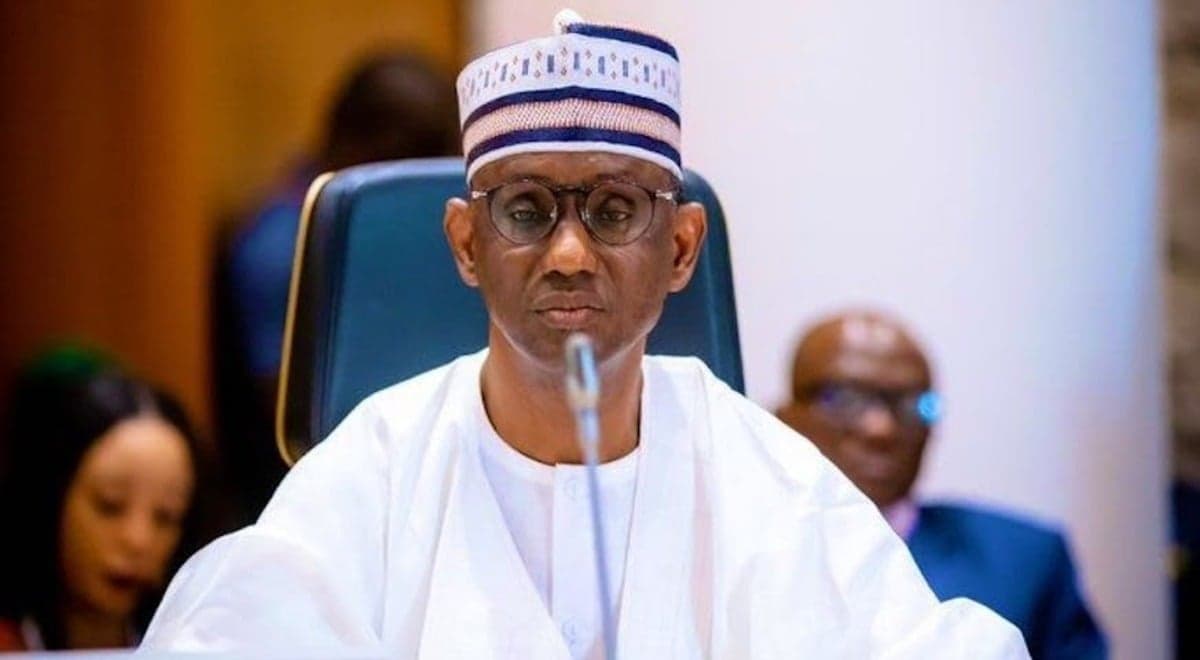
The National Security Adviser (NSA), Mallam Nuhu Ribadu, on Monday called for stronger global and regional cooperation, real-time intelligence sharing, and the responsible use of emerging technologies to tackle terrorism and violent extremism across Africa.
Ribadu made the call while delivering the keynote address at the opening of the High-Level African Lessons Learned Forum on Counter-Terrorism Cooperation, Intelligence Sharing, and Emerging Technologies, held in Abuja.
The NSA observed that terrorist networks are increasingly exploiting porous borders, communal grievances, illicit financial pipelines, digital spaces, misinformation, and online radicalisation to expand their destabilising operations across the continent.
According to him, the rapidly evolving threat environment necessitates closer intelligence coordination, durable partnerships, and operational collaboration between African nations and their international allies.
“Terrorist groups are exploiting porous borders, local grievances, illicit financial networks, digital platforms, misinformation, online radicalisation and emerging technologies,” Ribadu stated.
He pointed out that Nigeria’s counter-insurgency experience over the past 15 years demonstrates that kinetic military operations alone cannot deliver sustainable peace.
Consequently, he declared that the Federal Government remains committed to a whole-of-government and whole-of-society strategy to counter terrorism and prevent violent extremism.
“While security operations remain necessary, they must be complemented by intelligence coordination, law enforcement, financial intelligence, justice, strategic communications, prevention, rehabilitation, reintegration, reconciliation, community resilience, education, youth engagement, research, training, and technology-enabled analysis,” he explained.
Ribadu noted that the forum builds upon outcomes from the Senior Officials Dialogue on Counter-Terrorism in Africa held in Madrid in May 2026, which underscored the critical need for real-time intelligence sharing, institutional synergy, and practical field learning.
He insisted that while international partnerships remain invaluable, African nations must take the lead in designing and implementing solutions tailored to the continent’s distinct realities.
“Our partners remain important, and we value their continued support. However, sustainable solutions must be rooted in African ownership, African priorities, African institutions, and the lived experiences of our communities,” he said.
The NSA emphasised that no single nation can defeat transnational terrorist networks in isolation, particularly given their capacity to traverse international frontiers, communicate via encrypted platforms, and move funds through cross-border channels.
He also drew attention to the dual-use nature of artificial intelligence, encrypted applications, unmanned aerial vehicles (drones), and synthetic media.
While warning that violent extremists actively seek to weaponise these tools, Ribadu noted that the same technologies provide state actors with advanced capabilities for early warning, threat forecasting, digital forensics, border surveillance, and civilian protection.
“Our task is to ensure that technology is used responsibly, lawfully, and effectively in support of peace and security,” he noted.
Ribadu highlighted the role of the National Counter-Terrorism Centre (NCTC), domiciled within the Office of the National Security Adviser (ONSA), as a cornerstone of Nigeria’s coordination framework.
He stated that the centre has expanded its operational footprint in strategic threat analysis, intelligence fusion, empirical research, capacity building, policy harmonisation, and non-kinetic programming.
The NSA added that Nigeria will continue to share operational insights derived from initiatives such as Operation Safe Corridor and the European Union-backed Disarmament, Demobilisation, Rehabilitation, and Reintegration (DDRR) programme for individuals formerly associated with non-state armed groups in the North-East.
He, however, noted that these experiences are not presented as flawless templates, but rather as practical case studies to foster peer review and mutual learning among African states.
“These experiences are not presented as perfect models. Rather, they are offered as practical lessons from which we can all learn,” Ribadu said.
He urged delegates to prioritise tangible outcomes, including bilateral institutional frameworks, professional operational networks, technical training exchanges, and regional capacity partnerships.
Ribadu equally stressed the human-centric dimension of counter-terrorism, urging security institutions to protect vulnerable communities, uphold the rule of law, support victims of violence, and decisively address underlying socio-economic drivers of radicalisation.
“Security is not only the absence of violence; it is also the presence of justice, opportunity, dignity, and trust between citizens and the state,” he declared.
Speaking earlier, the National Coordinator of the NCTC, Maj.-Gen. Adamu Laka, explained that the forum was convened to enable African nations to compare field experiences, identify high-impact strategies, and align their operational architectures against violent extremism.
Laka stated that terror groups are aggressively deploying modern technology, illicit financial flows, corruption, and organised crime syndicates to expand their reach.
He affirmed that kinetic interventions must be systematically reinforced with prevention, rehabilitation, community resilience, and criminal justice measures.
ALSO READ: 2027: We don’t want rivers of blood, Wike says as he rallies support for Tinubu’s re-election
The coordinator revealed that through inter-agency coordination and enhanced legal frameworks, Nigeria has secured more than 1,200 convictions in terrorism-related cases.
He expressed appreciation to the African Union, the European Union, the United Nations Office on Drugs and Crime (UNODC), and MTN Nigeria for supporting the forum.
Also addressing the forum, the Director of the African Centre for the Study and Research on Terrorism (AUCTC), Dr. Lakhdar Idriss, called for deepened solidarity among member states.
Idriss urged security agencies across Africa to dismantle operational silos, accelerate real-time intelligence exchange, and institutionalise operational lessons to build enduring resilience against violent extremism across the continent.
WATCH TOP VIDEOS FROM NIGERIAN TRIBUNE TV
- Relationship Hangout: Public vs Private Proposals – Which Truly Wins in Love?
- “No” Is a Complete Sentence: Why You Should Stop Feeling Guilty
- Relationship Hangout: Friendship Talk 2025 – How to Be a Good Friend & Big Questions on Friendship
- Police Overpower Armed Robbers in Ibadan After Fierce Struggle