
WELCOME to the latest edition of This Week in Spanish History, written by Michael Coy.
OCTOBER 25, 1973 – Painter Luiz Fernandez Lopez dies
Luis Fernandez Lopez was an Asturian painter.
The death of both parents when he was a child forced him to leave Oviedo and relocate to Barcelona, where he lived with his uncle’s family.
This was a setback. His uncle had no sympathy for Luis’ artistic ambitions, and forced him to leave education and find work at the age of 12.
When he reached adulthood, he moved to Paris, where he befriended Braque and Brancusi.
It took him until the 1950s to win the acclaim of the critics, by which time he had formed a lasting friendship with Picasso, whom he eventually outlived by six months.
OCTOBER 27, 2010 – Dictionary of Spanish Americans published
Did you know that many of the words we use every day came to us from the Incas and the Mayans, through Spanish conquistadors?
An obvious example is ‘tobacco’, a plant unknown in Europe before Columbus. The original name is ‘tabaco’, from the Tain language.
A ‘cacique’ was a native Indian who showed ability, and was used by the Spanish to manage other Indians and organise their work. In modern Spanish it means a foreman.
These terms were collected and published in 2010, in the Diccionario de Americanismos.
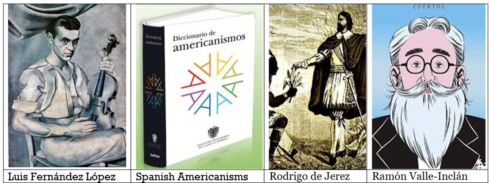
OCTOBER 28, 1492 – Jerez man discovers tobacco
Rodrigo of Jerez – we don’t know his surname – sailed to the Caribbean with Columbus.
He was from the village of Ayamonte, right on the Portuguese border, rather than Jerez itself.
In the Bahamas, the natives presented the Spanish sailors with dry tobacco leaves, which most of them threw away as valueless.
However, Rodrigo kept his, and watched the natives making ‘little rifles’ (cigars) and smoking them. He learned to do it for himself.
Back in Ayamonte, he was arrested for the ‘satanic’ practice of ‘drinking smoke’, but somehow the craze caught on.
OCTOBER 28, 1866 – Ramon Maria del Valle-Inclan is born
Valle-Inclan was certainly a character.
He single-handedly freed the Spanish theatre of its middle-class stuffiness at the start of the twentieth century, writing plays which contained swear words and which made fun of the royal family.
He is best compared to his exact contemporary, George Bernard Shaw. Like Shaw, he had a quick, waspish wit.
He was always getting in fights, and in 1899 he had an arm amputated after a punch-up led to gangrene. Ridiculing the church was another of his eccentric habits.
By the time of his death in 1936, the Spanish stage had shed its artificial rules, and the way was clear for Spain’s next dramatic genius – Lorca.
OCTOBER 28, 1999 – Rafael Alberti dies
Rafael Alberti Merello of El Puerto de Santa María was one of Spain’s greatest-ever poets.
Strongly opposed to the Franco regime, he went into exile at the end of the civil war, returning after Franco’s death in 1975.
In 1985 he was declared the official ‘favourite son’ of Andalucia.
When his life drew to its close in 1999, he was 96 years old.
He is remembered today for the moving verses he wrote about his ‘lost’ daughter. ‘Lost’ in the sense that she became a nun.
OCTOBER 30, 1910 – Miguel Hernandez is born
Another poet of the civil war period was Miguel Hernandez, who lived all of his short, sad life in Alicante.
As a child, Miguel was fascinated by words, but far from having his aptitude encouraged, he was beaten by his father for having ‘unrealistic’ ideas.
He left school at the end of his primary education. His family was poor, and they needed him to work in the fields.
Arrested by Franco’s forces, Hernandez died in Alicante prison in 1942, ostensibly of tuberculosis, but really of neglect. He was 31 years old.
READ MORE: OPINION: Think Ernest Hemingway is a fake? Then you must read The Sun Also Rises again
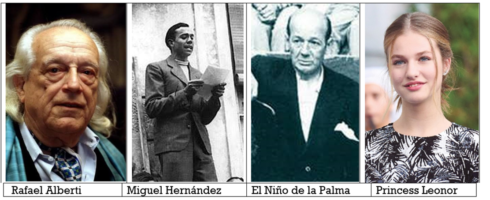
OCTOBER 30, 1961 – El Niño de la Palma dies
Shops in Spain (like pubs in England) used to have names, so that illiterate people could find them.
A hundred years ago in Ronda, a cobbler hung a palm leaf over his door and called his shop, ‘La Palma’.
When his son Cayetano showed promise as a bullfighter, the family decided to give him the nickname, ‘El Niño de la Palma’ (‘The Boy from La Palma’).
Cayetano was a big success in the 1920s. Riches followed, and friendship with Ernest Hemingway.
All of Cayetano’s five sons became bullfighters, and one – Antonio Ordoñez – attained legendary status.
OCTOBER 31, 2005 – Princess Leonor is born
Here are some things you may not know about Leonor, the heiress to the Spanish throne.
She studied for her university degree in Wales.
After formal training, she has qualified as an officer in all three branches of Spain’s military – Army, Navy and Air Force.
Her time is currently spent in postgraduate studies in political science.
As a baby, she was baptised with water taken from the river Jordan.
She speaks English and Catalan fluently.
When Spain won the World Cup last July, Leonor was there to watch the match live!
Click here to read more Spain News from The Olive Press.